When MTV Taught a Generation to See

Retro collage of vinyl records, cassette tapes, radio dials, and dancing silhouettes

At 12:01 a.m. on August 1, 1981, a new cable channel introduced itself with a sentence that sounded half like a concert emcee and half like a dare: “Ladies and gentlemen, rock and roll.” Then came the Buggles’ “Video Killed the Radio Star.” Britannica records the moment as MTV’s debut, and the first music video ever broadcast on the channel.

The opening sequence had an almost comic amount of ambition: space imagery, a moon, an MTV flag. The little network wanted to make music feel like an event. It did not yet have the reach to match the drama. The initial broadcast was available only to a small number of cable households in New Jersey, and distribution was hard to come by. NPR’s account of the first 100 videos notes that plenty of music-industry people expected the idea to fail.

That is part of the charm of the first year. MTV was not yet a monument. It was a strange little experiment that asked a strange little question: what if a song did not merely sound like something, but looked like something?

Radio had already taught us to carry music around in our heads. MTV added faces, clothes, rooms, gestures, choreography, and story. The five original video jockeys—Martha Quinn, Nina Blackwood, Alan Hunter, J.J. Jackson, and Mark Goodman—did not just introduce songs. They helped make the channel feel like a place you could visit. The screen became a kind of hallway where music, fashion, and personality kept bumping into one another.

The effect was bigger than a new way to promote records. A Newcastle University history of MTV describes how heavy rotation made visual image central to mainstream pop. A hit single now arrived with a look: the lighting, the jacket, the dance, the fantasy of the artist’s life. A song could become a short film, a commercial, and a little piece of mythology at the same time.

That formed people. Not in the grand, sermon-on-the-mount sense. More like a daily drip. We learned what confidence looked like before we had language for it. We learned that reinvention might involve a haircut, a hallway, a leather jacket, or simply the nerve to appear on camera as someone new. Some of us also learned to confuse a polished image with a whole person. Formation is rarely pure; it is usually a bundle of gifts and distortions.

And MTV’s early visual imagination had real blind spots. The Smithsonian’s history notes that the channel’s rock-oriented programming featured very few Black artists in its early years, a limitation challenged publicly by David Bowie and others. A truthful nostalgia keeps the wonder and the omission in the same frame.

So, what happened? A tiny cable experiment made sight part of the song. What did it mean? For a generation, music became a visual language for identity, aspiration, and belonging. What can we carry forward? Notice what is teaching you to see—and remember that every image, however thrilling, is still only one angle on a human life.

Take On Me and the Courage to Leave the Panel

Woman beside comic motorcycle race labeled STARDUST RACING 77

There is a moment in a-ha’s “Take On Me” when the girl looks up from her coffee and realizes the comic-book hero is looking back. It is a wonderfully 1985 idea: romance as a portal, pencil lines as a doorway, and a chorus that sounds like somebody asking for one brave chance.

Then the video does something more interesting. It refuses to let the two worlds stay separate.

If you have somehow missed it, the video moves between live action and a black-and-white comic drawn in loose pencil. The technique is rotoscoping: filming movement, then drawing over the frames. The BBC’s account of the video’s making says animator Michael Patterson spent 16 weeks sketching roughly 3,000 drawings. That is not a weekend project. That is a small mountain of patient marks.

The official credits at Patterson and Reckinger’s site name Michael Patterson and Candace Reckinger as the animation directors. Their work gives the video its strange double vision: the comic feels more alive than the café, while the café feels safer than the comic. One world is exciting but dangerous. The other is ordinary but solid.

That tension is the whole song’s emotional engine. “Take On Me” is not just asking, “Do you like me?” It is asking, “Will you come with me, even though the place I’m inviting you into is unfinished?” The comic hero is literally sketched in. He has no polished edges. He is a possibility with a motorcycle.

And then comes the escape. The girl returns to the ordinary world, but the ordinary world has been altered. The strange thing has followed her home. Or perhaps she has learned to see the room differently. That is what longing often does. It does not simply make us dissatisfied with the present. It gives the present a second outline.

My favorite part is that the video does not treat reinvention as a clean makeover. There is no triumphant “new you” montage with suspiciously good lighting. The transition is messy. It involves fear, a torn page, and a person who has to decide whether the familiar world is still enough.

The song’s public life followed a similar path. Official Charts records a 19-week UK chart run, while the video became a defining example of how an ambitious visual could change a pop song’s reach. The band did not merely release a track; they built a doorway around it.

So what happened? A Norwegian band made a pop song and paired it with an unusually labor-intensive animated film. What did it mean? Millions of listeners were invited to believe that longing could be both frightening and creative. What can we carry forward? Maybe this: reinvention rarely begins with a finished plan. It begins with a line, then another, then the willingness to step through the panel before you know how the story ends.

What is one unfinished possibility you keep treating as if it needs to be polished before you can enter it?

The Tea Ceremony’s Quiet Lesson: Attention Is a Way of Life

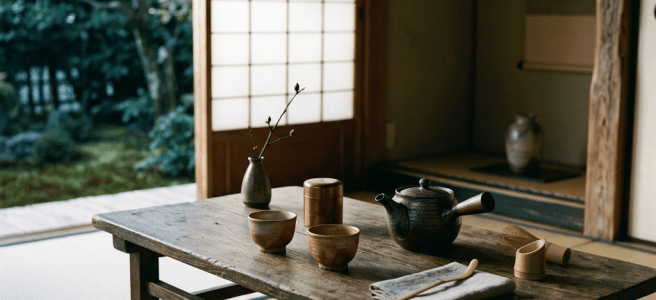
Tea table with teapot, cups, whisk, and vase beside a Japanese garden

I have a bad habit of drinking tea while doing three other things. I answer a message, glance at the news, and then wonder why the cup went cold. This is not a failure of tea. The tea has been giving me a perfectly clear assignment. I just keep submitting the wrong homework.

Chanoyu—often translated as “hot water for tea”—is a Japanese practice that turns an ordinary act into a carefully held encounter. The Metropolitan Museum of Art describes a small tea room where host, guests, utensils, garden, and season meet. The room is intimate. The movements are choreographed. The gathering is never quite repeated.

That last part matters. The Asian Art Museum’s teaching guide explains the phrase ichi-go ichi-e—“one time, one meeting”—as an awareness that each gathering is once in a lifetime. Not because the world is dramatic every minute, but because this minute is not coming back. The tea bowl in your hands is not a prop. It is the thing happening now.

The practice is not casual about attention. Before the tea arrives, the guest notices the scroll, the flowers, the kettle, the brazier. The host purifies the utensils and prepares the bowl in front of everyone. Guests watch with all five senses. Even the beautiful front of the bowl is turned away before drinking, then returned to face the host. Courtesy is taught through the hands before it is explained by the mouth.

Sen no Rikyu’s famous seven rules are wonderfully plain: make a satisfying bowl of tea; heat the water well; offer warmth in winter and coolness in summer; arrange flowers as they grow in the field; prepare ahead; be ready for rain; and show utmost consideration to your guests. The MIT Japanese Tea Ceremony page preserves the list. It sounds less like mysticism than good hosting. Which may be why it is so difficult. Most of us can manage one thoughtful gesture. The formation comes from making thoughtfulness the shape of the room.

The four principles often associated with the Way of Tea—wa (harmony), kei (respect), sei (purity), and jaku (tranquility)—are not four inspirational posters. They are a sequence. Attend to the setting and the other person. Clear what distracts. Then, sometimes, calm arrives. As the Association for Asian Studies notes, the methodical ritual cultivates respect, connection, and being “present in the present.”

What happened? Someone made tea with enough care for a simple cup to become an encounter. What did it mean? Attention is not merely a personality trait; it is a practice, reinforced by rooms, rituals, and repeated gestures. What can I carry forward? Perhaps one cup today with the phone in another room. No grand transformation. Just hot water, a little patience, and the courtesy of actually arriving.

What Raising Kids Taught Me About Compounding

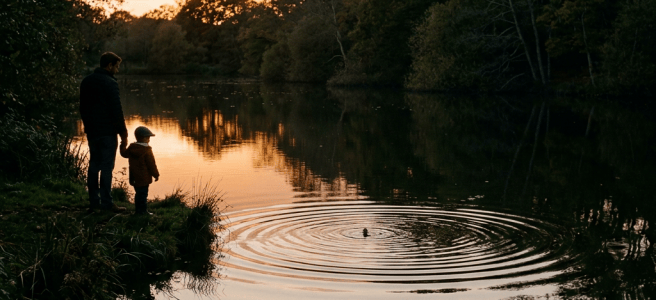
Adult and child watching ripples spread across a sunset pond

I used to think patience was a personality trait. Some people had it. Some people, like me, had a charming little emergency supply that ran out around 4:17 p.m.

Then I had children, and discovered that patience is less like a virtue you own and more like a muscle you use while someone asks the same question for the ninth time. It grows in small, mostly unphotogenic repetitions.

The money analogy is useful—but incomplete

We usually meet “compounding” in a finance conversation. Investor.gov defines compound interest as earning interest on interest. Its simple example begins with $100 at 5 percent: $105 after year one, $110.25 after year two, and more than $162 after ten years, even without another deposit. Time gives small gains a chance to earn their own gains.

Children do something similar to a parent’s character. One bedtime story does not make a reader. One calm explanation does not make a patient dad. But the repeated act leaves a little residue. The next explanation may come a half-second sooner. The apology may arrive before the lecture. Not dramatic growth. Just a slightly different default.

Small exchanges become the environment

This is not just a nice metaphor. The Harvard Center on the Developing Child describes “serve and return”—the back-and-forth between a child and a caring adult—as important for brain architecture and early language and social skills. A child points at a truck. You look. You name it. The child looks back. Tiny exchange, repeated across ordinary days. The Harvard Center explains why these responsive interactions matter.

And routines matter, too. A review of five decades of research in the American Psychological Association’s Journal of Family Psychology found that family routines and rituals were associated with parenting competence, child adjustment, and marital satisfaction, while also noting limits in the underlying studies. That word—associated—is doing honest work. A routine is not a magic spell. It is a repeated place where people can meet one another.

What I am trying to carry forward

What happened? I kept waiting for patience to arrive as a finished product. What did it mean? I was overlooking the deposits: the snack shared, the shoe found, the question answered without turning it into a courtroom drama.

What can I carry forward? Choose one small practice and make it boringly repeatable. Read ten minutes. Put the phone away during one conversation. Pause before answering the familiar question. In money, time lets returns build on returns. In a family, attention lets trust build on trust.

None of this makes the 4:17 p.m. hour disappear. Sorry. But it can make the next response a little more generous—and that, too, is a kind of compounding.