I have a bad habit with generosity: I count the size of the gift before I ask what it cost the giver. Very efficient. Very spreadsheet. Also, perhaps, a little spiritually tone-deaf.
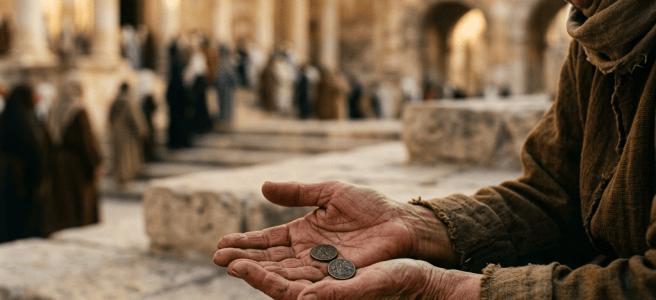
That is why the widow in Mark’s Gospel keeps interrupting my mental math. Jesus is sitting opposite the Temple treasury. The rich are putting in large sums. Then a poor widow drops in two small copper coins. In the text of Mark 12:38–44, Jesus says she has given more than all the others because they gave from abundance, while she gave “all she had to live on.”
The coins were called lepta. Two lepta made a tiny Roman coin, roughly 1/64 of a laborer’s day wage. In dollar terms, it was not an impressive donation. It would not win a fundraising leaderboard. It might not even earn a thank-you email with a tasteful banner.
But Jesus is not using the widow to teach a simple formula: poor people should give away their last dollar, and rich people can feel guilty until morale improves. The story sits immediately after his warning about religious leaders who “devour widows’ houses.” As the Working Preacher commentary notes, Mark places the widow’s gift inside a troubling scene of institutional ambiguity. Her faithfulness is real. So is her vulnerability.
That matters for how we read the passage at home, at church, and in the budget app. The widow’s offering is not a permission slip for institutions to praise sacrifice while ignoring the people who are being squeezed. It is also not a contest in which the person with the smallest account balance wins the holiness trophy. Jesus does not shame the rich for having resources. He notices that their gifts come from surplus, while hers comes from the center of her life.
This is where proportion becomes a useful word. A gift can be large in dollars and small in personal cost. Another can be small in dollars and enormous in trust. The same principle appears in ordinary household decisions: the grocery run for a sick neighbor, the hour given to a lonely parent, the money quietly set aside before lifestyle spending swallows it. The ledger sees amounts. Love notices weight.
The Catholic education commentary on the passage rightly keeps both truths in view: Jesus honors the widow’s wholehearted offering, and the story raises questions about systems that leave vulnerable people carrying the cost. That is a sturdier reading than either sentimentality or scolding.
So, what happened? A widow gave two nearly worthless coins, and Jesus called the gift greater. What did it mean? Formation is partly learning to measure what the world cannot see: proportion, sacrifice, dependence, and care. What can we carry forward? Before asking, “How much should I give?” ask a quieter question: “What is my money forming me to notice?”

