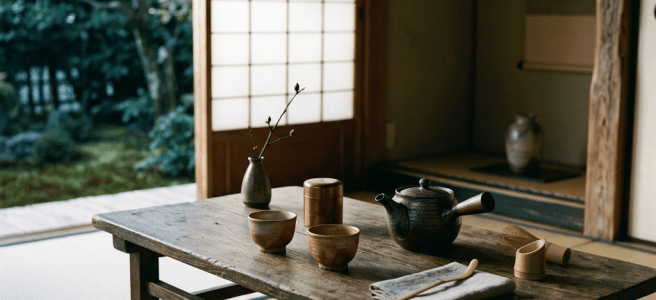
I have a bad habit of drinking tea while doing three other things. I answer a message, glance at the news, and then wonder why the cup went cold. This is not a failure of tea. The tea has been giving me a perfectly clear assignment. I just keep submitting the wrong homework.
Chanoyu—often translated as “hot water for tea”—is a Japanese practice that turns an ordinary act into a carefully held encounter. The Metropolitan Museum of Art describes a small tea room where host, guests, utensils, garden, and season meet. The room is intimate. The movements are choreographed. The gathering is never quite repeated.
That last part matters. The Asian Art Museum’s teaching guide explains the phrase ichi-go ichi-e—“one time, one meeting”—as an awareness that each gathering is once in a lifetime. Not because the world is dramatic every minute, but because this minute is not coming back. The tea bowl in your hands is not a prop. It is the thing happening now.
The practice is not casual about attention. Before the tea arrives, the guest notices the scroll, the flowers, the kettle, the brazier. The host purifies the utensils and prepares the bowl in front of everyone. Guests watch with all five senses. Even the beautiful front of the bowl is turned away before drinking, then returned to face the host. Courtesy is taught through the hands before it is explained by the mouth.
Sen no Rikyu’s famous seven rules are wonderfully plain: make a satisfying bowl of tea; heat the water well; offer warmth in winter and coolness in summer; arrange flowers as they grow in the field; prepare ahead; be ready for rain; and show utmost consideration to your guests. The MIT Japanese Tea Ceremony page preserves the list. It sounds less like mysticism than good hosting. Which may be why it is so difficult. Most of us can manage one thoughtful gesture. The formation comes from making thoughtfulness the shape of the room.
The four principles often associated with the Way of Tea—wa (harmony), kei (respect), sei (purity), and jaku (tranquility)—are not four inspirational posters. They are a sequence. Attend to the setting and the other person. Clear what distracts. Then, sometimes, calm arrives. As the Association for Asian Studies notes, the methodical ritual cultivates respect, connection, and being “present in the present.”
What happened? Someone made tea with enough care for a simple cup to become an encounter. What did it mean? Attention is not merely a personality trait; it is a practice, reinforced by rooms, rituals, and repeated gestures. What can I carry forward? Perhaps one cup today with the phone in another room. No grand transformation. Just hot water, a little patience, and the courtesy of actually arriving.

