
The Song That Asked a Generation Not to Disappear

Empty school hallway with colorful lockers and large sunset-lit windows

I used to think “Don’t You (Forget About Me)” was just the song that played while Judd Nelson raised his fist. A very 1985 sentence. Probably the sort of sentence that should come with a denim jacket.

But listen again. The song is doing something more interesting than decorating the final shot of The Breakfast Club. It is asking a group of people who have been reduced to labels to remember one another as whole human beings.

The song was written for the movie by producer Keith Forsey and guitarist Steve Schiff. Simple Minds initially declined to record it because the band wanted to make its own material. Then Forsey came to meet them, and the story took a turn familiar to anyone who has ever been persuaded by a conversation over a drink: the Scots went to the pub with him, liked him, and reconsidered. The Guardian’s account of how the song was made captures that lovely bit of creative resistance giving way to human connection.

The result became Simple Minds’ biggest North American hit, reaching No. 1 in the United States and Canada. In Britain, it reached No. 7, according to Official Charts. Numbers are useful here, not because a chart position tells us whether a song is good, but because it shows how widely this particular plea traveled.

And the plea matters because the film understood something about formation. The five students in detention are introduced as types: the brain, the athlete, the basket case, the princess, and the criminal. Then the locked room gets uncomfortable. They confess things. They listen badly, then better. The categories do not vanish, exactly. They become too small.

That is why the Library of Congress added The Breakfast Club to the National Film Registry in 2016, naming it among films of cultural, historic, or aesthetic importance. The announcement called it a seminal coming-of-age drama. “Seminal” can sound like a museum label, but the point is simple: a movie about teenagers in a Saturday detention room kept giving later generations a vocabulary for feeling mis-seen.

Formation often begins when someone refuses the label that has been handed to him. Not with a grand reinvention. With the smaller courage of saying, “That is part of me, but it is not all of me.”

What happened? A film song became an anthem. What did it mean? A generation heard its private ache turned into a public chorus. What can I carry forward? When I am tempted to summarize someone quickly — difficult, lazy, successful, dramatic — I can leave room for the locked-room conversation I have not heard yet.

And maybe, before the day ends, I can ask one person a better question than “How’s it going?” Maybe: “What part of you have I forgotten to notice?”
When MTV Taught a Generation to See

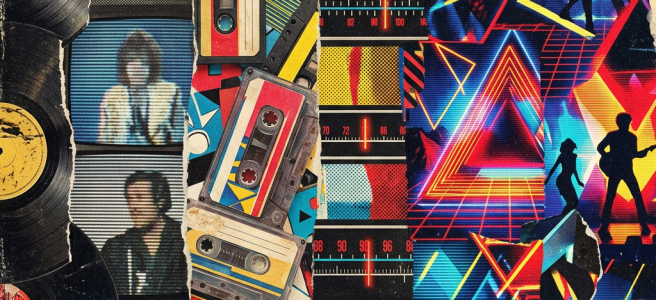
Retro collage of vinyl records, cassette tapes, radio dials, and dancing silhouettes

At 12:01 a.m. on August 1, 1981, a new cable channel introduced itself with a sentence that sounded half like a concert emcee and half like a dare: “Ladies and gentlemen, rock and roll.” Then came the Buggles’ “Video Killed the Radio Star.” Britannica records the moment as MTV’s debut, and the first music video ever broadcast on the channel.

The opening sequence had an almost comic amount of ambition: space imagery, a moon, an MTV flag. The little network wanted to make music feel like an event. It did not yet have the reach to match the drama. The initial broadcast was available only to a small number of cable households in New Jersey, and distribution was hard to come by. NPR’s account of the first 100 videos notes that plenty of music-industry people expected the idea to fail.

That is part of the charm of the first year. MTV was not yet a monument. It was a strange little experiment that asked a strange little question: what if a song did not merely sound like something, but looked like something?

Radio had already taught us to carry music around in our heads. MTV added faces, clothes, rooms, gestures, choreography, and story. The five original video jockeys—Martha Quinn, Nina Blackwood, Alan Hunter, J.J. Jackson, and Mark Goodman—did not just introduce songs. They helped make the channel feel like a place you could visit. The screen became a kind of hallway where music, fashion, and personality kept bumping into one another.

The effect was bigger than a new way to promote records. A Newcastle University history of MTV describes how heavy rotation made visual image central to mainstream pop. A hit single now arrived with a look: the lighting, the jacket, the dance, the fantasy of the artist’s life. A song could become a short film, a commercial, and a little piece of mythology at the same time.

That formed people. Not in the grand, sermon-on-the-mount sense. More like a daily drip. We learned what confidence looked like before we had language for it. We learned that reinvention might involve a haircut, a hallway, a leather jacket, or simply the nerve to appear on camera as someone new. Some of us also learned to confuse a polished image with a whole person. Formation is rarely pure; it is usually a bundle of gifts and distortions.

And MTV’s early visual imagination had real blind spots. The Smithsonian’s history notes that the channel’s rock-oriented programming featured very few Black artists in its early years, a limitation challenged publicly by David Bowie and others. A truthful nostalgia keeps the wonder and the omission in the same frame.

So, what happened? A tiny cable experiment made sight part of the song. What did it mean? For a generation, music became a visual language for identity, aspiration, and belonging. What can we carry forward? Notice what is teaching you to see—and remember that every image, however thrilling, is still only one angle on a human life.