The Shortcut Tax: Why Get-Rich-Quick Schemes Exploit Formation Gaps

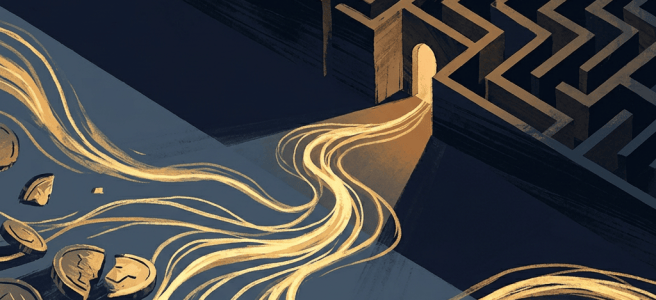
Golden streams winding through stones toward an illuminated maze opening

I have a confession: “get rich quick” still knows exactly where to find me. Give me a tired Tuesday, a headline about someone making six figures from a laptop, and suddenly my sensible financial plan looks like it was written by a committee of very cautious squirrels.

That is the first formation gap. Not stupidity. Not greed in some cartoonish sense. Just a human being who is tired, hopeful, and ready for a shortcut.

The pitch usually arrives dressed as freedom. Quit your job. Make passive income. Turn $500 into $5,000. The Federal Trade Commission describes investment scams in almost those terms: big returns, little risk, a “proven system,” and pressure to act before you have time to think. Its consumer guidance explains the pattern.

Notice what the scheme is really selling. It is not only an investment. It is a new identity: the person who has finally figured it out. That is why screenshots of luxury cars and exploding account balances matter. They are props in a little theater of future-you.

The Securities and Exchange Commission’s investor guidance names the warning signs plainly: guarantees, “risk-free” opportunities, urgency, unlicensed sellers, and testimonials that do too much of the persuading. Its red-flag checklist is worth keeping nearby.

But the deeper problem is formation. We are shaped by what we practice, especially when nobody is grading us. If I practice clicking first and researching later, I am forming myself into a person who mistakes urgency for opportunity. If I practice asking one calm question—“How, exactly, does this make money?”—I am building a small but useful muscle.

That question is not cynicism. It is stewardship.

FINRA’s red-flag guide recommends looking closely at guarantees, unsolicited offers, secrecy, unregistered products, complex strategies, and pushy salespeople. It also says a legitimate professional should be able to explain what the investment is, how it makes money, and what the risks are. The full checklist is a useful pause button.

Here is a tiny household examen for the next irresistible pitch:

What happened? Someone offered me an unusually easy path to unusual wealth, often with a clock attached.

What did it mean? My attention was being recruited before my judgment had a chance to show up.

What can I carry forward? A pause, a second opinion, and a written explanation of the downside. If the offer cannot survive those three things, it does not deserve my money.

The goal is not to become the uncle who distrusts every new idea. Some good opportunities are unfamiliar. The goal is to become less easily hurried. Wealth is not only what we accumulate; it is also the quality of attention we bring to a decision.

And if a stranger promises that quality of attention is unnecessary, well, that may be the most expensive dad joke of all.


Discipline Is a Practice; Self-Punishment Is a Trap

Stacked stones on a moss-covered rock beside a forest stream

I have occasionally confused discipline with being mean to myself. The evidence was compelling: a stern inner monologue, a new rule written in permanent ink, and the temporary satisfaction of feeling like a tiny prison warden. Very productive. Very exhausting.

But discipline and self-punishment are not twins. They are more like cousins who show up to the same family reunion wearing identical sweaters.

Discipline asks, “What helps me practice the good?”

Discipline is a structure that serves a value. I go for the walk because I want to be present for my family. I set a bedtime because tomorrow’s version of me deserves a functioning brain. I put money aside because generosity and stability both need somewhere to stand. The practice may be boring. That is not a bug. Boring is often where character gets its work clothes.

Self-punishment asks a different question: “How can I make failure hurt enough to prove I am serious?” It turns a missed workout, a sharp word, or a wasted hour into a courtroom. The verdict is not merely “I did something unhelpful.” It becomes “I am the kind of person who cannot be trusted.” That is a heavy sentence to carry into the next attempt.

The distinction matters because motivation has different flavors. In their overview of Self-Determination Theory, psychologists Richard Ryan and Edward Deci distinguish motivation supported by autonomy, competence, and relatedness from motivation driven by pressure and control. A rule we freely connect to a meaningful value can become a home. A rule enforced only by fear becomes a landlord who never fixes anything.

This is where self-compassion enters—not as a scented candle for people who have given up, but as a way of staying honest without becoming cruel. The American Psychological Association’s review of self-compassion research notes that it can be learned and is associated with well-being, relationships, physical health, and learning. In other words, treating yourself like a fellow human being is not the same as handing yourself a trophy for showing up late.

Self-compassion still tells the truth. I missed the deadline. I was impatient with my child. I spent money I meant to save. Then it adds the sentence punishment leaves out: I can repair this and practice differently next time.

A small examen for the next stumble

What happened? Name the event without adding a biography. “I skipped the plan” is usually more useful than “I never follow through.”

What did it mean? Maybe the goal was too vague. Maybe the day was overloaded. Maybe you were avoiding discomfort. Curiosity gives you information; shame mostly gives you volume.

What can I carry forward? Keep the standard, change the next step. Make the walk shorter. Move the savings transfer to payday. Apologize before composing the director’s cut of your defense.

Research on self-compassion describes it as a healthier way to relate to oneself, one that can support initiative rather than excuse passivity. That sounds like the formation I want: not a softer life, necessarily, but a sturdier way to return to it.

What happened? I failed at a practice. What did it mean? I am still being formed. What will I carry forward? Discipline can hold the line without picking up a stick.

Character Is Built in the Boring Reps

Glowing outline of a walking person over a mountainous valley at night

I used to think character showed up in the dramatic moments. The honest answer in the meeting. The brave decision. The cinematic pause before doing the right thing. Then I became a parent and discovered that most character is formed while somebody is asking for a snack.

The prompt on my desk says 10,000 small repeated choices. That number is not a scientific speed limit. It is a useful nudge: formation is usually less like a lightning strike and more like a path across a lawn. You walk it again and again, often without noticing that the grass is changing.

Habit researchers describe something similar. In a real-world study, people practiced a chosen eating, drinking, or activity behavior each day in a consistent context. Automaticity grew gradually, but at very different speeds: the time to reach a person’s plateau ranged from 18 to 254 days. Missing one opportunity did not ruin the process. Repetition mattered, but perfection was not the price of admission. The study is a helpful antidote to the internet’s favorite habit myth—that everyone needs exactly 66 days, or some other magic number.

That distinction matters for character. A child who puts one book back on the shelf is not becoming a librarian overnight. A spouse who pauses before answering is not suddenly a saint. But each small act is practicing a response. The cue arrives, and a slightly better path becomes easier to find.

There is some evidence that the practice itself can strengthen self-regulation. In one study, college students spent two weeks practicing a small exercise such as monitoring posture, regulating mood, or recording what they ate. Compared with a control group, the exercise groups improved on a later measure of self-regulatory capacity. The result was modest, not magical. Still, it suggests that discipline is not only a personality trait we either inherited or missed in the family raffle.

More recent work helps explain why repetition works: practice can strengthen the link between a recurring cue and a response. Researchers found that greater task practice was associated with stronger cue-response associations, which in turn supported performance. The brain learns the route we keep taking.

So what might this look like at home? Pick one tiny response and give it a familiar doorway. After dinner, ask one good question before reaching for the phone. When a mistake is named, say, “Thank you for telling me,” before explaining. On Sunday night, write down one thing you received and one thing you repaired. The point is not to turn the household into a monastery with better snacks. It is to make the next faithful move visible.

At the end of the day, an examen can be wonderfully ordinary: What happened? Where did I repeat an old groove? Where did grace—or simple patience—open a new one? What did it mean? That the small choices were not small to the people living inside them. What can I carry forward? One repeatable act, attached to a real moment, with room to miss once and begin again.

Ten thousand is a lot of choices. Fortunately, we only have to make the next one.