The Quiet Practice of Becoming

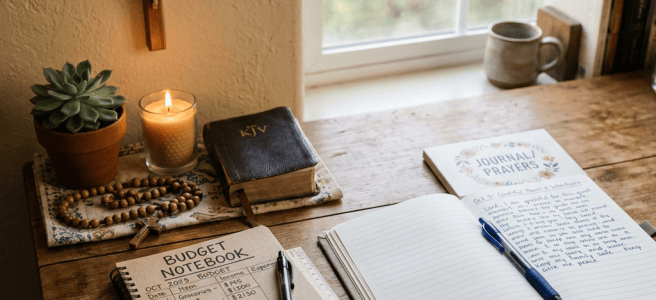
Desk with Bible, prayer journal, budget notebook, rosary, candle, and plant

I have a confession: I like the idea of a new habit much more than I like the middle of one. The beginning has fresh notebooks and heroic promises. The middle has Tuesday, a tired brain, and an instrument that sounds like it is filing a formal complaint.

But most of a life is built in that middle. Not by one grand decision, but by the small thing we return to when nobody is applauding. Prayer. A budget. Scales on a piano. These can look unrelated from the outside. Inside, they are all practices of attention.

Prayer, at its most ordinary, is not a performance review for God. It is a way of coming back. The same chair. The same few quiet minutes. The same honest question: What was moving in me today? Repetition does not make the moment empty. It gives the heart a familiar doorway.

A budget works in a surprisingly similar way. The Consumer Financial Protection Bureau recommends starting with a complete picture of income, spending, and bill timing, then making a working plan and adjusting it as life changes. That is less like building a cage and more like turning on the kitchen light. We are not trying to become perfectly predictable people. We are trying to see clearly enough to choose.

The same humility helps with an instrument. Practice is not merely “putting in the hours.” A meta-analysis of research on musical achievement found a meaningful relationship between task-relevant practice and musical performance, while also reminding us that practice is structured, goal-directed work—not magical time served. Ten distracted minutes and ten attentive minutes may share a clock, but they do not share a result. The metronome is a stern little uncle.

This is where long-term formation differs from self-punishment. Self-punishment asks, “How can I make myself pay for failing?” Discipline asks, “What small structure would help me return?” One tightens the knot. The other leaves a path back home.

And please, let us retire the fantasy that a habit becomes permanent after 21 days. In a real-world study summarized by University College London, automaticity took an average of 66 days—and the range varied widely from person to person. Missing one day did not erase the process. The lesson is not to worship a streak. It is to keep practicing the return.

What happened? We repeated small acts until they became easier to recognize and re-enter. What did it mean? Our routines were quietly teaching us what deserves attention. What can we carry forward? Pick one practice, make it modest, attach it to a real part of the day, and review it without drama.

Tonight, perhaps, pray for five minutes. Look at the last week of spending without flinching. Play one scale slowly. Becoming is rarely loud. Most days, it sounds like showing up again.

Praying With Your Kids About Money Without Making It Weird

Coins and seeds pour into a garden bed beside seedlings labeled “GROWTH”

I used to think praying with kids about money would be simple. “Thank you for what we have. Help us share. Amen.” Neat little package. Then a child asks, “If God loves us, can we get the giant box of cereal?” and suddenly the family theology department is taking questions.

Money is awkward because it carries so many adult feelings: worry, pride, comparison, secrecy, gratitude. Children notice those feelings before they understand a budget. The goal is not to give a five-year-old a quarterly earnings call. It is to make money ordinary enough that it can be discussed without becoming either a family secret or a family sermon.

The Consumer Financial Protection Bureau says school-age children are learning to save, plan ahead, wait for what they want, and connect choices with their own goals and values. It also points out that children watch us: the bargain we celebrate, the treat we splurge on, the future event we plan. The CFPB’s money-milestone guide suggests thinking out loud about those choices. That is already a kind of lesson—and, if we are paying attention, a kind of examination of conscience.

Research points in the same direction. In a qualitative study of 90 emerging adults, along with 17 parents and 8 grandparents, families described three helpful patterns: sharing financial experiences, involving children in decisions, and keeping conversations age-appropriate. The paper, “Can We Talk About Money?”, is not a command to turn every grocery trip into a seminar. It is a reminder that children learn through conversation and participation, not only through warnings delivered from the driver’s seat.

Prayer can give that conversation a gentler frame. The Catechism describes the family as a place where, from childhood, people learn moral values and “make good use of freedom,” and where members learn responsibility for one another. Read paragraphs 2207–2208 and you hear less about money as a scorecard than money as part of learning how to live with other people.

Try a three-part prayer once a week: “Thank you for what we have. Help us choose wisely. Show us someone we can help.” Then attach it to one concrete thing. We are saving for a trip. We are waiting before buying this toy. We are setting aside a gift for a neighbor. The point is not to make the child perform generosity on cue. It is to let them see that money can be received with gratitude, handled with care, and shared with love—the basic shape of Christian stewardship.

A few guardrails help. Do not make God sound like an ATM. Do not shame a child for wanting something. Do not pretend the family has no limits. Say, “That is a real want, and it is not what we are choosing today.” If the family is under financial strain, offer an age-appropriate truth without handing a child the whole burden: “We are being careful right now, and the grown-ups are making a plan.”

What happened? A money question became a prayer instead of a panic. What did it mean? The child learned that faith touches the checkout line, but does not erase reality. What can we carry forward? One honest sentence, one small choice, and one person to remember in prayer. That is not weird. That is formation, with a receipt attached.