I remember the first time I put on headphones and discovered that the walk to the bus stop could have a soundtrack. The sidewalk was the same. The mailbox was still disappointingly ordinary. But the world had acquired a little interior.
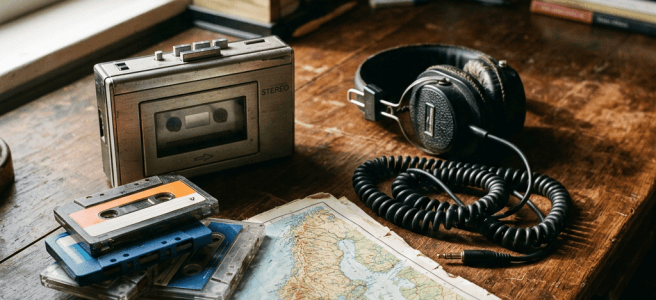
That is the quiet revolution of the Sony Walkman. We usually remember it as a gadget from the 1980s: blue plastic, chunky buttons, a cassette turning behind a small window. But its deeper invention was not merely portable music. It was portable privacy.
The story starts with a practical request. Sony co-founder Masaru Ibuka wanted to listen to stereo music on an overseas flight without carrying a heavy recorder. Sony engineers modified a small Pressman device by removing its recording function and adding stereo circuitry. Sony’s own history of the project describes the prototype as a compact cassette player that could travel with you, rather than asking you to remain beside the living-room stereo.
Sony released the first model, the TPS-L2, in Japan on July 1, 1979. The initial run was only 30,000 units. That sounds like a cautious beginning, and it was. Yet those units sold out in less than three months. By April 1980, reported monthly production still could not keep up with demand; by the end of October 1982, more than 60 percent of 5.5 million shipped units had gone abroad. Nippon.com’s account of the early years shows a small experiment becoming a worldwide habit.
But why did people want it so badly? Because headphones changed the meaning of being in public. A bus, a station, or a walk through Manhattan could now contain a private room. The city did not have to become silent; it could be edited.
The Smithsonian’s history of the Walkman calls attention to this double edge. A personal stereo could calm a person, shape a mood, or make a long commute bearable. It could also look like a tiny “do not disturb” sign. People criticized the device for shutting out the world, while users experienced it as a modest form of autonomy. The same pair of headphones could be refuge or retreat, depending on the day. The Smithsonian’s cultural history also notes the social side: shared earbuds and mixtapes made private listening strangely communal.
That tension feels familiar now. We carry whole libraries in our phones, and earbuds have become punctuation marks for modern life. The Walkman did not invent the desire to escape. It made the escape mobile, visible, and available to ordinary people on an ordinary Tuesday.
What happened? A modified recorder became a new kind of personal stereo. What did it mean? Technology could give a person not just information or entertainment, but a small boundary around attention. What can we carry forward? Maybe the question is not whether we should tune out. It is whether we know what we are tuning toward — and whether, every so often, we are willing to press stop and hear the street again.

