The Character Hiding in the Dishwater

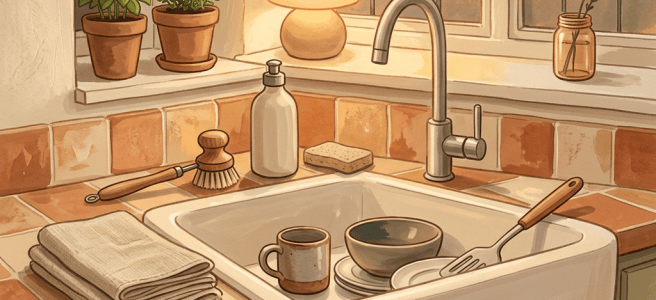
Cozy farmhouse kitchen sink with coffee, dishes, plants, and sunset light

I have never looked at a sink full of dinner plates and thought, “Behold, the gymnasium of the soul.” Mostly I’ve wondered who used every spoon. Still, the dishes have a way of showing us something: character is often practiced where nobody hands out a trophy.

Washing a plate is small work. You notice what is there, do the next useful thing, and leave a shared space a little better than you found it. Repeat until the fork situation is under control. That rhythm can teach patience, attention, and the plain fact that a home is not a hotel with a very mysterious kitchen staff.

Researchers have found reasons to take these ordinary tasks seriously, without turning them into magic. In a longitudinal study of nearly 10,000 children, kindergarten chore frequency was associated with stronger self-reported competence and prosocial measures in third grade. The authors describe an association, not proof that chores caused those outcomes. That distinction matters. A sink full of evidence is not the same as a sink full of certainty. (White, DeBoer, and Scharf’s study on PubMed.)

A smaller study of children ages five to thirteen also found that involvement in self-care and family-care chores predicted working memory and inhibition in parent-reported measures. The researchers themselves called for more research. So no, we cannot promise that drying a saucepan will upgrade a child’s brain by Tuesday. But a simple task can give a young person practice remembering steps, shifting attention, and finishing something useful. (The study in the Australian Occupational Therapy Journal.)

Here is the part I have to remind myself: formation is not the same thing as efficiency. The point is not to recruit a child as unpaid restaurant staff or to inspect every bowl like a health inspector with a grudge. The point is to let a child belong to the work of family life, at a level that fits their age, ability, and season.

The Child Mind Institute’s clinicians suggest making chores specific, routine, and manageable—“put the books away” is clearer than “clean everything,” which is also what I tell myself when the garage door opens. A task broken into steps can make a new responsibility feel possible rather than like a pop quiz in domestic engineering. (Child Mind Institute’s guide to chores.)

That is why today’s prompt asks what washing dishes has to do with character. What happened? A plate got clean. What did it mean? Someone practiced noticing, finishing, and helping keep a shared place livable. What can we carry forward? Give a child—or ourselves—one small, concrete task to do alongside someone else. Then let the moment be ordinary. Love sometimes wears rubber gloves, and it does not need to make a speech about it.

What Raising Kids Taught Me About Compounding

Adult and child watching ripples spread across a sunset pond

I used to think patience was a personality trait. Some people had it. Some people, like me, had a charming little emergency supply that ran out around 4:17 p.m.

Then I had children, and discovered that patience is less like a virtue you own and more like a muscle you use while someone asks the same question for the ninth time. It grows in small, mostly unphotogenic repetitions.

The money analogy is useful—but incomplete

We usually meet “compounding” in a finance conversation. Investor.gov defines compound interest as earning interest on interest. Its simple example begins with $100 at 5 percent: $105 after year one, $110.25 after year two, and more than $162 after ten years, even without another deposit. Time gives small gains a chance to earn their own gains.

Children do something similar to a parent’s character. One bedtime story does not make a reader. One calm explanation does not make a patient dad. But the repeated act leaves a little residue. The next explanation may come a half-second sooner. The apology may arrive before the lecture. Not dramatic growth. Just a slightly different default.

Small exchanges become the environment

This is not just a nice metaphor. The Harvard Center on the Developing Child describes “serve and return”—the back-and-forth between a child and a caring adult—as important for brain architecture and early language and social skills. A child points at a truck. You look. You name it. The child looks back. Tiny exchange, repeated across ordinary days. The Harvard Center explains why these responsive interactions matter.

And routines matter, too. A review of five decades of research in the American Psychological Association’s Journal of Family Psychology found that family routines and rituals were associated with parenting competence, child adjustment, and marital satisfaction, while also noting limits in the underlying studies. That word—associated—is doing honest work. A routine is not a magic spell. It is a repeated place where people can meet one another.

What I am trying to carry forward

What happened? I kept waiting for patience to arrive as a finished product. What did it mean? I was overlooking the deposits: the snack shared, the shoe found, the question answered without turning it into a courtroom drama.

What can I carry forward? Choose one small practice and make it boringly repeatable. Read ten minutes. Put the phone away during one conversation. Pause before answering the familiar question. In money, time lets returns build on returns. In a family, attention lets trust build on trust.

None of this makes the 4:17 p.m. hour disappear. Sorry. But it can make the next response a little more generous—and that, too, is a kind of compounding.