
The Song That Asked a Generation Not to Disappear

Empty school hallway with colorful lockers and large sunset-lit windows

I used to think “Don’t You (Forget About Me)” was just the song that played while Judd Nelson raised his fist. A very 1985 sentence. Probably the sort of sentence that should come with a denim jacket.

But listen again. The song is doing something more interesting than decorating the final shot of The Breakfast Club. It is asking a group of people who have been reduced to labels to remember one another as whole human beings.

The song was written for the movie by producer Keith Forsey and guitarist Steve Schiff. Simple Minds initially declined to record it because the band wanted to make its own material. Then Forsey came to meet them, and the story took a turn familiar to anyone who has ever been persuaded by a conversation over a drink: the Scots went to the pub with him, liked him, and reconsidered. The Guardian’s account of how the song was made captures that lovely bit of creative resistance giving way to human connection.

The result became Simple Minds’ biggest North American hit, reaching No. 1 in the United States and Canada. In Britain, it reached No. 7, according to Official Charts. Numbers are useful here, not because a chart position tells us whether a song is good, but because it shows how widely this particular plea traveled.

And the plea matters because the film understood something about formation. The five students in detention are introduced as types: the brain, the athlete, the basket case, the princess, and the criminal. Then the locked room gets uncomfortable. They confess things. They listen badly, then better. The categories do not vanish, exactly. They become too small.

That is why the Library of Congress added The Breakfast Club to the National Film Registry in 2016, naming it among films of cultural, historic, or aesthetic importance. The announcement called it a seminal coming-of-age drama. “Seminal” can sound like a museum label, but the point is simple: a movie about teenagers in a Saturday detention room kept giving later generations a vocabulary for feeling mis-seen.

Formation often begins when someone refuses the label that has been handed to him. Not with a grand reinvention. With the smaller courage of saying, “That is part of me, but it is not all of me.”

What happened? A film song became an anthem. What did it mean? A generation heard its private ache turned into a public chorus. What can I carry forward? When I am tempted to summarize someone quickly — difficult, lazy, successful, dramatic — I can leave room for the locked-room conversation I have not heard yet.

And maybe, before the day ends, I can ask one person a better question than “How’s it going?” Maybe: “What part of you have I forgotten to notice?”
The Meiji Restoration: How a Nation Was Formed Under Pressure

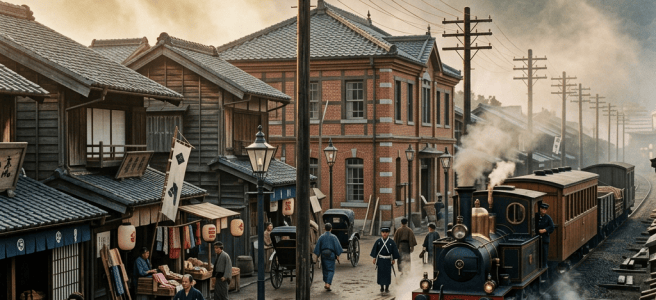
Steam locomotive passing traditional Japanese buildings in a mountain town

I used to think national character was something a country simply possessed, like a flag or a favorite snack. History is less tidy. Sometimes a nation is formed in public, under pressure, while everyone is arguing about what must be saved and what must change.

Japan’s Meiji Restoration is one of the clearest examples. In 1853, Commodore Matthew Perry arrived in Edo Bay with American warships. The Tokugawa shogunate, which had governed Japan for more than 250 years, was forced to open the country and sign unequal treaties. The shock was not only military. It was psychological: an old political order suddenly looked unable to protect the country’s independence. Encyclopaedia Britannica’s account describes the resulting pressure from foreign powers, famine, peasant unrest, and samurai debt.

What followed was not a neat handoff. On January 3, 1868, reform-minded samurai and court allies seized control in Kyoto and announced the restoration of imperial rule. The Boshin War continued into 1869. As historian Chushichi Tsuzuki notes in Oxford Academic, calling the whole process a “restoration” can hide the fact that a small group of leaders was building a new state while speaking in the language of old authority.

That tension makes the story useful for thinking about formation. The new government did not merely ask, “What do we believe?” It asked, “What practices will make those beliefs durable?” Domains were replaced by prefectures. A national army and conscription followed. Schools, railways, telegraphs, tax systems, and new industries tied distant places to a central government. Within five years, the reformers had dismantled much of the Tokugawa structure and begun assembling the machinery of a modern nation. The Ohio State University’s Origins essay calls this the “spirit of 1868”: the event mattered, but the habits and institutions that followed mattered more.

Then there was the Charter Oath. Its five articles called for public discussion, cooperation across classes, freedom to pursue one’s calling, a break with harmful customs, and the search for knowledge throughout the world. Britannica’s translation of the oath sounds surprisingly fresh: learn widely, consult others, and do not confuse inherited practice with permanent wisdom.

But formation is never the same as perfection. The modernization story also carried coercion, exclusion, industrial disease, and the colonization of Ainu lands. The reforms created new possibilities while imposing new burdens. A country can become more capable without becoming uniformly just. That is not a footnote; it is part of the history.

So, what happened? Japan faced external danger and internal strain, then rebuilt its political and social machinery at remarkable speed. What did it mean? National identity is not only inherited; it is practiced through institutions, education, infrastructure, and the stories leaders tell about change. What can we carry forward? Under pressure, we may need to learn quickly without pretending every “new” thing is good—or every old thing is disposable.

Perhaps the small examen is this: when life asks us to change, which parts of our formation are sturdy enough to keep, and which parts have simply been waiting for a crisis to be questioned?