The Courage to Sound Bad: Learning an Instrument Later in Life

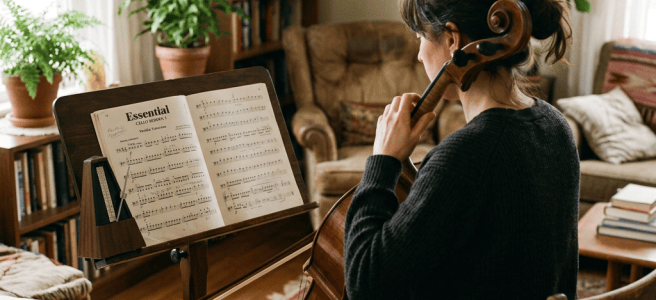
Musician playing cello while reading sheet music at home

Learning an instrument as an adult begins with a small indignity: the song in your head is playing in a different room from the notes under your fingers. You mean to strike a graceful chord. Instead, one finger arrives late, another takes a personal day, and the piano politely records the incident. It is a fine lesson in humility before the first scale is finished.

A beginner’s instrument is not a test of whether we are naturally gifted. It is a place where impatience becomes audible. The fingers need repetition; the ear needs time; our pride would like a certificate by Thursday. Learning later in life asks us to be comfortable being visibly unfinished.

Research gives that ordinary work a useful, unsensational context. In a year-long study, 156 healthy retirees ages 64 to 76, with little prior musical practice, took part in piano-practice sessions or music-culture classes. Piano learners improved in some measured skills, including articulation and timing on scale exercises, while other measures did not clearly change. Not every part of playing rose together. That is encouraging in its own way: progress can be real without being tidy. The study’s authors found that older beginners could acquire new musical skills, even as their progress varied from one ability to another.

That unevenness is familiar outside the music room. We repeat a passage, miss the same note, slow down, and try again. The humility is not saying, “I’ll never be any good.” That is just discouragement wearing a sensible hat. Humility is admitting, “I’m a beginner here,” and staying curious enough to notice what one careful repetition changes.

There is a difference between repetition and a grind. Repetition pays attention. It asks us to return to the same small stretch of music and listen: Was the rhythm steadier? Did my hand relax? Can I keep the left hand moving while the right one catches up? The answer might be no today. That is information, not a verdict.

A separate four-year follow-up tracked 32 older adults after an initial melodica program. Those who chose to continue practicing had better preservation of verbal working memory than those who stopped, though the groups were not randomly assigned, so the finding cannot prove that practice caused the difference. It is a careful hint, not a magic promise. The researchers describe both the association and the limits of what their small study can establish.

So maybe the gift of learning music late is not a sudden burst of talent. It is the chance to meet ourselves at the scale: a little awkward, a little amused, willing to begin again. Pick one short passage. Practice it slowly for five minutes. Notice one thing that changed, however modestly.

What happened? A note went sideways. What did it mean? I am still learning. What can I carry forward? I do not have to wait until I am good to begin; I only have to be willing to listen, repeat, and return.

Before Self-Help, There Was Apprenticeship

Two woodworkers assembling a wooden frame at a workshop bench

I have bought enough self-help books to build a small, slightly judgmental bookshelf. Most promise a better life through a plan: wake earlier, track the habit, optimize the morning. Useful, sometimes. But before we learned to call everything a system, people learned by standing near someone who already knew how to do the thing.

That older pattern was apprenticeship. Not a weekend course. Not a motivational quote over a photo of a mountain. You watched, copied, failed, received correction, and tried again. The point was not merely to collect information. It was to become the sort of person who could notice what mattered and respond well.

In early modern Europe, apprenticeship was probably the largest organized form of learning available to ordinary people, and artisans commonly began that way, according to historian Patrick Wallis in Science in Context. The arrangement was imperfect. Masters did not always teach systematically. Apprentices had to find other workshops, books, and teachers. Still, the workshop gave learning a place, a rhythm, and a human face.

The same logic lives in music. A young player does not become a musician by downloading every scale chart. She listens to a teacher phrase a line, tries it, hears where it goes flat, and discovers that “almost right” is a useful address. Modern learning researchers call this cognitive apprenticeship: authentic work beside someone more experienced, with scaffolding, reflection, and even productive failure. In plain English, you get better by doing the real thing with company.

Faith has an apprenticeship shape, too. In the Gospel accounts, Jesus does not simply hand the disciples a syllabus and wish them luck. He says, “Come, follow me.” They watch him pray, teach, welcome, confront, rest, and serve. Then they are sent to practice. One theological account describes those three years of following, watching, and hearing as a kind of theological apprenticeship, aimed at preparing the disciples to continue the work. The pattern is wonderfully concrete: learn a way of life by living near it.

The American story kept this practical tradition in view. The U.S. Department of Labor’s history points to George Washington, Benjamin Franklin, and Paul Revere as early apprentices who later became nationally known. The detail is almost funny: before the résumé, before the personal brand, there was a master, a bench, and a beginner doing the unglamorous work.

What happened? People were formed in proximity to a craft, a community, or a teacher. What did it mean? Skill was never only a private possession; it carried a responsibility to pass something on. What might we carry forward? Choose one practice you respect and find a living example: a musician, craftsperson, elder, or faithful friend. Watch closely. Try the work. Let correction be a gift instead of a verdict. A life may still need goals, but it probably needs a few good teachers more.