Boredom Is Not Empty: The Quiet Practice of Staying Put

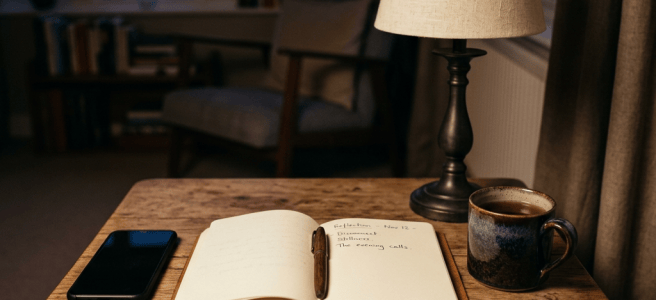
Open journal with handwritten notes beside coffee, phone, and lit lamp

The Prompt Bank asks about “the forgotten discipline of boredom” and why constant stimulation might stunt formation. My own field research is mostly waiting for the kettle to boil: I reach for my phone before the water has even remembered it is hot. The pause feels tiny. The reflex is not.

We do not have to make boredom noble. It can be uncomfortable, even painful. And it is not automatically a doorway to genius. But perhaps the first question is not “How do I get rid of this feeling?” It might be “What is this feeling telling me about the way I am living?”

A University of New Hampshire account of two small experiments describes participants who watched a brief boring video before returning to a divergent-thinking task. In those experiments, they sometimes produced more answers or more unique answers than people who watched an engaging video. That is interesting, not a universal law: the task was specific, and a few minutes of laboratory boredom are not the same as a hard season of life.

The caution matters. In a 2023 essay in Frontiers in Sociology, philosopher Josefa Ros Velasco includes “boredom makes us more creative” among the familiar claims about boredom that deserve scrutiny. So let’s not turn a dull afternoon into a wellness prescription. Sometimes the right move is to change the task, ask for help, or rest.

Still, constant stimulation can train a quick escape hatch. A quiet moment arrives; a screen appears. A difficult paragraph arrives; another tab opens. No single choice tells the whole story. Repeated often, though, the choices teach us what to do with the first hint of friction. We become practiced—not bad, just practiced—at leaving before we have noticed what is happening inside us.

Formation often happens in these unremarkable seconds. Try washing one dish without a video playing. Walk from the car to the door without filling the silence. Let the elevator ride be an elevator ride. Not as a challenge to win, and certainly not to prove you are more disciplined than the rest of us. Just notice the itch to fill the space. What are you hoping the next thing will do for you?

There is a useful distinction between making room for a pause and pretending every kind of boredom should be endured. If a routine is empty, perhaps it needs meaning or change. If a person is isolated or overwhelmed, “sit with it” may be the wrong counsel. The practice is attention, not stoicism: see the signal, then choose a response.

What happened: a few seconds with nothing demanding us. What it meant: maybe we were tired, maybe restless, maybe simply unused to quiet. What to carry forward: leave one small gap unfilled today, and listen before you reach. If boredom has something to say, we can at least let it finish the sentence.
Ikigai, Translated Honestly: It Is Not Your Perfect Job

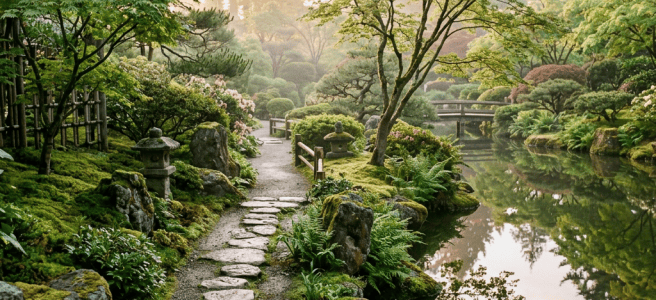
Moss-covered stepping-stone path beside a pond in a Japanese garden

I first met ikigai on a corporate wellness poster. Four circles leaned into one another: what you love, what you are good at, what the world needs, and what you can be paid for. In the middle sat a small, confident promise. Find this intersection and your life will click. Even the diagram looked well-rested.

The trouble is that this is not quite what ikigai means in Japanese. The word is often translated as “a reason for being,” but that translation can sound grander and more career-shaped than the thing itself. The Government of Japan describes it as something that brings value and joy to life. It can be a person—your child, a friend—or an activity, such as work or a hobby. It is less a job title than a felt sense that living is worthwhile.

That wider meaning matters. A word like “purpose” can make us imagine a mission statement, complete with a logo. Ikigai may be much more ordinary: tending a garden, making lunch for people you love, showing up for a club, learning a craft badly for three years before getting slightly less bad. The point is not that these activities are secretly monetizable. The point is that they can make a life feel inhabited.

The academic picture is appropriately humbling. A University of Pennsylvania review of psychological research notes that scholars still lack one consistent definition. Its useful threads are personally valued experiences, authentic relationships, and a sense of direction. That sounds less like a personality quiz and more like a life slowly teaching us what gives it weight.

Which brings us back to the famous four-circle graphic. It is a handy worksheet for thinking about work. It is not an ancient Japanese map. Marc Winn’s own account says that in 2014 he joined the word ikigai to Andrés Zuzunaga’s existing purpose diagram. That is a perfectly legitimate creative mash-up. It just should not be presented as a literal translation of a Japanese tradition. A foreign word can add mystery to a framework; it cannot make the framework native.

There is real reason to take the concept seriously, without turning it into a productivity hack. In a large Japanese cohort study of 73,272 adults, researchers found that people who reported having ikigai had lower all-cause mortality during follow-up. The authors described an association with longevity, not proof that a cheerful hobby causes a longer life. The PubMed record is a useful antidote to both cynicism and hype.

So, what happened? A modest Japanese word traveled into the English-speaking self-help world, picked up a four-circle diagram, and became a career brand. What did it mean? The word itself remained more spacious than the brand: value and joy can arrive through people, practices, and small loyalties, not only through a vocation. What can we carry forward? Instead of asking, “What is my one perfect purpose?” try asking, “What made life feel quietly worth living this week?” Then notice the answer before turning it into a business plan.