Ukiyo-e and the Courage to Notice What Won’t Stay

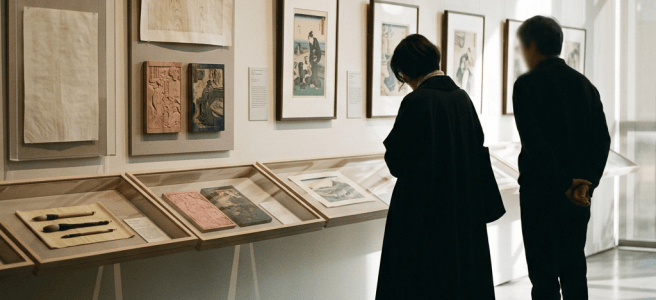
Two visitors examining framed artworks and artifacts in a museum gallery

A prompt landed on my desk about ukiyo-e woodblock prints and the art of fleeting things. Which is a fine way to spend a morning, especially if your alternative is reorganizing the sock drawer for the third time. Ukiyo-e does not merely show a passing world. It trains the eye to receive one.

The word ukiyo-e is often translated as “pictures of the floating world,” or, with a slightly heavier sigh, “pictures of the sorrowful world.” The Library of Congress’s overview places the tradition in Japan’s seventeenth- through nineteenth-century print culture, where artists pictured actors, courtesans, landscapes, stories, and the pleasures of ordinary urban life. This was not art kept at a safe distance from daily life. It was made to circulate.

That circulation required a small orchestra of patience. A publisher organized the project. An artist supplied the design. A carver cut the image into wood. A printer pressed pigment onto paper, lining up each impression with care. As The Metropolitan Museum of Art explains, polychrome prints used a separate carved block for each color—sometimes as many as twenty. The bright final image was therefore a visible record of invisible repetition.

Then there is mono no aware, a phrase that resists being flattened into “everything is temporary.” The Stanford Encyclopedia of Philosophy describes it as the pathos of things, a feeling arising from their transience. The point is not to scold us for loving what changes. It is to notice that the change is part of what makes the thing dear.

Hokusai’s Under the Wave off Kanagawa makes this almost comically clear. A wave rises like a blue claw. Three boats work their way beneath it. Mount Fuji sits in the distance, small and composed. Smarthistory’s account of the print notes how the image turns a split second of danger into something that can be looked at again and again. The wave still falls. The print does not pretend otherwise.

That may be the formation lesson. We often confuse attention with control. We photograph the birthday because we cannot keep the child that age. We save the message because the conversation will move on. We make a plan, then discover that life has its own carving tools. Ukiyo-e offers a gentler practice: receive the impression while it is here.

What happened? A team of makers built images of a world always in motion. What did it mean? Beauty and loss are not always enemies; sometimes they arrive holding hands. What can I carry forward? Today, notice one ordinary thing before rushing past it—the steam from a mug, a joke you have heard before, the last light on the wall. You do not have to make it permanent. Just be there for the impression.
What a Japanese Konbini Teaches About Quiet Excellence

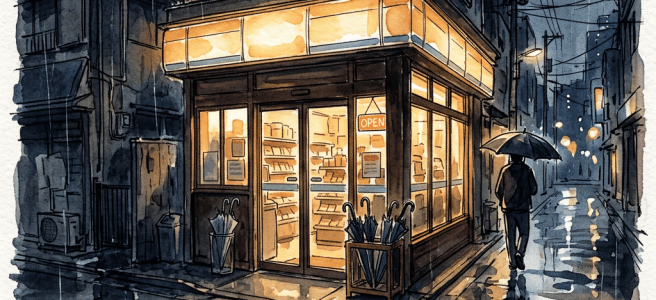
Illuminated corner shop with an OPEN sign on a rainy city street

I have a weakness for Japanese convenience stores. Give me ten minutes in a konbini and I will emerge with an onigiri, a coffee, and the vague conviction that I have briefly become a more organized person.

The joke works because the store feels so un-dramatic. No grand entrance. No luxury branding. Just bright shelves, a polite greeting, and the quiet sense that somebody has thought through the next five minutes of your life.

“Konbini” is short for convenience store, but that English phrase undersells the institution. A scholarly essay on Japanese food culture describes the konbini as one of contemporary Japan’s “peculiar institutions,” alongside the vending machine, and places it inside a larger story about modernity, speed, and convenience. The point is not that every Japanese shop is perfect. It is that these stores have become woven into ordinary life. The essay is worth reading for both the convenience and its discontents.

The scale is substantial. Japan’s Ministry of Economy, Trade and Industry reported convenience-store sales of ¥12.8887 trillion in 2024, counting goods and services together. The METI review is a useful reminder that “convenience” is not merely a feeling; it is a serious retail system. The Japan Franchise Association also publishes monthly and annual data on store sales and store numbers, which you can see in its statistical archive.

And then there are the small acts of infrastructure. At Seven-Eleven, the multifunction copy machine can print photos, send faxes, order tickets, and—in some municipalities—produce official documents such as residence certificates and tax statements, including on weekends and holidays. The company’s service guide reads less like an advertisement than a list of ways a neighborhood store quietly absorbs friction.

That, to me, is the formation story. Excellence here is not a heroic burst. It is a chain of modest decisions: the right item in the right place, a delivery arriving on time, a package accepted without fuss, a counter kept clean. One recent account of the Japanese model highlights the combination of franchise organization, data and technology, and a reconstructed distribution system. The system is designed, not accidental.

There is a temptation to turn this into a postcard about Japanese perfection. Let’s resist that. Systems have costs. Convenience can mean long hours, demanding work, packaging, and pressure that customers do not see. Respect begins by noticing the people and resources underneath the smooth surface.

Still, the konbini offers a lovely question for the rest of us: where could a little less drama and a little more preparation make someone else’s day easier? In a household, that might be a basket by the door for keys. In a budget, an automatic transfer before the month gets noisy. In faith, five quiet minutes before the day starts making demands.

What happened? A corner shop became part grocery, part post office, part civic counter, part dependable neighbor. What did it mean? Small repeated acts can become a form of care. What can we carry forward? Pick one useful thing, make it easier to repeat, and let the excellence stay quiet.

The Tea Ceremony’s Quiet Lesson: Attention Is a Way of Life

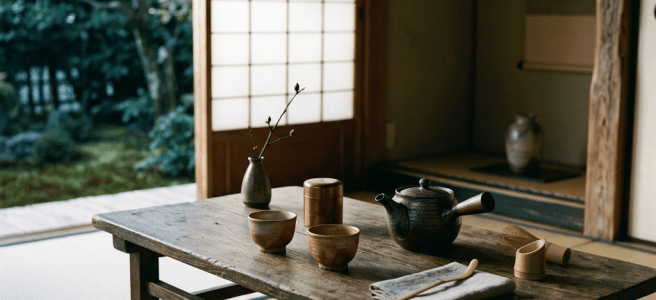
Tea table with teapot, cups, whisk, and vase beside a Japanese garden

I have a bad habit of drinking tea while doing three other things. I answer a message, glance at the news, and then wonder why the cup went cold. This is not a failure of tea. The tea has been giving me a perfectly clear assignment. I just keep submitting the wrong homework.

Chanoyu—often translated as “hot water for tea”—is a Japanese practice that turns an ordinary act into a carefully held encounter. The Metropolitan Museum of Art describes a small tea room where host, guests, utensils, garden, and season meet. The room is intimate. The movements are choreographed. The gathering is never quite repeated.

That last part matters. The Asian Art Museum’s teaching guide explains the phrase ichi-go ichi-e—“one time, one meeting”—as an awareness that each gathering is once in a lifetime. Not because the world is dramatic every minute, but because this minute is not coming back. The tea bowl in your hands is not a prop. It is the thing happening now.

The practice is not casual about attention. Before the tea arrives, the guest notices the scroll, the flowers, the kettle, the brazier. The host purifies the utensils and prepares the bowl in front of everyone. Guests watch with all five senses. Even the beautiful front of the bowl is turned away before drinking, then returned to face the host. Courtesy is taught through the hands before it is explained by the mouth.

Sen no Rikyu’s famous seven rules are wonderfully plain: make a satisfying bowl of tea; heat the water well; offer warmth in winter and coolness in summer; arrange flowers as they grow in the field; prepare ahead; be ready for rain; and show utmost consideration to your guests. The MIT Japanese Tea Ceremony page preserves the list. It sounds less like mysticism than good hosting. Which may be why it is so difficult. Most of us can manage one thoughtful gesture. The formation comes from making thoughtfulness the shape of the room.

The four principles often associated with the Way of Tea—wa (harmony), kei (respect), sei (purity), and jaku (tranquility)—are not four inspirational posters. They are a sequence. Attend to the setting and the other person. Clear what distracts. Then, sometimes, calm arrives. As the Association for Asian Studies notes, the methodical ritual cultivates respect, connection, and being “present in the present.”

What happened? Someone made tea with enough care for a simple cup to become an encounter. What did it mean? Attention is not merely a personality trait; it is a practice, reinforced by rooms, rituals, and repeated gestures. What can I carry forward? Perhaps one cup today with the phone in another room. No grand transformation. Just hot water, a little patience, and the courtesy of actually arriving.