Ukiyo-e and the Courage to Notice What Won’t Stay

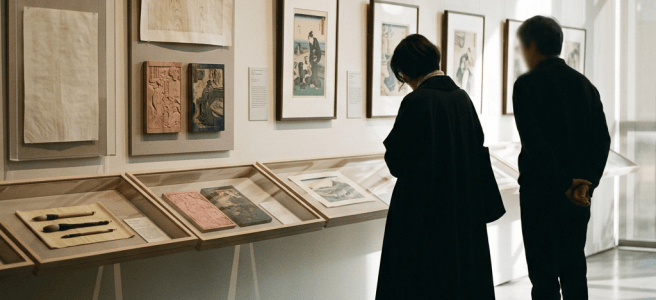
Two visitors examining framed artworks and artifacts in a museum gallery

A prompt landed on my desk about ukiyo-e woodblock prints and the art of fleeting things. Which is a fine way to spend a morning, especially if your alternative is reorganizing the sock drawer for the third time. Ukiyo-e does not merely show a passing world. It trains the eye to receive one.

The word ukiyo-e is often translated as “pictures of the floating world,” or, with a slightly heavier sigh, “pictures of the sorrowful world.” The Library of Congress’s overview places the tradition in Japan’s seventeenth- through nineteenth-century print culture, where artists pictured actors, courtesans, landscapes, stories, and the pleasures of ordinary urban life. This was not art kept at a safe distance from daily life. It was made to circulate.

That circulation required a small orchestra of patience. A publisher organized the project. An artist supplied the design. A carver cut the image into wood. A printer pressed pigment onto paper, lining up each impression with care. As The Metropolitan Museum of Art explains, polychrome prints used a separate carved block for each color—sometimes as many as twenty. The bright final image was therefore a visible record of invisible repetition.

Then there is mono no aware, a phrase that resists being flattened into “everything is temporary.” The Stanford Encyclopedia of Philosophy describes it as the pathos of things, a feeling arising from their transience. The point is not to scold us for loving what changes. It is to notice that the change is part of what makes the thing dear.

Hokusai’s Under the Wave off Kanagawa makes this almost comically clear. A wave rises like a blue claw. Three boats work their way beneath it. Mount Fuji sits in the distance, small and composed. Smarthistory’s account of the print notes how the image turns a split second of danger into something that can be looked at again and again. The wave still falls. The print does not pretend otherwise.

That may be the formation lesson. We often confuse attention with control. We photograph the birthday because we cannot keep the child that age. We save the message because the conversation will move on. We make a plan, then discover that life has its own carving tools. Ukiyo-e offers a gentler practice: receive the impression while it is here.

What happened? A team of makers built images of a world always in motion. What did it mean? Beauty and loss are not always enemies; sometimes they arrive holding hands. What can I carry forward? Today, notice one ordinary thing before rushing past it—the steam from a mug, a joke you have heard before, the last light on the wall. You do not have to make it permanent. Just be there for the impression.
Ikigai, Translated Honestly: It Is Not Your Perfect Job

Moss-covered stepping-stone path beside a pond in a Japanese garden

I first met ikigai on a corporate wellness poster. Four circles leaned into one another: what you love, what you are good at, what the world needs, and what you can be paid for. In the middle sat a small, confident promise. Find this intersection and your life will click. Even the diagram looked well-rested.

The trouble is that this is not quite what ikigai means in Japanese. The word is often translated as “a reason for being,” but that translation can sound grander and more career-shaped than the thing itself. The Government of Japan describes it as something that brings value and joy to life. It can be a person—your child, a friend—or an activity, such as work or a hobby. It is less a job title than a felt sense that living is worthwhile.

That wider meaning matters. A word like “purpose” can make us imagine a mission statement, complete with a logo. Ikigai may be much more ordinary: tending a garden, making lunch for people you love, showing up for a club, learning a craft badly for three years before getting slightly less bad. The point is not that these activities are secretly monetizable. The point is that they can make a life feel inhabited.

The academic picture is appropriately humbling. A University of Pennsylvania review of psychological research notes that scholars still lack one consistent definition. Its useful threads are personally valued experiences, authentic relationships, and a sense of direction. That sounds less like a personality quiz and more like a life slowly teaching us what gives it weight.

Which brings us back to the famous four-circle graphic. It is a handy worksheet for thinking about work. It is not an ancient Japanese map. Marc Winn’s own account says that in 2014 he joined the word ikigai to Andrés Zuzunaga’s existing purpose diagram. That is a perfectly legitimate creative mash-up. It just should not be presented as a literal translation of a Japanese tradition. A foreign word can add mystery to a framework; it cannot make the framework native.

There is real reason to take the concept seriously, without turning it into a productivity hack. In a large Japanese cohort study of 73,272 adults, researchers found that people who reported having ikigai had lower all-cause mortality during follow-up. The authors described an association with longevity, not proof that a cheerful hobby causes a longer life. The PubMed record is a useful antidote to both cynicism and hype.

So, what happened? A modest Japanese word traveled into the English-speaking self-help world, picked up a four-circle diagram, and became a career brand. What did it mean? The word itself remained more spacious than the brand: value and joy can arrive through people, practices, and small loyalties, not only through a vocation. What can we carry forward? Instead of asking, “What is my one perfect purpose?” try asking, “What made life feel quietly worth living this week?” Then notice the answer before turning it into a business plan.