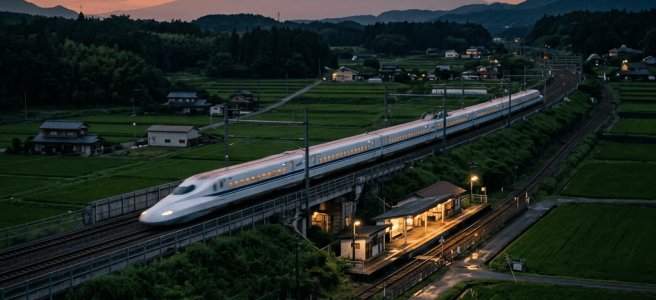
The Shinkansen’s Formation Lesson: Punctuality Is Built, Not Born

Bullet train crossing rural rice fields with Mount Fuji in background

I have a confession: I am the sort of person who considers a train arriving “only” four minutes late a minor weather event. Somewhere between the platform and the coffee machine, I have already rewritten the morning.

Then there is the Shinkansen.

The Tokaido Shinkansen opened on October 1, 1964, linking Tokyo and Osaka just before the Tokyo Olympics. It cut the trip from six and a half hours to four; after a sensible bedding-in period, the 1965 timetable brought it down to three hours and ten minutes, according to the Japan Railway & Transport Review. A national project arrived not merely fast, but with a new relationship to time.

Today, JR Central reports an average delay of 1.6 minutes per train on the Tokaido line in fiscal year 2023, including delays caused by natural disasters. That is not a claim that Japan has defeated weather, earthquakes, or the occasional disgruntled pigeon. It is a reminder that reliability is measured across the real world, not a laboratory. The figure comes from JR Central’s own Shinkansen overview.

But punctuality is not a national personality trait that descends from the clouds and taps everyone on the shoulder. It is formed.

Dedicated tracks keep the trains away from many outside disturbances. Control systems, maintenance crews, detailed timetables, and operations-room staff all do their quiet work before a passenger ever hears the familiar chime. One account of the system describes drivers who can reach a destination within five seconds of schedule and stop within a centimeter of the prescribed position—precision made possible by an entire supporting organization, not heroic willpower alone. Read the wider story in Japan Policy Forum’s account of the high-speed rail network.

Even passengers were part of the formation. In 1925, Japan National Railways posted rules explaining that people getting off should go first, followed by those boarding. Shorter station stops meant more capacity without immediately buying more trains. In other words, the system taught people how to make the system work. Manners became infrastructure.

That line stays with me. We often imagine character as something stored inside us, like a coin in a pocket. The Shinkansen suggests another picture: character is also the arrangement of the track, the timetable, the checklist, the well-rehearsed response when something goes wrong. We become dependable partly by practicing, and partly by building surroundings that make the dependable choice easier.

So, a small evening examen. What happened? A train became a symbol of national modernity, then a daily exercise in coordination. What did it mean? Quiet excellence is rarely quiet because nothing is happening; it is quiet because thousands of small acts are happening on purpose. What can I carry forward? Perhaps one timetable for tomorrow, one five-minute reset, one place where I stop relying on last-minute inspiration.

Not every life needs to run on bullet-train precision. Mine certainly does not. But maybe the next faithful step is less about becoming a more disciplined person and more about laying a little better track.
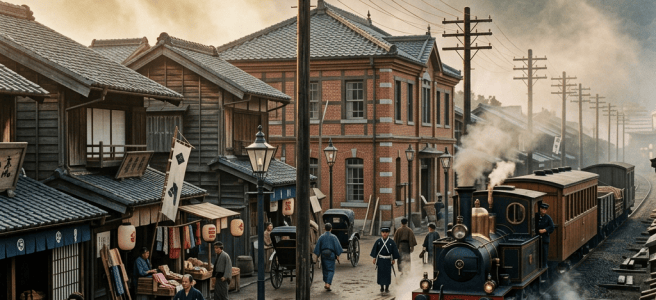
The Meiji Restoration: How a Nation Was Formed Under Pressure

Steam locomotive passing traditional Japanese buildings in a mountain town

I used to think national character was something a country simply possessed, like a flag or a favorite snack. History is less tidy. Sometimes a nation is formed in public, under pressure, while everyone is arguing about what must be saved and what must change.

Japan’s Meiji Restoration is one of the clearest examples. In 1853, Commodore Matthew Perry arrived in Edo Bay with American warships. The Tokugawa shogunate, which had governed Japan for more than 250 years, was forced to open the country and sign unequal treaties. The shock was not only military. It was psychological: an old political order suddenly looked unable to protect the country’s independence. Encyclopaedia Britannica’s account describes the resulting pressure from foreign powers, famine, peasant unrest, and samurai debt.

What followed was not a neat handoff. On January 3, 1868, reform-minded samurai and court allies seized control in Kyoto and announced the restoration of imperial rule. The Boshin War continued into 1869. As historian Chushichi Tsuzuki notes in Oxford Academic, calling the whole process a “restoration” can hide the fact that a small group of leaders was building a new state while speaking in the language of old authority.

That tension makes the story useful for thinking about formation. The new government did not merely ask, “What do we believe?” It asked, “What practices will make those beliefs durable?” Domains were replaced by prefectures. A national army and conscription followed. Schools, railways, telegraphs, tax systems, and new industries tied distant places to a central government. Within five years, the reformers had dismantled much of the Tokugawa structure and begun assembling the machinery of a modern nation. The Ohio State University’s Origins essay calls this the “spirit of 1868”: the event mattered, but the habits and institutions that followed mattered more.

Then there was the Charter Oath. Its five articles called for public discussion, cooperation across classes, freedom to pursue one’s calling, a break with harmful customs, and the search for knowledge throughout the world. Britannica’s translation of the oath sounds surprisingly fresh: learn widely, consult others, and do not confuse inherited practice with permanent wisdom.

But formation is never the same as perfection. The modernization story also carried coercion, exclusion, industrial disease, and the colonization of Ainu lands. The reforms created new possibilities while imposing new burdens. A country can become more capable without becoming uniformly just. That is not a footnote; it is part of the history.

So, what happened? Japan faced external danger and internal strain, then rebuilt its political and social machinery at remarkable speed. What did it mean? National identity is not only inherited; it is practiced through institutions, education, infrastructure, and the stories leaders tell about change. What can we carry forward? Under pressure, we may need to learn quickly without pretending every “new” thing is good—or every old thing is disposable.

Perhaps the small examen is this: when life asks us to change, which parts of our formation are sturdy enough to keep, and which parts have simply been waiting for a crisis to be questioned?