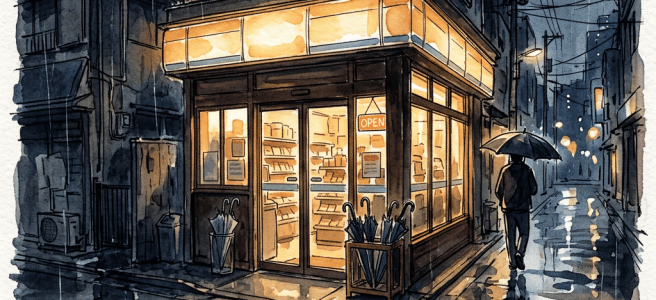
I have a weakness for Japanese convenience stores. Give me ten minutes in a konbini and I will emerge with an onigiri, a coffee, and the vague conviction that I have briefly become a more organized person.
The joke works because the store feels so un-dramatic. No grand entrance. No luxury branding. Just bright shelves, a polite greeting, and the quiet sense that somebody has thought through the next five minutes of your life.
“Konbini” is short for convenience store, but that English phrase undersells the institution. A scholarly essay on Japanese food culture describes the konbini as one of contemporary Japan’s “peculiar institutions,” alongside the vending machine, and places it inside a larger story about modernity, speed, and convenience. The point is not that every Japanese shop is perfect. It is that these stores have become woven into ordinary life. The essay is worth reading for both the convenience and its discontents.
The scale is substantial. Japan’s Ministry of Economy, Trade and Industry reported convenience-store sales of ¥12.8887 trillion in 2024, counting goods and services together. The METI review is a useful reminder that “convenience” is not merely a feeling; it is a serious retail system. The Japan Franchise Association also publishes monthly and annual data on store sales and store numbers, which you can see in its statistical archive.
And then there are the small acts of infrastructure. At Seven-Eleven, the multifunction copy machine can print photos, send faxes, order tickets, and—in some municipalities—produce official documents such as residence certificates and tax statements, including on weekends and holidays. The company’s service guide reads less like an advertisement than a list of ways a neighborhood store quietly absorbs friction.
That, to me, is the formation story. Excellence here is not a heroic burst. It is a chain of modest decisions: the right item in the right place, a delivery arriving on time, a package accepted without fuss, a counter kept clean. One recent account of the Japanese model highlights the combination of franchise organization, data and technology, and a reconstructed distribution system. The system is designed, not accidental.
There is a temptation to turn this into a postcard about Japanese perfection. Let’s resist that. Systems have costs. Convenience can mean long hours, demanding work, packaging, and pressure that customers do not see. Respect begins by noticing the people and resources underneath the smooth surface.
Still, the konbini offers a lovely question for the rest of us: where could a little less drama and a little more preparation make someone else’s day easier? In a household, that might be a basket by the door for keys. In a budget, an automatic transfer before the month gets noisy. In faith, five quiet minutes before the day starts making demands.
What happened? A corner shop became part grocery, part post office, part civic counter, part dependable neighbor. What did it mean? Small repeated acts can become a form of care. What can we carry forward? Pick one useful thing, make it easier to repeat, and let the excellence stay quiet.

