Gratitude Is Not the Opposite of Lament

Open journal with fountain pen, autumn leaves, and tea on a wooden desk

I have a bad habit with journals: I buy the handsome one, write in it for three nights, then let it become a very expensive coaster. The problem is not the paper. It is that I keep imagining reflection has to be relentlessly upbeat.

Gratitude journaling gets marketed that way. List three good things. Smile at the small stuff. Please do not mention the overdue bill or the ache in your chest. The Psalms, thankfully, are less tidy. They give us another kind of spiritual notebook: lament.

At first, gratitude and lament look like opposites. One names what is good. The other names what hurts. But both are practices of attention. Both slow the blur of a day and ask us to tell the truth about what we find there.

The research on gratitude is encouraging, with an important asterisk. A 2025 meta-analysis of 145 papers, 163 samples, and 24,804 participants found a small overall improvement in well-being from gratitude interventions such as journals and gratitude letters. Small is not nothing. It is also not magic. The effect varied by country and by study design, which is a useful reminder that a journal is a tool, not a vending machine for happiness. Read the meta-analysis if you enjoy the sort of footnote that wears sensible shoes.

Now open a lament. In Bible Odyssey’s overview, the pattern is wonderfully direct: address God, describe the trouble, ask for help, remember trust, and leave room for thanksgiving. Psalm 13 does not begin with “I am grateful for this learning opportunity.” It begins, “How long?” That is not a failure of faith. It is a relationship honest enough to complain.

A Yale Bible Study guide calls complaint or lament the most common type of psalm, in both individual and communal forms. The psalm gives suffering a shape that can be carried by more than one person. It does not solve the crisis on contact. It makes the crisis speakable.

That may be the shared spiritual work. Gratitude asks, “What gift was here?” Lament asks, “What wound is here?” Both resist the lazy story that our inner life is either fine or ruined. Both turn scattered feeling into a truthful practice. Both can move us from private fog toward relationship: with God, with another person, or simply with the self we keep avoiding.

So tonight, try a three-line examen: one gift, one grief, one next faithful step. Do not sand down the grief to make the page look nicer. Do not let the grief erase the gift, either. What happened? You noticed the whole day. What did it mean? Your attention became a form of care. What can you carry forward? Perhaps just enough honesty for tomorrow’s page.


The Widow’s Mite: When Giving Is Measured in Proportion, Not Amount

Seated person holding two coins before ancient stone ruins

I have a bad habit with generosity: I count the size of the gift before I ask what it cost the giver. Very efficient. Very spreadsheet. Also, perhaps, a little spiritually tone-deaf.

That is why the widow in Mark’s Gospel keeps interrupting my mental math. Jesus is sitting opposite the Temple treasury. The rich are putting in large sums. Then a poor widow drops in two small copper coins. In the text of Mark 12:38–44, Jesus says she has given more than all the others because they gave from abundance, while she gave “all she had to live on.”

The coins were called lepta. Two lepta made a tiny Roman coin, roughly 1/64 of a laborer’s day wage. In dollar terms, it was not an impressive donation. It would not win a fundraising leaderboard. It might not even earn a thank-you email with a tasteful banner.

But Jesus is not using the widow to teach a simple formula: poor people should give away their last dollar, and rich people can feel guilty until morale improves. The story sits immediately after his warning about religious leaders who “devour widows’ houses.” As the Working Preacher commentary notes, Mark places the widow’s gift inside a troubling scene of institutional ambiguity. Her faithfulness is real. So is her vulnerability.

That matters for how we read the passage at home, at church, and in the budget app. The widow’s offering is not a permission slip for institutions to praise sacrifice while ignoring the people who are being squeezed. It is also not a contest in which the person with the smallest account balance wins the holiness trophy. Jesus does not shame the rich for having resources. He notices that their gifts come from surplus, while hers comes from the center of her life.

This is where proportion becomes a useful word. A gift can be large in dollars and small in personal cost. Another can be small in dollars and enormous in trust. The same principle appears in ordinary household decisions: the grocery run for a sick neighbor, the hour given to a lonely parent, the money quietly set aside before lifestyle spending swallows it. The ledger sees amounts. Love notices weight.

The Catholic education commentary on the passage rightly keeps both truths in view: Jesus honors the widow’s wholehearted offering, and the story raises questions about systems that leave vulnerable people carrying the cost. That is a sturdier reading than either sentimentality or scolding.

So, what happened? A widow gave two nearly worthless coins, and Jesus called the gift greater. What did it mean? Formation is partly learning to measure what the world cannot see: proportion, sacrifice, dependence, and care. What can we carry forward? Before asking, “How much should I give?” ask a quieter question: “What is my money forming me to notice?”

The Prodigal Son and the Economics of Forgiveness

Traveler walking along a dirt road toward a lit farmhouse at sunset

I have a confession to make: I have kept spreadsheets for things that did not need spreadsheets. Grocery spending, school fees, the mysterious category called “miscellaneous.” It is comforting to believe every problem can be solved by better bookkeeping.

Then Jesus tells a story about a father whose younger son asks for his inheritance early. In the world of Luke 15, that is not a small budgeting disagreement. The son is treating his father as a financial institution with a pulse. The father divides the property, and the boy leaves.

He spends everything. A famine arrives. The son ends up hungry, humiliated, and rehearsing a speech: I am no longer worthy to be called your son; make me one of your hired workers. It is the sort of speech we write in our heads when we have failed badly enough. We do not just owe money, or an apology, or an explanation. We start to think we are the debt.

But the father does something economically irrational and emotionally astonishing. He sees the son while he is still far away. He runs. He embraces him before the repayment plan is negotiated. The robe, ring, sandals, and feast are not a refund. They are a restoration of identity.

This is why “the economics of forgiveness” is a useful phrase, as long as we handle it gently. Philosopher Brandon Warmke describes the comparison this way: we often speak of forgiveness as the cancellation of a moral debt, borrowing the shape of economic debt-cancellation. The analogy helps us notice something real: forgiveness changes what is carried forward. But a person is not a balance sheet, and mercy is not a clever way to make consequences disappear.

The World Bank’s discussion of debt relief makes the caution plain: relief can address “debt overhang,” yet it also raises questions about future behavior, fairness, and the design of responsible systems. Forgiveness in public policy needs structure. Forgiveness in a family needs truth. Neither is served by pretending the loss never happened.

The older brother understands this part. He counts. He remembers. He knows the property was swallowed up. The father does not correct the arithmetic. He goes outside and pleads with him too. The story is not “money does not matter.” It is that money cannot be allowed to become the final word about who belongs.

What happened? A son left, lost everything, and came home. What did it mean? The father treated failure as a chapter, not a name. What can I carry forward? Tonight, I might review my own ledger—financial, emotional, spiritual—and ask where I have confused owing something with being something.

There is still a practical question: whom do I need to forgive, and what honest repair would make that forgiveness sturdy enough to live in?

Formation Happens in Seasons, Not Sprints

Colorful abstract artwork featuring overlapping patterned circles and botanical motifs

I have a bad habit of treating my life like a software launch. Pick a goal, announce the goal, buy the notebook, and expect a new personality by Thursday. The notebook is usually beautiful. The personality remains in beta.

That is why the Christian liturgical year keeps catching my attention. It does not ask us to become a finished person in one heroic burst. It gives us a rhythm. The United States Conference of Catholic Bishops describes a cycle of seasons and saints that returns again and again: Advent, Christmas, Lent, the Triduum, Easter, and Ordinary Time. The point is not merely to remember dates. The cycle is meant to draw people into the mystery of Christ and into lives shaped by it.

Formation is repetition with meaning

Modern life loves the sprint. Thirty days to a new body. Ninety days to a new business. One inspirational podcast to a new soul. Some of these promises are useful. Most are wearing very fast shoes.

A season works differently. It gives a theme enough time to sink below the level of a slogan. Advent, for example, is not simply a countdown to Christmas. The USCCB presents it as a four-week season of preparation for both Christ’s birth and his promised return, a time of alertness, hope, and a heart made quieter. You do not “win” Advent. You practice receiving it.

Historically, this rhythm grew rather than dropped from the sky fully assembled. Britannica traces Sunday worship to the apostolic age and describes how other observances and seasons developed over centuries. That matters. It means formation can be organic. A community repeats what helps it remember, then refines the repetition until the calendar becomes a kind of shared memory.

The long middle counts

We tend to notice beginnings and endings. New Year’s Day. Graduation. Retirement. Before-and-after photos. But the long stretch called Ordinary Time makes a quieter claim: ordinary days are not empty space between meaningful events. They are where a life is practiced. Scripture is heard. Patience is attempted. We fail, apologize, and try again without a dramatic soundtrack.

This is good news for anyone whose progress feels unimpressive. A season gives you permission to return. You can begin Lent tired. You can enter Easter still carrying questions. You can come back to prayer after missing a week without issuing a press release about your spiritual collapse.

What happened, what it meant, what to carry forward

What happened? I kept trying to force change through intensity. What did it mean? I had confused urgency with faithfulness. What can I carry forward? Choose one season-shaped practice for the next few weeks: a Sunday review, a short daily prayer, a weekly act of generosity, or simply five minutes of silence before the phone gets a vote.

Do not demand a new self by Thursday. Return to the practice next week. Then the week after that. A life is not formed in a sprint. It is formed by what we keep coming back to.

The Quiet Practice of Becoming

Desk with Bible, prayer journal, budget notebook, rosary, candle, and plant

I have a confession: I like the idea of a new habit much more than I like the middle of one. The beginning has fresh notebooks and heroic promises. The middle has Tuesday, a tired brain, and an instrument that sounds like it is filing a formal complaint.

But most of a life is built in that middle. Not by one grand decision, but by the small thing we return to when nobody is applauding. Prayer. A budget. Scales on a piano. These can look unrelated from the outside. Inside, they are all practices of attention.

Prayer, at its most ordinary, is not a performance review for God. It is a way of coming back. The same chair. The same few quiet minutes. The same honest question: What was moving in me today? Repetition does not make the moment empty. It gives the heart a familiar doorway.

A budget works in a surprisingly similar way. The Consumer Financial Protection Bureau recommends starting with a complete picture of income, spending, and bill timing, then making a working plan and adjusting it as life changes. That is less like building a cage and more like turning on the kitchen light. We are not trying to become perfectly predictable people. We are trying to see clearly enough to choose.

The same humility helps with an instrument. Practice is not merely “putting in the hours.” A meta-analysis of research on musical achievement found a meaningful relationship between task-relevant practice and musical performance, while also reminding us that practice is structured, goal-directed work—not magical time served. Ten distracted minutes and ten attentive minutes may share a clock, but they do not share a result. The metronome is a stern little uncle.

This is where long-term formation differs from self-punishment. Self-punishment asks, “How can I make myself pay for failing?” Discipline asks, “What small structure would help me return?” One tightens the knot. The other leaves a path back home.

And please, let us retire the fantasy that a habit becomes permanent after 21 days. In a real-world study summarized by University College London, automaticity took an average of 66 days—and the range varied widely from person to person. Missing one day did not erase the process. The lesson is not to worship a streak. It is to keep practicing the return.

What happened? We repeated small acts until they became easier to recognize and re-enter. What did it mean? Our routines were quietly teaching us what deserves attention. What can we carry forward? Pick one practice, make it modest, attach it to a real part of the day, and review it without drama.

Tonight, perhaps, pray for five minutes. Look at the last week of spending without flinching. Play one scale slowly. Becoming is rarely loud. Most days, it sounds like showing up again.

Praying With Your Kids About Money Without Making It Weird

Coins and seeds pour into a garden bed beside seedlings labeled “GROWTH”

I used to think praying with kids about money would be simple. “Thank you for what we have. Help us share. Amen.” Neat little package. Then a child asks, “If God loves us, can we get the giant box of cereal?” and suddenly the family theology department is taking questions.

Money is awkward because it carries so many adult feelings: worry, pride, comparison, secrecy, gratitude. Children notice those feelings before they understand a budget. The goal is not to give a five-year-old a quarterly earnings call. It is to make money ordinary enough that it can be discussed without becoming either a family secret or a family sermon.

The Consumer Financial Protection Bureau says school-age children are learning to save, plan ahead, wait for what they want, and connect choices with their own goals and values. It also points out that children watch us: the bargain we celebrate, the treat we splurge on, the future event we plan. The CFPB’s money-milestone guide suggests thinking out loud about those choices. That is already a kind of lesson—and, if we are paying attention, a kind of examination of conscience.

Research points in the same direction. In a qualitative study of 90 emerging adults, along with 17 parents and 8 grandparents, families described three helpful patterns: sharing financial experiences, involving children in decisions, and keeping conversations age-appropriate. The paper, “Can We Talk About Money?”, is not a command to turn every grocery trip into a seminar. It is a reminder that children learn through conversation and participation, not only through warnings delivered from the driver’s seat.

Prayer can give that conversation a gentler frame. The Catechism describes the family as a place where, from childhood, people learn moral values and “make good use of freedom,” and where members learn responsibility for one another. Read paragraphs 2207–2208 and you hear less about money as a scorecard than money as part of learning how to live with other people.

Try a three-part prayer once a week: “Thank you for what we have. Help us choose wisely. Show us someone we can help.” Then attach it to one concrete thing. We are saving for a trip. We are waiting before buying this toy. We are setting aside a gift for a neighbor. The point is not to make the child perform generosity on cue. It is to let them see that money can be received with gratitude, handled with care, and shared with love—the basic shape of Christian stewardship.

A few guardrails help. Do not make God sound like an ATM. Do not shame a child for wanting something. Do not pretend the family has no limits. Say, “That is a real want, and it is not what we are choosing today.” If the family is under financial strain, offer an age-appropriate truth without handing a child the whole burden: “We are being careful right now, and the grown-ups are making a plan.”

What happened? A money question became a prayer instead of a panic. What did it mean? The child learned that faith touches the checkout line, but does not erase reality. What can we carry forward? One honest sentence, one small choice, and one person to remember in prayer. That is not weird. That is formation, with a receipt attached.

The Audit Trail of the Soul

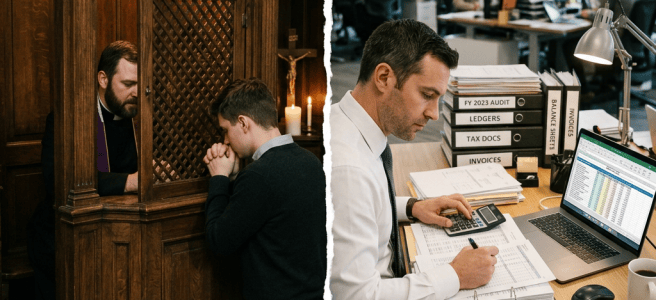
Priest hearing confession beside accountant reviewing FY 2023 audit, ledgers, tax docs, and invoices

I have a confession to make: when I hear “financial audit,” my soul leaves the room and looks for snacks. An audit sounds like spreadsheets, fluorescent light, and somebody asking why a receipt from March is labeled “miscellaneous.” Yet confession and an audit share a surprisingly useful first move: they ask us to stop editing the story.

In the Catholic understanding, confession is not a performance of shame. The Catechism calls it an examination of conscience, followed by the honest disclosure of what we have done, so that responsibility and reconciliation become possible. The point is not to discover that a person is secretly terrible. It is to bring the truth into the light, where healing can begin. You can read the relevant sections in the Catechism’s account of the penitent’s acts.

An audit begins with a different kind of account, but the discipline is familiar. Management prepares the financial statements; an independent auditor examines them, tests evidence, and issues an opinion about whether they are fairly presented. The SEC’s plain-language guide to auditors is refreshingly clear about the arrangement: the people inside the company tell the story, while an outside professional checks whether the story can bear weight.

That distinction matters. A priest is not a CPA with better lighting, and God is not an investor comparing quarterly reports. Confession is sacramental and relational; an audit is professional assurance for people who need reliable financial information. Still, both practices resist the fantasy that what remains unspoken somehow does not count.

Here is where the comparison gets practical. In an audit, “material” does not simply mean “large.” A small error can matter if it changes the reader’s understanding. Our inner bookkeeping works the same way. The sharp comment we call “just stress.” The purchase we call “a one-time thing” for the seventh time. The resentment we file under “I’m fine.” Each item may look small in isolation. Together, they can reveal the habits shaping the whole household.

And neither process ends with noticing. The AICPA explains that an audit provides high, but not absolute, assurance; it produces a report that helps others make decisions. Confession, too, is aimed at a future—not merely a perfectly itemized past. The AICPA’s explanation of audits emphasizes evidence and judgment, not magical certainty. The Catechism pairs confession with satisfaction: repair what can be repaired, accept a penance, and practice a different way forward.

What happened? We hid, minimized, or misclassified something. What did it mean? The hidden line item was forming us, quietly and faithfully. What can we carry forward? Try a ten-minute weekly review: name one financial choice, one relationship, and one habit without defending yourself. Then choose one small repair. No dramatic vows. Just an honest ledger and the next faithful entry.

“What confession has in common with a financial audit.”

The Examen and the Expense Report: A Better Way to End the Day

Open journal with handwritten notes, lit candle, smartphone, books, and cup of tea on wooden table at dusk

I have two end-of-day rituals, at least in theory. One is spiritual: the examen, that quiet Ignatian habit of looking back over the day with God. The other is financial: opening the bank app and asking where the money went. One sounds holy. The other sounds like a small punishment invented by a spreadsheet.

But they have more in common than I expected. Both are practices of attention. Both ask us to stop guessing and look honestly at the day we actually lived—not the day we intended to live, or the budget we intended to keep.

The daily review is not a courtroom

The Jesuits describe the Ignatian Examen as a prayerful review: become aware of God’s presence, give thanks, notice what happened, and look toward tomorrow. The point is not to produce a perfect scorecard. It is to become more awake to where we were alive, distracted, generous, anxious, or quietly carried.

A financial review works best with the same posture. Start with the facts: the grocery run, the subscription renewal, the restaurant charge that seemed harmless until it joined its twelve little cousins. Then ask a gentler question than “What is wrong with me?” Ask: “What was I seeking?” Convenience? Rest? Belonging? A reward after a long day? The numbers are not a moral verdict. They are clues.

Attention turns into agency

The Consumer Financial Protection Bureau recommends tracking spending for at least two weeks, or even a month, so patterns become visible. That is a wonderfully unglamorous form of freedom. You cannot choose what to change until you can see what is happening.

This is where the spiritual and financial reviews meet. In the examen, I might notice that a certain conversation left me impatient. In the ledger, I might notice that the same kind of day ends with delivery food and late-night shopping. Neither observation is the whole story. Together, they might reveal a need for a better pause before I reach for the easiest relief.

And “better” does not have to mean dramatic. Investor.gov suggests keeping track of income and expenses and including savings in the picture. For tonight, that could mean writing down three purchases, one gratitude, and one small adjustment for tomorrow. No overhaul. No financial monasticism. Just a little light.

What happened, what it meant, what to carry forward

What happened? I spent the day making choices, some deliberate and some automatic. What did it mean? My attention—and my money—moved toward whatever felt urgent, comforting, or important in the moment. What can I carry forward? A five-minute review, done without self-contempt, can turn a blur into a pattern. A pattern can become a choice.

Tonight, before closing the banking app, try one question from each practice: “Where did I receive a gift today?” and “What did my spending say mattered?” The answers may not match perfectly. That is not failure. That is information—and information is a decent place to begin again.

The Riskiest Servant in the Bible Might Be the Hero You Forgot

Single coin buried in soil, light above

I always assumed the “bad guy” in the Parable of the Talents was obvious — the servant who buried his money in the ground, out of laziness. Then I actually sat with the text again in Matthew 25:14-30, and I noticed something I’d skipped for twenty years: the master doesn’t scold him for being lazy. He scolds him for being afraid.

“I knew you were a hard man,” the servant says, basically accusing his boss of being the kind of guy who’d fire you over a bad quarter. So he did the safest thing available — he buried the money, kept it exactly intact, and handed it back penny for penny. No loss. No embarrassment. No risk.

And that’s the servant who gets called “wicked and slothful.”

Here’s the part that stopped me mid-coffee: the two servants who doubled their money took real risk to do it. First-century “trading” wasn’t a savings account — it meant loaning capital, backing ventures, betting the harvest would come in. As The Catholic Herald points out, this parable isn’t really a finance seminar in disguise. It’s a parable about fear disguised as caution.

I think about this every time I explain to my kids why we don’t keep all our savings under the mattress — and also every time I catch myself doing the spiritual version of burying a talent. Not using a gift because someone might criticize it. Not writing the song, not sending the blog post, not saying the prayer out loud, because staying safe feels responsible.

Ray Stedman’s reading of this parable puts it plainly: the sin here isn’t losing money. It’s refusing to risk anything at all in service of something bigger than yourself.

That reframes stewardship for me. I used to think good stewardship meant protecting what I’ve been given — keep it safe, don’t waste it, hand it back in one piece. Turns out the parable’s definition of good stewardship is closer to the opposite: put it to work, accept that work carries risk, and trust the One who gave it to you in the first place.

What happened: I reread a parable I thought I already understood.

What it meant: the “safe” choice in the story wasn’t safe at all — it was the only choice that produced zero fruit.

What I’m carrying forward: the next time I feel the urge to bury something — a dollar, a talent, an idea — I want to ask whether I’m being prudent, or just scared with better branding.

(And if you’re the one in your family who still keeps cash in a coffee can — I see you. I’m not judging. I’m just going to gently suggest an index fund.)