The Audit Trail of the Soul

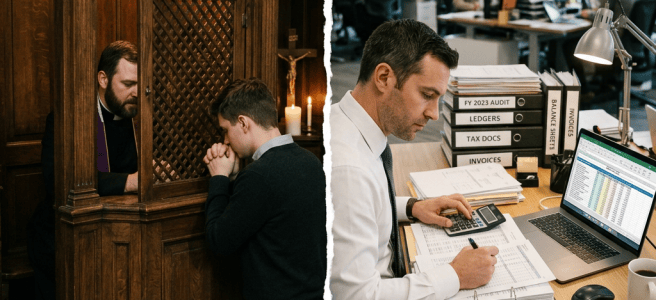
Priest hearing confession beside accountant reviewing FY 2023 audit, ledgers, tax docs, and invoices

I have a confession to make: when I hear “financial audit,” my soul leaves the room and looks for snacks. An audit sounds like spreadsheets, fluorescent light, and somebody asking why a receipt from March is labeled “miscellaneous.” Yet confession and an audit share a surprisingly useful first move: they ask us to stop editing the story.

In the Catholic understanding, confession is not a performance of shame. The Catechism calls it an examination of conscience, followed by the honest disclosure of what we have done, so that responsibility and reconciliation become possible. The point is not to discover that a person is secretly terrible. It is to bring the truth into the light, where healing can begin. You can read the relevant sections in the Catechism’s account of the penitent’s acts.

An audit begins with a different kind of account, but the discipline is familiar. Management prepares the financial statements; an independent auditor examines them, tests evidence, and issues an opinion about whether they are fairly presented. The SEC’s plain-language guide to auditors is refreshingly clear about the arrangement: the people inside the company tell the story, while an outside professional checks whether the story can bear weight.

That distinction matters. A priest is not a CPA with better lighting, and God is not an investor comparing quarterly reports. Confession is sacramental and relational; an audit is professional assurance for people who need reliable financial information. Still, both practices resist the fantasy that what remains unspoken somehow does not count.

Here is where the comparison gets practical. In an audit, “material” does not simply mean “large.” A small error can matter if it changes the reader’s understanding. Our inner bookkeeping works the same way. The sharp comment we call “just stress.” The purchase we call “a one-time thing” for the seventh time. The resentment we file under “I’m fine.” Each item may look small in isolation. Together, they can reveal the habits shaping the whole household.

And neither process ends with noticing. The AICPA explains that an audit provides high, but not absolute, assurance; it produces a report that helps others make decisions. Confession, too, is aimed at a future—not merely a perfectly itemized past. The AICPA’s explanation of audits emphasizes evidence and judgment, not magical certainty. The Catechism pairs confession with satisfaction: repair what can be repaired, accept a penance, and practice a different way forward.

What happened? We hid, minimized, or misclassified something. What did it mean? The hidden line item was forming us, quietly and faithfully. What can we carry forward? Try a ten-minute weekly review: name one financial choice, one relationship, and one habit without defending yourself. Then choose one small repair. No dramatic vows. Just an honest ledger and the next faithful entry.

“What confession has in common with a financial audit.”

The Catholic Case for Boring, Patient Investing

Tree on hill changing through winter, spring, summer, and autumn

I have a confession to make: I find “boring” reassuring. Give me a quiet Saturday, a pot of coffee, and an investment plan that does not require me to check my phone every twelve minutes. My younger self wanted a financial life with plot twists. My current self would like fewer plot twists, please.

That is one way into the Catholic case for patient investing. It is not a promise that markets will behave, or that every fund deserves a halo. It is a question of formation: What kind of person does my money practice me into becoming?

Patience is not passivity

Patient investing still makes choices. You decide what the money is for, how much risk you can bear, and what you are unwilling to support. The United States Conference of Catholic Bishops’ investment guidelines hold those pieces together: responsible financial stewardship, a reasonable return, prudence about risk, and attention to human dignity and the common good.

That is a sturdier picture than “maximize everything.” A return matters because resources support real obligations: a family, a parish, a future act of generosity. But the return is not the only question. The old Catholic word is stewardship, which means the money is entrusted to us, not enthroned over us.

Slow is a strategy

In practical terms, boring often looks like regular contributions, broad diversification, and a long time horizon. Investor.gov defines dollar-cost averaging as investing equal portions at regular intervals, regardless of market ups and downs. You buy more when prices are lower and less when they are higher. It is not magic. It is a way to keep one anxious afternoon from running the whole household.

FINRA explains that asset allocation and diversification can help manage investment risk by spreading money among and within asset classes. That does not make losses impossible; it does make the portfolio less dependent on one heroic bet. Even the phrase “heroic bet” sounds like something that ends with a lesson and a repair bill.

None of this means ignoring companies, communities, or conscience. A patient investor can read a fund’s holdings, ask how a manager votes, and decide which harms are incompatible with the family’s principles. Patience gives discernment time to work. Speculation often gives impatience a costume.

What is being formed?

What happened? I put money into a future I cannot see, then watched prices wiggle as if they knew I was watching. What did it mean? The account was never just a scoreboard; it was training my attention, my appetite, and my sense of enough. What can I carry forward? A simple rule: automate what serves the plan, review what deserves discernment, and refuse to confuse excitement with wisdom.

Perhaps the most countercultural investment move is not finding the next miracle. It is becoming the kind of person who can keep a promise across an ordinary Tuesday. What is your money asking you to practice: patience, prudence, generosity, or a little less phone-checking?

The Examen and the Expense Report: A Better Way to End the Day

Open journal with handwritten notes, lit candle, smartphone, books, and cup of tea on wooden table at dusk

I have two end-of-day rituals, at least in theory. One is spiritual: the examen, that quiet Ignatian habit of looking back over the day with God. The other is financial: opening the bank app and asking where the money went. One sounds holy. The other sounds like a small punishment invented by a spreadsheet.

But they have more in common than I expected. Both are practices of attention. Both ask us to stop guessing and look honestly at the day we actually lived—not the day we intended to live, or the budget we intended to keep.

The daily review is not a courtroom

The Jesuits describe the Ignatian Examen as a prayerful review: become aware of God’s presence, give thanks, notice what happened, and look toward tomorrow. The point is not to produce a perfect scorecard. It is to become more awake to where we were alive, distracted, generous, anxious, or quietly carried.

A financial review works best with the same posture. Start with the facts: the grocery run, the subscription renewal, the restaurant charge that seemed harmless until it joined its twelve little cousins. Then ask a gentler question than “What is wrong with me?” Ask: “What was I seeking?” Convenience? Rest? Belonging? A reward after a long day? The numbers are not a moral verdict. They are clues.

Attention turns into agency

The Consumer Financial Protection Bureau recommends tracking spending for at least two weeks, or even a month, so patterns become visible. That is a wonderfully unglamorous form of freedom. You cannot choose what to change until you can see what is happening.

This is where the spiritual and financial reviews meet. In the examen, I might notice that a certain conversation left me impatient. In the ledger, I might notice that the same kind of day ends with delivery food and late-night shopping. Neither observation is the whole story. Together, they might reveal a need for a better pause before I reach for the easiest relief.

And “better” does not have to mean dramatic. Investor.gov suggests keeping track of income and expenses and including savings in the picture. For tonight, that could mean writing down three purchases, one gratitude, and one small adjustment for tomorrow. No overhaul. No financial monasticism. Just a little light.

What happened, what it meant, what to carry forward

What happened? I spent the day making choices, some deliberate and some automatic. What did it mean? My attention—and my money—moved toward whatever felt urgent, comforting, or important in the moment. What can I carry forward? A five-minute review, done without self-contempt, can turn a blur into a pattern. A pattern can become a choice.

Tonight, before closing the banking app, try one question from each practice: “Where did I receive a gift today?” and “What did my spending say mattered?” The answers may not match perfectly. That is not failure. That is information—and information is a decent place to begin again.