The Warrior Way of a Boring Budget

Samurai helmet, sword, and glazed doughnut on a wooden table

I once saw a coffee mug that said, “Train like a samurai.” It was beside a plate of office doughnuts. I admired the ambition and ate the doughnut.

Still, the question is useful: what would a warrior ethic have to do with a household budget?

First, a small historical brake pedal. Bushido is often presented as one timeless Japanese code. It was not quite that tidy. A University of British Columbia study notes that premodern warriors did not share one universally accepted ethic; ideas and loyalties shifted by era and region. Even the word bushido appears late and changed meaning over time. Britannica’s overview likewise traces a changing tradition, shaped by Buddhist and Confucian thought and later repurposed for modern national instruction.

So this is not an attempt to turn your 401(k) into a miniature castle keep. It is a modest borrowing: a few virtues, translated carefully into ordinary money decisions.

1. Frugality is freedom, not a costume.

Frugal living was among the qualities associated with Bushido in later summaries. In personal finance, that does not mean performing poverty or refusing every pleasant thing. It means making enough room between income and spending that a surprise bill does not become a personal crisis. A budget is less a punishment than a little patch of open ground.

2. Discipline beats mood.

The samurai image is all dramatic resolve: rain, sword, excellent posture. Most financial progress is less cinematic. It is an automatic transfer on payday, repeated while you are tired, distracted, or mildly annoyed. Investor.gov recommends automatic deposits to an emergency fund and regular investing over time, even suggesting a fixed affordable amount or a portion such as 5% or 10% of income. The virtue here is not intensity. It is returning to the practice.

3. Courage includes refusing the exciting mistake.

Courage in investing is not clicking “buy” on the loudest story in the room. Sometimes it is declining a hot tip, paying down expensive debt, or keeping emergency savings somewhere boring and accessible. The brave choice may look, from the outside, like nothing happened. That is often the point.

4. Loyalty needs a better object.

Historical Bushido could place supreme loyalty in a lord or state. We should not import that hierarchy into family finances. But we can ask what our money serves: a child’s stability, a spouse’s breathing room, a future self who may be sick or between jobs. A savings plan is a small declaration of allegiance to people and purposes beyond today’s impulse.

What happened? A varied warrior tradition was later gathered into a powerful story about character. What did it mean? Discipline is not a personality trait reserved for heroes; it is a structure that helps ordinary people keep promises. What can we carry forward? Choose one quiet practice: an automatic transfer, a weekly spending check, or a 24-hour pause before a major purchase.

No sword required. The doughnut remains optional.

Discipline Is a Practice; Self-Punishment Is a Trap

Stacked stones on a moss-covered rock beside a forest stream

I have occasionally confused discipline with being mean to myself. The evidence was compelling: a stern inner monologue, a new rule written in permanent ink, and the temporary satisfaction of feeling like a tiny prison warden. Very productive. Very exhausting.

But discipline and self-punishment are not twins. They are more like cousins who show up to the same family reunion wearing identical sweaters.

Discipline asks, “What helps me practice the good?”

Discipline is a structure that serves a value. I go for the walk because I want to be present for my family. I set a bedtime because tomorrow’s version of me deserves a functioning brain. I put money aside because generosity and stability both need somewhere to stand. The practice may be boring. That is not a bug. Boring is often where character gets its work clothes.

Self-punishment asks a different question: “How can I make failure hurt enough to prove I am serious?” It turns a missed workout, a sharp word, or a wasted hour into a courtroom. The verdict is not merely “I did something unhelpful.” It becomes “I am the kind of person who cannot be trusted.” That is a heavy sentence to carry into the next attempt.

The distinction matters because motivation has different flavors. In their overview of Self-Determination Theory, psychologists Richard Ryan and Edward Deci distinguish motivation supported by autonomy, competence, and relatedness from motivation driven by pressure and control. A rule we freely connect to a meaningful value can become a home. A rule enforced only by fear becomes a landlord who never fixes anything.

This is where self-compassion enters—not as a scented candle for people who have given up, but as a way of staying honest without becoming cruel. The American Psychological Association’s review of self-compassion research notes that it can be learned and is associated with well-being, relationships, physical health, and learning. In other words, treating yourself like a fellow human being is not the same as handing yourself a trophy for showing up late.

Self-compassion still tells the truth. I missed the deadline. I was impatient with my child. I spent money I meant to save. Then it adds the sentence punishment leaves out: I can repair this and practice differently next time.

A small examen for the next stumble

What happened? Name the event without adding a biography. “I skipped the plan” is usually more useful than “I never follow through.”

What did it mean? Maybe the goal was too vague. Maybe the day was overloaded. Maybe you were avoiding discomfort. Curiosity gives you information; shame mostly gives you volume.

What can I carry forward? Keep the standard, change the next step. Make the walk shorter. Move the savings transfer to payday. Apologize before composing the director’s cut of your defense.

Research on self-compassion describes it as a healthier way to relate to oneself, one that can support initiative rather than excuse passivity. That sounds like the formation I want: not a softer life, necessarily, but a sturdier way to return to it.

What happened? I failed at a practice. What did it mean? I am still being formed. What will I carry forward? Discipline can hold the line without picking up a stick.

Formation Happens in Seasons, Not Sprints

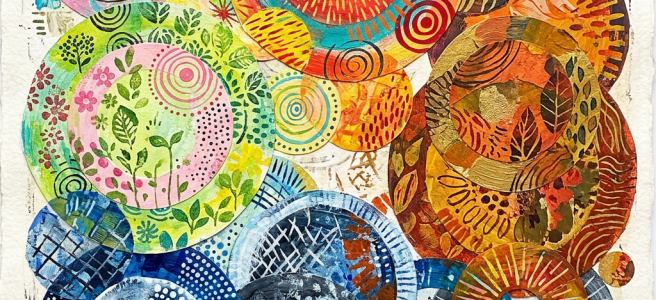
Colorful abstract artwork featuring overlapping patterned circles and botanical motifs

I have a bad habit of treating my life like a software launch. Pick a goal, announce the goal, buy the notebook, and expect a new personality by Thursday. The notebook is usually beautiful. The personality remains in beta.

That is why the Christian liturgical year keeps catching my attention. It does not ask us to become a finished person in one heroic burst. It gives us a rhythm. The United States Conference of Catholic Bishops describes a cycle of seasons and saints that returns again and again: Advent, Christmas, Lent, the Triduum, Easter, and Ordinary Time. The point is not merely to remember dates. The cycle is meant to draw people into the mystery of Christ and into lives shaped by it.

Formation is repetition with meaning

Modern life loves the sprint. Thirty days to a new body. Ninety days to a new business. One inspirational podcast to a new soul. Some of these promises are useful. Most are wearing very fast shoes.

A season works differently. It gives a theme enough time to sink below the level of a slogan. Advent, for example, is not simply a countdown to Christmas. The USCCB presents it as a four-week season of preparation for both Christ’s birth and his promised return, a time of alertness, hope, and a heart made quieter. You do not “win” Advent. You practice receiving it.

Historically, this rhythm grew rather than dropped from the sky fully assembled. Britannica traces Sunday worship to the apostolic age and describes how other observances and seasons developed over centuries. That matters. It means formation can be organic. A community repeats what helps it remember, then refines the repetition until the calendar becomes a kind of shared memory.

The long middle counts

We tend to notice beginnings and endings. New Year’s Day. Graduation. Retirement. Before-and-after photos. But the long stretch called Ordinary Time makes a quieter claim: ordinary days are not empty space between meaningful events. They are where a life is practiced. Scripture is heard. Patience is attempted. We fail, apologize, and try again without a dramatic soundtrack.

This is good news for anyone whose progress feels unimpressive. A season gives you permission to return. You can begin Lent tired. You can enter Easter still carrying questions. You can come back to prayer after missing a week without issuing a press release about your spiritual collapse.

What happened, what it meant, what to carry forward

What happened? I kept trying to force change through intensity. What did it mean? I had confused urgency with faithfulness. What can I carry forward? Choose one season-shaped practice for the next few weeks: a Sunday review, a short daily prayer, a weekly act of generosity, or simply five minutes of silence before the phone gets a vote.

Do not demand a new self by Thursday. Return to the practice next week. Then the week after that. A life is not formed in a sprint. It is formed by what we keep coming back to.

Character Is Built in the Boring Reps

Glowing outline of a walking person over a mountainous valley at night

I used to think character showed up in the dramatic moments. The honest answer in the meeting. The brave decision. The cinematic pause before doing the right thing. Then I became a parent and discovered that most character is formed while somebody is asking for a snack.

The prompt on my desk says 10,000 small repeated choices. That number is not a scientific speed limit. It is a useful nudge: formation is usually less like a lightning strike and more like a path across a lawn. You walk it again and again, often without noticing that the grass is changing.

Habit researchers describe something similar. In a real-world study, people practiced a chosen eating, drinking, or activity behavior each day in a consistent context. Automaticity grew gradually, but at very different speeds: the time to reach a person’s plateau ranged from 18 to 254 days. Missing one opportunity did not ruin the process. Repetition mattered, but perfection was not the price of admission. The study is a helpful antidote to the internet’s favorite habit myth—that everyone needs exactly 66 days, or some other magic number.

That distinction matters for character. A child who puts one book back on the shelf is not becoming a librarian overnight. A spouse who pauses before answering is not suddenly a saint. But each small act is practicing a response. The cue arrives, and a slightly better path becomes easier to find.

There is some evidence that the practice itself can strengthen self-regulation. In one study, college students spent two weeks practicing a small exercise such as monitoring posture, regulating mood, or recording what they ate. Compared with a control group, the exercise groups improved on a later measure of self-regulatory capacity. The result was modest, not magical. Still, it suggests that discipline is not only a personality trait we either inherited or missed in the family raffle.

More recent work helps explain why repetition works: practice can strengthen the link between a recurring cue and a response. Researchers found that greater task practice was associated with stronger cue-response associations, which in turn supported performance. The brain learns the route we keep taking.

So what might this look like at home? Pick one tiny response and give it a familiar doorway. After dinner, ask one good question before reaching for the phone. When a mistake is named, say, “Thank you for telling me,” before explaining. On Sunday night, write down one thing you received and one thing you repaired. The point is not to turn the household into a monastery with better snacks. It is to make the next faithful move visible.

At the end of the day, an examen can be wonderfully ordinary: What happened? Where did I repeat an old groove? Where did grace—or simple patience—open a new one? What did it mean? That the small choices were not small to the people living inside them. What can I carry forward? One repeatable act, attached to a real moment, with room to miss once and begin again.

Ten thousand is a lot of choices. Fortunately, we only have to make the next one.