The Tea Ceremony’s Quiet Lesson: Attention Is a Way of Life

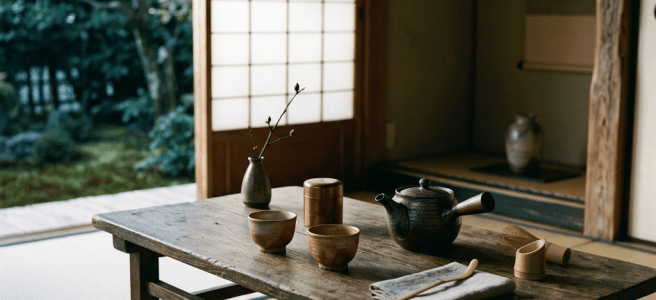
Tea table with teapot, cups, whisk, and vase beside a Japanese garden

I have a bad habit of drinking tea while doing three other things. I answer a message, glance at the news, and then wonder why the cup went cold. This is not a failure of tea. The tea has been giving me a perfectly clear assignment. I just keep submitting the wrong homework.

Chanoyu—often translated as “hot water for tea”—is a Japanese practice that turns an ordinary act into a carefully held encounter. The Metropolitan Museum of Art describes a small tea room where host, guests, utensils, garden, and season meet. The room is intimate. The movements are choreographed. The gathering is never quite repeated.

That last part matters. The Asian Art Museum’s teaching guide explains the phrase ichi-go ichi-e—“one time, one meeting”—as an awareness that each gathering is once in a lifetime. Not because the world is dramatic every minute, but because this minute is not coming back. The tea bowl in your hands is not a prop. It is the thing happening now.

The practice is not casual about attention. Before the tea arrives, the guest notices the scroll, the flowers, the kettle, the brazier. The host purifies the utensils and prepares the bowl in front of everyone. Guests watch with all five senses. Even the beautiful front of the bowl is turned away before drinking, then returned to face the host. Courtesy is taught through the hands before it is explained by the mouth.

Sen no Rikyu’s famous seven rules are wonderfully plain: make a satisfying bowl of tea; heat the water well; offer warmth in winter and coolness in summer; arrange flowers as they grow in the field; prepare ahead; be ready for rain; and show utmost consideration to your guests. The MIT Japanese Tea Ceremony page preserves the list. It sounds less like mysticism than good hosting. Which may be why it is so difficult. Most of us can manage one thoughtful gesture. The formation comes from making thoughtfulness the shape of the room.

The four principles often associated with the Way of Tea—wa (harmony), kei (respect), sei (purity), and jaku (tranquility)—are not four inspirational posters. They are a sequence. Attend to the setting and the other person. Clear what distracts. Then, sometimes, calm arrives. As the Association for Asian Studies notes, the methodical ritual cultivates respect, connection, and being “present in the present.”

What happened? Someone made tea with enough care for a simple cup to become an encounter. What did it mean? Attention is not merely a personality trait; it is a practice, reinforced by rooms, rituals, and repeated gestures. What can I carry forward? Perhaps one cup today with the phone in another room. No grand transformation. Just hot water, a little patience, and the courtesy of actually arriving.

Before Self-Help, There Was Apprenticeship

Two woodworkers assembling a wooden frame at a workshop bench

I have bought enough self-help books to build a small, slightly judgmental bookshelf. Most promise a better life through a plan: wake earlier, track the habit, optimize the morning. Useful, sometimes. But before we learned to call everything a system, people learned by standing near someone who already knew how to do the thing.

That older pattern was apprenticeship. Not a weekend course. Not a motivational quote over a photo of a mountain. You watched, copied, failed, received correction, and tried again. The point was not merely to collect information. It was to become the sort of person who could notice what mattered and respond well.

In early modern Europe, apprenticeship was probably the largest organized form of learning available to ordinary people, and artisans commonly began that way, according to historian Patrick Wallis in Science in Context. The arrangement was imperfect. Masters did not always teach systematically. Apprentices had to find other workshops, books, and teachers. Still, the workshop gave learning a place, a rhythm, and a human face.

The same logic lives in music. A young player does not become a musician by downloading every scale chart. She listens to a teacher phrase a line, tries it, hears where it goes flat, and discovers that “almost right” is a useful address. Modern learning researchers call this cognitive apprenticeship: authentic work beside someone more experienced, with scaffolding, reflection, and even productive failure. In plain English, you get better by doing the real thing with company.

Faith has an apprenticeship shape, too. In the Gospel accounts, Jesus does not simply hand the disciples a syllabus and wish them luck. He says, “Come, follow me.” They watch him pray, teach, welcome, confront, rest, and serve. Then they are sent to practice. One theological account describes those three years of following, watching, and hearing as a kind of theological apprenticeship, aimed at preparing the disciples to continue the work. The pattern is wonderfully concrete: learn a way of life by living near it.

The American story kept this practical tradition in view. The U.S. Department of Labor’s history points to George Washington, Benjamin Franklin, and Paul Revere as early apprentices who later became nationally known. The detail is almost funny: before the résumé, before the personal brand, there was a master, a bench, and a beginner doing the unglamorous work.

What happened? People were formed in proximity to a craft, a community, or a teacher. What did it mean? Skill was never only a private possession; it carried a responsibility to pass something on. What might we carry forward? Choose one practice you respect and find a living example: a musician, craftsperson, elder, or faithful friend. Watch closely. Try the work. Let correction be a gift instead of a verdict. A life may still need goals, but it probably needs a few good teachers more.

The Quiet Practice of Becoming

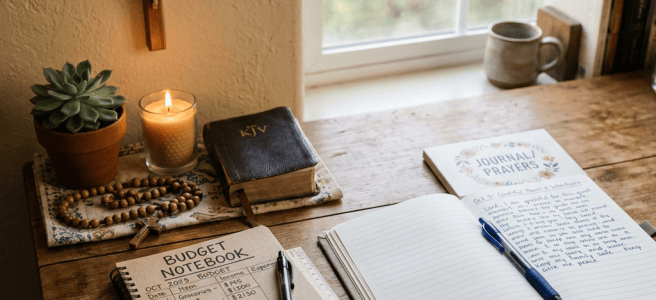
Desk with Bible, prayer journal, budget notebook, rosary, candle, and plant

I have a confession: I like the idea of a new habit much more than I like the middle of one. The beginning has fresh notebooks and heroic promises. The middle has Tuesday, a tired brain, and an instrument that sounds like it is filing a formal complaint.

But most of a life is built in that middle. Not by one grand decision, but by the small thing we return to when nobody is applauding. Prayer. A budget. Scales on a piano. These can look unrelated from the outside. Inside, they are all practices of attention.

Prayer, at its most ordinary, is not a performance review for God. It is a way of coming back. The same chair. The same few quiet minutes. The same honest question: What was moving in me today? Repetition does not make the moment empty. It gives the heart a familiar doorway.

A budget works in a surprisingly similar way. The Consumer Financial Protection Bureau recommends starting with a complete picture of income, spending, and bill timing, then making a working plan and adjusting it as life changes. That is less like building a cage and more like turning on the kitchen light. We are not trying to become perfectly predictable people. We are trying to see clearly enough to choose.

The same humility helps with an instrument. Practice is not merely “putting in the hours.” A meta-analysis of research on musical achievement found a meaningful relationship between task-relevant practice and musical performance, while also reminding us that practice is structured, goal-directed work—not magical time served. Ten distracted minutes and ten attentive minutes may share a clock, but they do not share a result. The metronome is a stern little uncle.

This is where long-term formation differs from self-punishment. Self-punishment asks, “How can I make myself pay for failing?” Discipline asks, “What small structure would help me return?” One tightens the knot. The other leaves a path back home.

And please, let us retire the fantasy that a habit becomes permanent after 21 days. In a real-world study summarized by University College London, automaticity took an average of 66 days—and the range varied widely from person to person. Missing one day did not erase the process. The lesson is not to worship a streak. It is to keep practicing the return.

What happened? We repeated small acts until they became easier to recognize and re-enter. What did it mean? Our routines were quietly teaching us what deserves attention. What can we carry forward? Pick one practice, make it modest, attach it to a real part of the day, and review it without drama.

Tonight, perhaps, pray for five minutes. Look at the last week of spending without flinching. Play one scale slowly. Becoming is rarely loud. Most days, it sounds like showing up again.

Character Is Built in the Boring Reps

Glowing outline of a walking person over a mountainous valley at night

I used to think character showed up in the dramatic moments. The honest answer in the meeting. The brave decision. The cinematic pause before doing the right thing. Then I became a parent and discovered that most character is formed while somebody is asking for a snack.

The prompt on my desk says 10,000 small repeated choices. That number is not a scientific speed limit. It is a useful nudge: formation is usually less like a lightning strike and more like a path across a lawn. You walk it again and again, often without noticing that the grass is changing.

Habit researchers describe something similar. In a real-world study, people practiced a chosen eating, drinking, or activity behavior each day in a consistent context. Automaticity grew gradually, but at very different speeds: the time to reach a person’s plateau ranged from 18 to 254 days. Missing one opportunity did not ruin the process. Repetition mattered, but perfection was not the price of admission. The study is a helpful antidote to the internet’s favorite habit myth—that everyone needs exactly 66 days, or some other magic number.

That distinction matters for character. A child who puts one book back on the shelf is not becoming a librarian overnight. A spouse who pauses before answering is not suddenly a saint. But each small act is practicing a response. The cue arrives, and a slightly better path becomes easier to find.

There is some evidence that the practice itself can strengthen self-regulation. In one study, college students spent two weeks practicing a small exercise such as monitoring posture, regulating mood, or recording what they ate. Compared with a control group, the exercise groups improved on a later measure of self-regulatory capacity. The result was modest, not magical. Still, it suggests that discipline is not only a personality trait we either inherited or missed in the family raffle.

More recent work helps explain why repetition works: practice can strengthen the link between a recurring cue and a response. Researchers found that greater task practice was associated with stronger cue-response associations, which in turn supported performance. The brain learns the route we keep taking.

So what might this look like at home? Pick one tiny response and give it a familiar doorway. After dinner, ask one good question before reaching for the phone. When a mistake is named, say, “Thank you for telling me,” before explaining. On Sunday night, write down one thing you received and one thing you repaired. The point is not to turn the household into a monastery with better snacks. It is to make the next faithful move visible.

At the end of the day, an examen can be wonderfully ordinary: What happened? Where did I repeat an old groove? Where did grace—or simple patience—open a new one? What did it mean? That the small choices were not small to the people living inside them. What can I carry forward? One repeatable act, attached to a real moment, with room to miss once and begin again.

Ten thousand is a lot of choices. Fortunately, we only have to make the next one.