Boredom Is Not Empty: The Quiet Practice of Staying Put

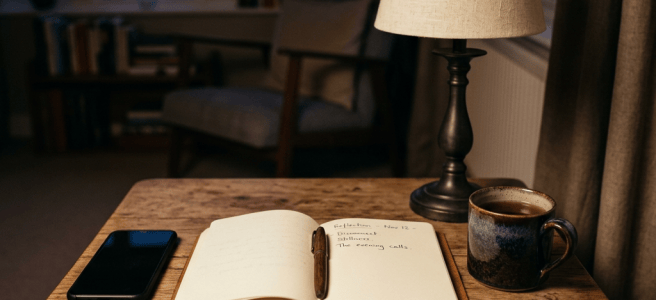
Open journal with handwritten notes beside coffee, phone, and lit lamp

The Prompt Bank asks about “the forgotten discipline of boredom” and why constant stimulation might stunt formation. My own field research is mostly waiting for the kettle to boil: I reach for my phone before the water has even remembered it is hot. The pause feels tiny. The reflex is not.

We do not have to make boredom noble. It can be uncomfortable, even painful. And it is not automatically a doorway to genius. But perhaps the first question is not “How do I get rid of this feeling?” It might be “What is this feeling telling me about the way I am living?”

A University of New Hampshire account of two small experiments describes participants who watched a brief boring video before returning to a divergent-thinking task. In those experiments, they sometimes produced more answers or more unique answers than people who watched an engaging video. That is interesting, not a universal law: the task was specific, and a few minutes of laboratory boredom are not the same as a hard season of life.

The caution matters. In a 2023 essay in Frontiers in Sociology, philosopher Josefa Ros Velasco includes “boredom makes us more creative” among the familiar claims about boredom that deserve scrutiny. So let’s not turn a dull afternoon into a wellness prescription. Sometimes the right move is to change the task, ask for help, or rest.

Still, constant stimulation can train a quick escape hatch. A quiet moment arrives; a screen appears. A difficult paragraph arrives; another tab opens. No single choice tells the whole story. Repeated often, though, the choices teach us what to do with the first hint of friction. We become practiced—not bad, just practiced—at leaving before we have noticed what is happening inside us.

Formation often happens in these unremarkable seconds. Try washing one dish without a video playing. Walk from the car to the door without filling the silence. Let the elevator ride be an elevator ride. Not as a challenge to win, and certainly not to prove you are more disciplined than the rest of us. Just notice the itch to fill the space. What are you hoping the next thing will do for you?

There is a useful distinction between making room for a pause and pretending every kind of boredom should be endured. If a routine is empty, perhaps it needs meaning or change. If a person is isolated or overwhelmed, “sit with it” may be the wrong counsel. The practice is attention, not stoicism: see the signal, then choose a response.

What happened: a few seconds with nothing demanding us. What it meant: maybe we were tired, maybe restless, maybe simply unused to quiet. What to carry forward: leave one small gap unfilled today, and listen before you reach. If boredom has something to say, we can at least let it finish the sentence.
The Song in the Prompt: What Suno Can Make—and What a Human Still Has to Mean

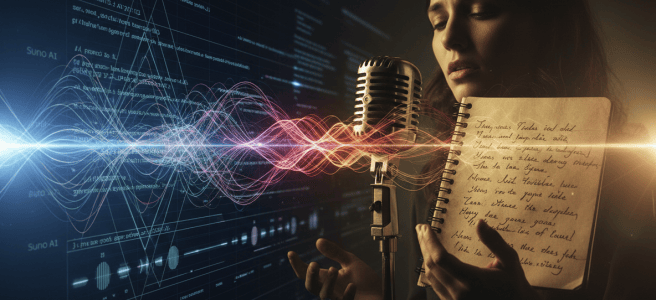
Editorial featured image for an article about Suno AI music generation and human creativity. Split composition: on the left, abstract code, algorithms, glowing waveform data, and digital audio controls; on the right, handwritten lyrics, a vintage microphone, and a human performer’s emotional creative presence. The two halves blend through colorful musical waveforms. Sophisticated, thought-provoking, album-cover-inspired, cinematic lighting, no readable text, landscape orientation.

I made a song with Suno the other day. “Made” may be doing a little heavy lifting there. I typed a mood, a subject, and a few musical breadcrumbs; the machine handed me a finished track before I had time to locate my reading glasses.

That is Suno’s genuine trick. Its own how-to guide says a user can describe a genre, mood, instrumentation, tempo, or lyrics, and the system will generate a song with structure, instruments, and vocals. It returns two versions. You pick one, revise, extend, and try again. For the first ten minutes, it feels like having a very fast studio band that never asks whether you have paid the deposit.

And yet, “fast” is not the same as “deep.” Suno is excellent at turning a direction into an object. It can give you atmosphere, polish, and a surprisingly convincing chorus. It can help a stuck songwriter get unstuck. It can also produce the musical equivalent of a handsome hotel lobby: pleasant, competent, and hard to remember once you leave.

The human songwriter is doing something stranger. She is not merely arranging sounds. She is deciding which embarrassment to keep. Which line is too true. Which silence belongs before the chorus because that is where the father stopped calling, or the marriage ended, or the kid finally came home. A songwriter brings consequences to the room. The song is shaped not only by taste, but by a life that has had to live with its choices.

There is some evidence for this distinction, with an important asterisk. A 2026 MIT Media Lab report on a controlled study of 152 participants compared SunoAI tracks with music by human composers in calming and energizing settings. Human-composed music elicited the target emotions more effectively, even when listeners said they preferred the AI music. That is not a verdict on every song, or every listener. It is a useful reminder that liking a sound and being moved by it are not always the same thing.

There is another wrinkle. The U.S. Copyright Office’s January 2025 report says human authorship is required for copyright protection. Under current generally available technology, a prompt alone usually does not give a user enough control over the expressive elements to make that user the author of the output. Human-written lyrics, creative arrangement, and substantial edits can matter. Typing “make it sadder” 117 times is not, by itself, a songwriting apprenticeship.

So what happened? A machine made a very usable musical sketch. What did it mean? The sketch was not the same thing as a song with a history. What can we carry forward? Use the tool for speed, surprise, and play. Then bring the part no model can supply on command: attention to a particular life.

And before you release anything, check the rules. Suno’s rights-and-ownership guidance says free-plan songs are for personal, non-commercial use, while songs made while subscribed to Pro or Premier receive commercial-use rights; those rights are not automatically retroactive. The machine may be quick. The fine print, like a good bridge, deserves another listen.