Ukiyo-e and the Courage to Notice What Won’t Stay

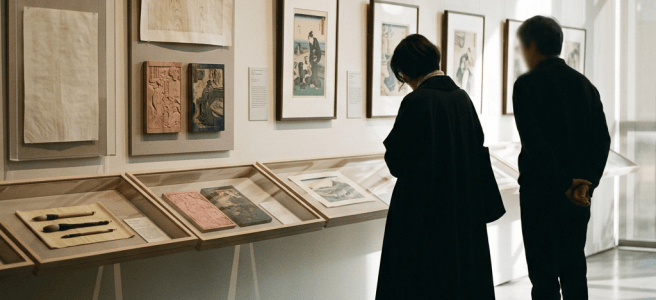
Two visitors examining framed artworks and artifacts in a museum gallery

A prompt landed on my desk about ukiyo-e woodblock prints and the art of fleeting things. Which is a fine way to spend a morning, especially if your alternative is reorganizing the sock drawer for the third time. Ukiyo-e does not merely show a passing world. It trains the eye to receive one.

The word ukiyo-e is often translated as “pictures of the floating world,” or, with a slightly heavier sigh, “pictures of the sorrowful world.” The Library of Congress’s overview places the tradition in Japan’s seventeenth- through nineteenth-century print culture, where artists pictured actors, courtesans, landscapes, stories, and the pleasures of ordinary urban life. This was not art kept at a safe distance from daily life. It was made to circulate.

That circulation required a small orchestra of patience. A publisher organized the project. An artist supplied the design. A carver cut the image into wood. A printer pressed pigment onto paper, lining up each impression with care. As The Metropolitan Museum of Art explains, polychrome prints used a separate carved block for each color—sometimes as many as twenty. The bright final image was therefore a visible record of invisible repetition.

Then there is mono no aware, a phrase that resists being flattened into “everything is temporary.” The Stanford Encyclopedia of Philosophy describes it as the pathos of things, a feeling arising from their transience. The point is not to scold us for loving what changes. It is to notice that the change is part of what makes the thing dear.

Hokusai’s Under the Wave off Kanagawa makes this almost comically clear. A wave rises like a blue claw. Three boats work their way beneath it. Mount Fuji sits in the distance, small and composed. Smarthistory’s account of the print notes how the image turns a split second of danger into something that can be looked at again and again. The wave still falls. The print does not pretend otherwise.

That may be the formation lesson. We often confuse attention with control. We photograph the birthday because we cannot keep the child that age. We save the message because the conversation will move on. We make a plan, then discover that life has its own carving tools. Ukiyo-e offers a gentler practice: receive the impression while it is here.

What happened? A team of makers built images of a world always in motion. What did it mean? Beauty and loss are not always enemies; sometimes they arrive holding hands. What can I carry forward? Today, notice one ordinary thing before rushing past it—the steam from a mug, a joke you have heard before, the last light on the wall. You do not have to make it permanent. Just be there for the impression.

Kintsugi and the Next Careful Repair

Kintsugi-repaired ceramic mug beside broken pottery pieces on wooden table

I broke a favorite mug last month. Not dramatically—no cinematic slow motion, just an elbow, a tile floor, and the small domestic silence that follows. I swept up the pieces and wondered whether the mug had become trash or a project.

Kintsugi, the Japanese craft of repairing broken ceramics with lacquer and powdered metal, offers a third category: not new, not ruined. Re-made. Japan’s National Crafts Museum describes it as a technique for repairing cracks and chips with lacquer and gold powder, rooted in preserving objects and passing them down. That is a sturdier idea than “everything happens for a reason.” Sometimes things simply break.

The technical detail matters. Traditional repairs use urushi, a tree-based lacquer that acts as an adhesive; the gold is not the glue, but the visible finish. The Smithsonian’s Folklife program notes that a traditional project can take up to three months, and that wet urushi can irritate skin even though it is harmless once dry. In other words, the pretty line on the finished bowl is the last chapter of a long, careful process. Gold gets the photograph. Patience does the work.

That is where the metaphor becomes useful—and where I want to handle it gently. A scholarly study of kintsugi warns us not to reduce the practice to the slogan that damage automatically makes an object more beautiful. The break still names a catastrophe. The repair names an amelioration. Both remain visible. Kintsugi is not pretending the crack was secretly good news.

This has obvious applications to money. A failed business, a layoff, a foolish purchase, or a season of debt can leave a seam in the household story. We do not need to gild the mistake or turn it into a personality. We can name what happened, repair what is repairable, and let the new habits show where the work was done: a smaller fixed expense, an honest conversation, an emergency fund built one transfer at a time.

It also has a spiritual edge, though not a shortcut. The repaired bowl is not valuable because it suffered. It is valuable because someone stayed with it. Someone cleaned the edges, fitted the pieces, waited for the lacquer to cure, and refused the easy conclusion that broken means finished. That feels close to the quiet work of formation: not self-invention, but faithful return.

So, what happened? A vessel broke. What did it mean? The break became part of its history, but not the whole of it. What can we carry forward? This week, choose one damaged place—financial, relational, or inward—and ask a less heroic question: what is the next careful repair?

The Tea Ceremony’s Quiet Lesson: Attention Is a Way of Life

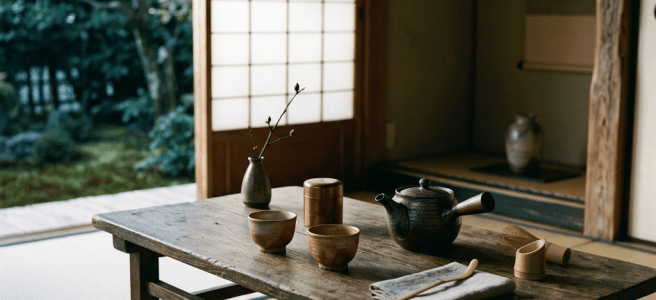
Tea table with teapot, cups, whisk, and vase beside a Japanese garden

I have a bad habit of drinking tea while doing three other things. I answer a message, glance at the news, and then wonder why the cup went cold. This is not a failure of tea. The tea has been giving me a perfectly clear assignment. I just keep submitting the wrong homework.

Chanoyu—often translated as “hot water for tea”—is a Japanese practice that turns an ordinary act into a carefully held encounter. The Metropolitan Museum of Art describes a small tea room where host, guests, utensils, garden, and season meet. The room is intimate. The movements are choreographed. The gathering is never quite repeated.

That last part matters. The Asian Art Museum’s teaching guide explains the phrase ichi-go ichi-e—“one time, one meeting”—as an awareness that each gathering is once in a lifetime. Not because the world is dramatic every minute, but because this minute is not coming back. The tea bowl in your hands is not a prop. It is the thing happening now.

The practice is not casual about attention. Before the tea arrives, the guest notices the scroll, the flowers, the kettle, the brazier. The host purifies the utensils and prepares the bowl in front of everyone. Guests watch with all five senses. Even the beautiful front of the bowl is turned away before drinking, then returned to face the host. Courtesy is taught through the hands before it is explained by the mouth.

Sen no Rikyu’s famous seven rules are wonderfully plain: make a satisfying bowl of tea; heat the water well; offer warmth in winter and coolness in summer; arrange flowers as they grow in the field; prepare ahead; be ready for rain; and show utmost consideration to your guests. The MIT Japanese Tea Ceremony page preserves the list. It sounds less like mysticism than good hosting. Which may be why it is so difficult. Most of us can manage one thoughtful gesture. The formation comes from making thoughtfulness the shape of the room.

The four principles often associated with the Way of Tea—wa (harmony), kei (respect), sei (purity), and jaku (tranquility)—are not four inspirational posters. They are a sequence. Attend to the setting and the other person. Clear what distracts. Then, sometimes, calm arrives. As the Association for Asian Studies notes, the methodical ritual cultivates respect, connection, and being “present in the present.”

What happened? Someone made tea with enough care for a simple cup to become an encounter. What did it mean? Attention is not merely a personality trait; it is a practice, reinforced by rooms, rituals, and repeated gestures. What can I carry forward? Perhaps one cup today with the phone in another room. No grand transformation. Just hot water, a little patience, and the courtesy of actually arriving.

Before Self-Help, There Was Apprenticeship

Two woodworkers assembling a wooden frame at a workshop bench

I have bought enough self-help books to build a small, slightly judgmental bookshelf. Most promise a better life through a plan: wake earlier, track the habit, optimize the morning. Useful, sometimes. But before we learned to call everything a system, people learned by standing near someone who already knew how to do the thing.

That older pattern was apprenticeship. Not a weekend course. Not a motivational quote over a photo of a mountain. You watched, copied, failed, received correction, and tried again. The point was not merely to collect information. It was to become the sort of person who could notice what mattered and respond well.

In early modern Europe, apprenticeship was probably the largest organized form of learning available to ordinary people, and artisans commonly began that way, according to historian Patrick Wallis in Science in Context. The arrangement was imperfect. Masters did not always teach systematically. Apprentices had to find other workshops, books, and teachers. Still, the workshop gave learning a place, a rhythm, and a human face.

The same logic lives in music. A young player does not become a musician by downloading every scale chart. She listens to a teacher phrase a line, tries it, hears where it goes flat, and discovers that “almost right” is a useful address. Modern learning researchers call this cognitive apprenticeship: authentic work beside someone more experienced, with scaffolding, reflection, and even productive failure. In plain English, you get better by doing the real thing with company.

Faith has an apprenticeship shape, too. In the Gospel accounts, Jesus does not simply hand the disciples a syllabus and wish them luck. He says, “Come, follow me.” They watch him pray, teach, welcome, confront, rest, and serve. Then they are sent to practice. One theological account describes those three years of following, watching, and hearing as a kind of theological apprenticeship, aimed at preparing the disciples to continue the work. The pattern is wonderfully concrete: learn a way of life by living near it.

The American story kept this practical tradition in view. The U.S. Department of Labor’s history points to George Washington, Benjamin Franklin, and Paul Revere as early apprentices who later became nationally known. The detail is almost funny: before the résumé, before the personal brand, there was a master, a bench, and a beginner doing the unglamorous work.

What happened? People were formed in proximity to a craft, a community, or a teacher. What did it mean? Skill was never only a private possession; it carried a responsibility to pass something on. What might we carry forward? Choose one practice you respect and find a living example: a musician, craftsperson, elder, or faithful friend. Watch closely. Try the work. Let correction be a gift instead of a verdict. A life may still need goals, but it probably needs a few good teachers more.