
Before Self-Help, There Was Apprenticeship

Two woodworkers assembling a wooden frame at a workshop bench

I have bought enough self-help books to build a small, slightly judgmental bookshelf. Most promise a better life through a plan: wake earlier, track the habit, optimize the morning. Useful, sometimes. But before we learned to call everything a system, people learned by standing near someone who already knew how to do the thing.

That older pattern was apprenticeship. Not a weekend course. Not a motivational quote over a photo of a mountain. You watched, copied, failed, received correction, and tried again. The point was not merely to collect information. It was to become the sort of person who could notice what mattered and respond well.

In early modern Europe, apprenticeship was probably the largest organized form of learning available to ordinary people, and artisans commonly began that way, according to historian Patrick Wallis in Science in Context. The arrangement was imperfect. Masters did not always teach systematically. Apprentices had to find other workshops, books, and teachers. Still, the workshop gave learning a place, a rhythm, and a human face.

The same logic lives in music. A young player does not become a musician by downloading every scale chart. She listens to a teacher phrase a line, tries it, hears where it goes flat, and discovers that “almost right” is a useful address. Modern learning researchers call this cognitive apprenticeship: authentic work beside someone more experienced, with scaffolding, reflection, and even productive failure. In plain English, you get better by doing the real thing with company.

Faith has an apprenticeship shape, too. In the Gospel accounts, Jesus does not simply hand the disciples a syllabus and wish them luck. He says, “Come, follow me.” They watch him pray, teach, welcome, confront, rest, and serve. Then they are sent to practice. One theological account describes those three years of following, watching, and hearing as a kind of theological apprenticeship, aimed at preparing the disciples to continue the work. The pattern is wonderfully concrete: learn a way of life by living near it.

The American story kept this practical tradition in view. The U.S. Department of Labor’s history points to George Washington, Benjamin Franklin, and Paul Revere as early apprentices who later became nationally known. The detail is almost funny: before the résumé, before the personal brand, there was a master, a bench, and a beginner doing the unglamorous work.

What happened? People were formed in proximity to a craft, a community, or a teacher. What did it mean? Skill was never only a private possession; it carried a responsibility to pass something on. What might we carry forward? Choose one practice you respect and find a living example: a musician, craftsperson, elder, or faithful friend. Watch closely. Try the work. Let correction be a gift instead of a verdict. A life may still need goals, but it probably needs a few good teachers more.

Praying With Your Kids About Money Without Making It Weird

Coins and seeds pour into a garden bed beside seedlings labeled “GROWTH”

I used to think praying with kids about money would be simple. “Thank you for what we have. Help us share. Amen.” Neat little package. Then a child asks, “If God loves us, can we get the giant box of cereal?” and suddenly the family theology department is taking questions.

Money is awkward because it carries so many adult feelings: worry, pride, comparison, secrecy, gratitude. Children notice those feelings before they understand a budget. The goal is not to give a five-year-old a quarterly earnings call. It is to make money ordinary enough that it can be discussed without becoming either a family secret or a family sermon.

The Consumer Financial Protection Bureau says school-age children are learning to save, plan ahead, wait for what they want, and connect choices with their own goals and values. It also points out that children watch us: the bargain we celebrate, the treat we splurge on, the future event we plan. The CFPB’s money-milestone guide suggests thinking out loud about those choices. That is already a kind of lesson—and, if we are paying attention, a kind of examination of conscience.

Research points in the same direction. In a qualitative study of 90 emerging adults, along with 17 parents and 8 grandparents, families described three helpful patterns: sharing financial experiences, involving children in decisions, and keeping conversations age-appropriate. The paper, “Can We Talk About Money?”, is not a command to turn every grocery trip into a seminar. It is a reminder that children learn through conversation and participation, not only through warnings delivered from the driver’s seat.

Prayer can give that conversation a gentler frame. The Catechism describes the family as a place where, from childhood, people learn moral values and “make good use of freedom,” and where members learn responsibility for one another. Read paragraphs 2207–2208 and you hear less about money as a scorecard than money as part of learning how to live with other people.

Try a three-part prayer once a week: “Thank you for what we have. Help us choose wisely. Show us someone we can help.” Then attach it to one concrete thing. We are saving for a trip. We are waiting before buying this toy. We are setting aside a gift for a neighbor. The point is not to make the child perform generosity on cue. It is to let them see that money can be received with gratitude, handled with care, and shared with love—the basic shape of Christian stewardship.

A few guardrails help. Do not make God sound like an ATM. Do not shame a child for wanting something. Do not pretend the family has no limits. Say, “That is a real want, and it is not what we are choosing today.” If the family is under financial strain, offer an age-appropriate truth without handing a child the whole burden: “We are being careful right now, and the grown-ups are making a plan.”

What happened? A money question became a prayer instead of a panic. What did it mean? The child learned that faith touches the checkout line, but does not erase reality. What can we carry forward? One honest sentence, one small choice, and one person to remember in prayer. That is not weird. That is formation, with a receipt attached.

The Audit Trail of the Soul

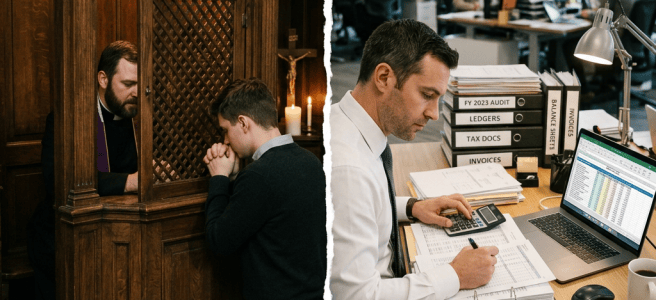
Priest hearing confession beside accountant reviewing FY 2023 audit, ledgers, tax docs, and invoices

I have a confession to make: when I hear “financial audit,” my soul leaves the room and looks for snacks. An audit sounds like spreadsheets, fluorescent light, and somebody asking why a receipt from March is labeled “miscellaneous.” Yet confession and an audit share a surprisingly useful first move: they ask us to stop editing the story.

In the Catholic understanding, confession is not a performance of shame. The Catechism calls it an examination of conscience, followed by the honest disclosure of what we have done, so that responsibility and reconciliation become possible. The point is not to discover that a person is secretly terrible. It is to bring the truth into the light, where healing can begin. You can read the relevant sections in the Catechism’s account of the penitent’s acts.

An audit begins with a different kind of account, but the discipline is familiar. Management prepares the financial statements; an independent auditor examines them, tests evidence, and issues an opinion about whether they are fairly presented. The SEC’s plain-language guide to auditors is refreshingly clear about the arrangement: the people inside the company tell the story, while an outside professional checks whether the story can bear weight.

That distinction matters. A priest is not a CPA with better lighting, and God is not an investor comparing quarterly reports. Confession is sacramental and relational; an audit is professional assurance for people who need reliable financial information. Still, both practices resist the fantasy that what remains unspoken somehow does not count.

Here is where the comparison gets practical. In an audit, “material” does not simply mean “large.” A small error can matter if it changes the reader’s understanding. Our inner bookkeeping works the same way. The sharp comment we call “just stress.” The purchase we call “a one-time thing” for the seventh time. The resentment we file under “I’m fine.” Each item may look small in isolation. Together, they can reveal the habits shaping the whole household.

And neither process ends with noticing. The AICPA explains that an audit provides high, but not absolute, assurance; it produces a report that helps others make decisions. Confession, too, is aimed at a future—not merely a perfectly itemized past. The AICPA’s explanation of audits emphasizes evidence and judgment, not magical certainty. The Catechism pairs confession with satisfaction: repair what can be repaired, accept a penance, and practice a different way forward.

What happened? We hid, minimized, or misclassified something. What did it mean? The hidden line item was forming us, quietly and faithfully. What can we carry forward? Try a ten-minute weekly review: name one financial choice, one relationship, and one habit without defending yourself. Then choose one small repair. No dramatic vows. Just an honest ledger and the next faithful entry.

“What confession has in common with a financial audit.”

The Sabbath Lesson for a Busy Dad

Rustic wooden table with bread, butter, jam, a lit candle, and a coffee mug near a window

I once tried to take a day off and spent most of it explaining to my family that I was taking a day off. I answered one “quick” email, fixed a cabinet hinge, checked the weather three times, and somehow ended the afternoon more tired than when I began. Rest, it turns out, is not simply the absence of paid labor. It is a skill. I am still in remedial class.

That is why Sabbath feels less like an antique rule and more like a kindly interruption. The command in Exodus 20 does not reserve rest for the impressive or the spiritually organized. It names sons and daughters, servants, animals, and the resident alien. The household stops. Even the ox gets a weekend, which is a strong argument for humane management.

Rest says I am more than my output

A busy dad can turn every hour into a tiny performance review. Did I answer enough? Earn enough? Parent well enough? The Sabbath answers with a stubborn “not today.” Not because the work is worthless, but because the worker is not a machine with a family subscription.

The Catechism of the Catholic Church describes Sabbath as a respite and “a day of protest against the servitude of work and the worship of money.” That line lands differently when the laptop is open beside the cereal bowl. Rest is not laziness wearing nicer shoes. It is a refusal to let productivity become a god.

Rest is also a gift to other people

Notice the social shape of the command. I do not keep Sabbath merely by declaring myself unavailable while quietly making everyone else serve my “day of renewal.” The biblical vision makes room for the people whose labor usually props up my convenience. That may mean cooking simply, sharing the cleanup, choosing a walk over a shopping marathon, or not creating an emergency that somebody else must solve.

There is a bodily wisdom here, too. The Centers for Disease Control and Prevention recommends at least seven hours of sleep for adults ages 18–60. Sleep is not the whole of Sabbath, of course. But it is a useful reminder that the body keeps receipts. We can call exhaustion dedication for a while. The invoice eventually arrives.

What happened, what it meant, what to carry forward

What happened? I kept treating rest as something I could earn after finishing everything. What did it mean? I had quietly accepted the idea that my worth rose and fell with the task list. What can I carry forward? A Sabbath need not be elaborate. Choose a block of time. Put the phone in another room. Let one meal be slow. Give the people around you permission to stop, too.

For this week, I am trying one small practice: when a non-urgent task appears on the day of rest, I will write it down instead of obeying it immediately. The list can wait. Maybe I can, too. What would your family learn about God—and about their own dignity—if you let rest be a shared gift rather than a reward for finally becoming caught up?

The Riskiest Servant in the Bible Might Be the Hero You Forgot

Single coin buried in soil, light above

I always assumed the “bad guy” in the Parable of the Talents was obvious — the servant who buried his money in the ground, out of laziness. Then I actually sat with the text again in Matthew 25:14-30, and I noticed something I’d skipped for twenty years: the master doesn’t scold him for being lazy. He scolds him for being afraid.

“I knew you were a hard man,” the servant says, basically accusing his boss of being the kind of guy who’d fire you over a bad quarter. So he did the safest thing available — he buried the money, kept it exactly intact, and handed it back penny for penny. No loss. No embarrassment. No risk.

And that’s the servant who gets called “wicked and slothful.”

Here’s the part that stopped me mid-coffee: the two servants who doubled their money took real risk to do it. First-century “trading” wasn’t a savings account — it meant loaning capital, backing ventures, betting the harvest would come in. As The Catholic Herald points out, this parable isn’t really a finance seminar in disguise. It’s a parable about fear disguised as caution.

I think about this every time I explain to my kids why we don’t keep all our savings under the mattress — and also every time I catch myself doing the spiritual version of burying a talent. Not using a gift because someone might criticize it. Not writing the song, not sending the blog post, not saying the prayer out loud, because staying safe feels responsible.

Ray Stedman’s reading of this parable puts it plainly: the sin here isn’t losing money. It’s refusing to risk anything at all in service of something bigger than yourself.

That reframes stewardship for me. I used to think good stewardship meant protecting what I’ve been given — keep it safe, don’t waste it, hand it back in one piece. Turns out the parable’s definition of good stewardship is closer to the opposite: put it to work, accept that work carries risk, and trust the One who gave it to you in the first place.

What happened: I reread a parable I thought I already understood.

What it meant: the “safe” choice in the story wasn’t safe at all — it was the only choice that produced zero fruit.

What I’m carrying forward: the next time I feel the urge to bury something — a dollar, a talent, an idea — I want to ask whether I’m being prudent, or just scared with better branding.

(And if you’re the one in your family who still keeps cash in a coffee can — I see you. I’m not judging. I’m just going to gently suggest an index fund.)