When MTV Taught a Generation to See

Retro collage of vinyl records, cassette tapes, radio dials, and dancing silhouettes

At 12:01 a.m. on August 1, 1981, a new cable channel introduced itself with a sentence that sounded half like a concert emcee and half like a dare: “Ladies and gentlemen, rock and roll.” Then came the Buggles’ “Video Killed the Radio Star.” Britannica records the moment as MTV’s debut, and the first music video ever broadcast on the channel.

The opening sequence had an almost comic amount of ambition: space imagery, a moon, an MTV flag. The little network wanted to make music feel like an event. It did not yet have the reach to match the drama. The initial broadcast was available only to a small number of cable households in New Jersey, and distribution was hard to come by. NPR’s account of the first 100 videos notes that plenty of music-industry people expected the idea to fail.

That is part of the charm of the first year. MTV was not yet a monument. It was a strange little experiment that asked a strange little question: what if a song did not merely sound like something, but looked like something?

Radio had already taught us to carry music around in our heads. MTV added faces, clothes, rooms, gestures, choreography, and story. The five original video jockeys—Martha Quinn, Nina Blackwood, Alan Hunter, J.J. Jackson, and Mark Goodman—did not just introduce songs. They helped make the channel feel like a place you could visit. The screen became a kind of hallway where music, fashion, and personality kept bumping into one another.

The effect was bigger than a new way to promote records. A Newcastle University history of MTV describes how heavy rotation made visual image central to mainstream pop. A hit single now arrived with a look: the lighting, the jacket, the dance, the fantasy of the artist’s life. A song could become a short film, a commercial, and a little piece of mythology at the same time.

That formed people. Not in the grand, sermon-on-the-mount sense. More like a daily drip. We learned what confidence looked like before we had language for it. We learned that reinvention might involve a haircut, a hallway, a leather jacket, or simply the nerve to appear on camera as someone new. Some of us also learned to confuse a polished image with a whole person. Formation is rarely pure; it is usually a bundle of gifts and distortions.

And MTV’s early visual imagination had real blind spots. The Smithsonian’s history notes that the channel’s rock-oriented programming featured very few Black artists in its early years, a limitation challenged publicly by David Bowie and others. A truthful nostalgia keeps the wonder and the omission in the same frame.

So, what happened? A tiny cable experiment made sight part of the song. What did it mean? For a generation, music became a visual language for identity, aspiration, and belonging. What can we carry forward? Notice what is teaching you to see—and remember that every image, however thrilling, is still only one angle on a human life.


The Shinkansen’s Formation Lesson: Punctuality Is Built, Not Born

Bullet train crossing rural rice fields with Mount Fuji in background

I have a confession: I am the sort of person who considers a train arriving “only” four minutes late a minor weather event. Somewhere between the platform and the coffee machine, I have already rewritten the morning.

Then there is the Shinkansen.

The Tokaido Shinkansen opened on October 1, 1964, linking Tokyo and Osaka just before the Tokyo Olympics. It cut the trip from six and a half hours to four; after a sensible bedding-in period, the 1965 timetable brought it down to three hours and ten minutes, according to the Japan Railway & Transport Review. A national project arrived not merely fast, but with a new relationship to time.

Today, JR Central reports an average delay of 1.6 minutes per train on the Tokaido line in fiscal year 2023, including delays caused by natural disasters. That is not a claim that Japan has defeated weather, earthquakes, or the occasional disgruntled pigeon. It is a reminder that reliability is measured across the real world, not a laboratory. The figure comes from JR Central’s own Shinkansen overview.

But punctuality is not a national personality trait that descends from the clouds and taps everyone on the shoulder. It is formed.

Dedicated tracks keep the trains away from many outside disturbances. Control systems, maintenance crews, detailed timetables, and operations-room staff all do their quiet work before a passenger ever hears the familiar chime. One account of the system describes drivers who can reach a destination within five seconds of schedule and stop within a centimeter of the prescribed position—precision made possible by an entire supporting organization, not heroic willpower alone. Read the wider story in Japan Policy Forum’s account of the high-speed rail network.

Even passengers were part of the formation. In 1925, Japan National Railways posted rules explaining that people getting off should go first, followed by those boarding. Shorter station stops meant more capacity without immediately buying more trains. In other words, the system taught people how to make the system work. Manners became infrastructure.

That line stays with me. We often imagine character as something stored inside us, like a coin in a pocket. The Shinkansen suggests another picture: character is also the arrangement of the track, the timetable, the checklist, the well-rehearsed response when something goes wrong. We become dependable partly by practicing, and partly by building surroundings that make the dependable choice easier.

So, a small evening examen. What happened? A train became a symbol of national modernity, then a daily exercise in coordination. What did it mean? Quiet excellence is rarely quiet because nothing is happening; it is quiet because thousands of small acts are happening on purpose. What can I carry forward? Perhaps one timetable for tomorrow, one five-minute reset, one place where I stop relying on last-minute inspiration.

Not every life needs to run on bullet-train precision. Mine certainly does not. But maybe the next faithful step is less about becoming a more disciplined person and more about laying a little better track.

What a Japanese Konbini Teaches About Quiet Excellence

Illuminated corner shop with an OPEN sign on a rainy city street

I have a weakness for Japanese convenience stores. Give me ten minutes in a konbini and I will emerge with an onigiri, a coffee, and the vague conviction that I have briefly become a more organized person.

The joke works because the store feels so un-dramatic. No grand entrance. No luxury branding. Just bright shelves, a polite greeting, and the quiet sense that somebody has thought through the next five minutes of your life.

“Konbini” is short for convenience store, but that English phrase undersells the institution. A scholarly essay on Japanese food culture describes the konbini as one of contemporary Japan’s “peculiar institutions,” alongside the vending machine, and places it inside a larger story about modernity, speed, and convenience. The point is not that every Japanese shop is perfect. It is that these stores have become woven into ordinary life. The essay is worth reading for both the convenience and its discontents.

The scale is substantial. Japan’s Ministry of Economy, Trade and Industry reported convenience-store sales of ¥12.8887 trillion in 2024, counting goods and services together. The METI review is a useful reminder that “convenience” is not merely a feeling; it is a serious retail system. The Japan Franchise Association also publishes monthly and annual data on store sales and store numbers, which you can see in its statistical archive.

And then there are the small acts of infrastructure. At Seven-Eleven, the multifunction copy machine can print photos, send faxes, order tickets, and—in some municipalities—produce official documents such as residence certificates and tax statements, including on weekends and holidays. The company’s service guide reads less like an advertisement than a list of ways a neighborhood store quietly absorbs friction.

That, to me, is the formation story. Excellence here is not a heroic burst. It is a chain of modest decisions: the right item in the right place, a delivery arriving on time, a package accepted without fuss, a counter kept clean. One recent account of the Japanese model highlights the combination of franchise organization, data and technology, and a reconstructed distribution system. The system is designed, not accidental.

There is a temptation to turn this into a postcard about Japanese perfection. Let’s resist that. Systems have costs. Convenience can mean long hours, demanding work, packaging, and pressure that customers do not see. Respect begins by noticing the people and resources underneath the smooth surface.

Still, the konbini offers a lovely question for the rest of us: where could a little less drama and a little more preparation make someone else’s day easier? In a household, that might be a basket by the door for keys. In a budget, an automatic transfer before the month gets noisy. In faith, five quiet minutes before the day starts making demands.

What happened? A corner shop became part grocery, part post office, part civic counter, part dependable neighbor. What did it mean? Small repeated acts can become a form of care. What can we carry forward? Pick one useful thing, make it easier to repeat, and let the excellence stay quiet.

Ikigai, Translated Honestly: It Is Not Your Perfect Job

Moss-covered stepping-stone path beside a pond in a Japanese garden

I first met ikigai on a corporate wellness poster. Four circles leaned into one another: what you love, what you are good at, what the world needs, and what you can be paid for. In the middle sat a small, confident promise. Find this intersection and your life will click. Even the diagram looked well-rested.

The trouble is that this is not quite what ikigai means in Japanese. The word is often translated as “a reason for being,” but that translation can sound grander and more career-shaped than the thing itself. The Government of Japan describes it as something that brings value and joy to life. It can be a person—your child, a friend—or an activity, such as work or a hobby. It is less a job title than a felt sense that living is worthwhile.

That wider meaning matters. A word like “purpose” can make us imagine a mission statement, complete with a logo. Ikigai may be much more ordinary: tending a garden, making lunch for people you love, showing up for a club, learning a craft badly for three years before getting slightly less bad. The point is not that these activities are secretly monetizable. The point is that they can make a life feel inhabited.

The academic picture is appropriately humbling. A University of Pennsylvania review of psychological research notes that scholars still lack one consistent definition. Its useful threads are personally valued experiences, authentic relationships, and a sense of direction. That sounds less like a personality quiz and more like a life slowly teaching us what gives it weight.

Which brings us back to the famous four-circle graphic. It is a handy worksheet for thinking about work. It is not an ancient Japanese map. Marc Winn’s own account says that in 2014 he joined the word ikigai to Andrés Zuzunaga’s existing purpose diagram. That is a perfectly legitimate creative mash-up. It just should not be presented as a literal translation of a Japanese tradition. A foreign word can add mystery to a framework; it cannot make the framework native.

There is real reason to take the concept seriously, without turning it into a productivity hack. In a large Japanese cohort study of 73,272 adults, researchers found that people who reported having ikigai had lower all-cause mortality during follow-up. The authors described an association with longevity, not proof that a cheerful hobby causes a longer life. The PubMed record is a useful antidote to both cynicism and hype.

So, what happened? A modest Japanese word traveled into the English-speaking self-help world, picked up a four-circle diagram, and became a career brand. What did it mean? The word itself remained more spacious than the brand: value and joy can arrive through people, practices, and small loyalties, not only through a vocation. What can we carry forward? Instead of asking, “What is my one perfect purpose?” try asking, “What made life feel quietly worth living this week?” Then notice the answer before turning it into a business plan.

Kintsugi and the Next Careful Repair

Kintsugi-repaired ceramic mug beside broken pottery pieces on wooden table

I broke a favorite mug last month. Not dramatically—no cinematic slow motion, just an elbow, a tile floor, and the small domestic silence that follows. I swept up the pieces and wondered whether the mug had become trash or a project.

Kintsugi, the Japanese craft of repairing broken ceramics with lacquer and powdered metal, offers a third category: not new, not ruined. Re-made. Japan’s National Crafts Museum describes it as a technique for repairing cracks and chips with lacquer and gold powder, rooted in preserving objects and passing them down. That is a sturdier idea than “everything happens for a reason.” Sometimes things simply break.

The technical detail matters. Traditional repairs use urushi, a tree-based lacquer that acts as an adhesive; the gold is not the glue, but the visible finish. The Smithsonian’s Folklife program notes that a traditional project can take up to three months, and that wet urushi can irritate skin even though it is harmless once dry. In other words, the pretty line on the finished bowl is the last chapter of a long, careful process. Gold gets the photograph. Patience does the work.

That is where the metaphor becomes useful—and where I want to handle it gently. A scholarly study of kintsugi warns us not to reduce the practice to the slogan that damage automatically makes an object more beautiful. The break still names a catastrophe. The repair names an amelioration. Both remain visible. Kintsugi is not pretending the crack was secretly good news.

This has obvious applications to money. A failed business, a layoff, a foolish purchase, or a season of debt can leave a seam in the household story. We do not need to gild the mistake or turn it into a personality. We can name what happened, repair what is repairable, and let the new habits show where the work was done: a smaller fixed expense, an honest conversation, an emergency fund built one transfer at a time.

It also has a spiritual edge, though not a shortcut. The repaired bowl is not valuable because it suffered. It is valuable because someone stayed with it. Someone cleaned the edges, fitted the pieces, waited for the lacquer to cure, and refused the easy conclusion that broken means finished. That feels close to the quiet work of formation: not self-invention, but faithful return.

So, what happened? A vessel broke. What did it mean? The break became part of its history, but not the whole of it. What can we carry forward? This week, choose one damaged place—financial, relational, or inward—and ask a less heroic question: what is the next careful repair?

The Tea Ceremony’s Quiet Lesson: Attention Is a Way of Life

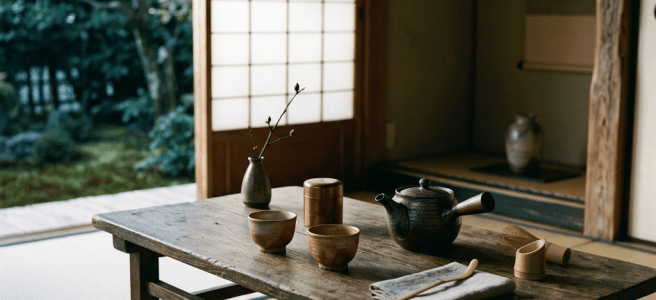
Tea table with teapot, cups, whisk, and vase beside a Japanese garden

I have a bad habit of drinking tea while doing three other things. I answer a message, glance at the news, and then wonder why the cup went cold. This is not a failure of tea. The tea has been giving me a perfectly clear assignment. I just keep submitting the wrong homework.

Chanoyu—often translated as “hot water for tea”—is a Japanese practice that turns an ordinary act into a carefully held encounter. The Metropolitan Museum of Art describes a small tea room where host, guests, utensils, garden, and season meet. The room is intimate. The movements are choreographed. The gathering is never quite repeated.

That last part matters. The Asian Art Museum’s teaching guide explains the phrase ichi-go ichi-e—“one time, one meeting”—as an awareness that each gathering is once in a lifetime. Not because the world is dramatic every minute, but because this minute is not coming back. The tea bowl in your hands is not a prop. It is the thing happening now.

The practice is not casual about attention. Before the tea arrives, the guest notices the scroll, the flowers, the kettle, the brazier. The host purifies the utensils and prepares the bowl in front of everyone. Guests watch with all five senses. Even the beautiful front of the bowl is turned away before drinking, then returned to face the host. Courtesy is taught through the hands before it is explained by the mouth.

Sen no Rikyu’s famous seven rules are wonderfully plain: make a satisfying bowl of tea; heat the water well; offer warmth in winter and coolness in summer; arrange flowers as they grow in the field; prepare ahead; be ready for rain; and show utmost consideration to your guests. The MIT Japanese Tea Ceremony page preserves the list. It sounds less like mysticism than good hosting. Which may be why it is so difficult. Most of us can manage one thoughtful gesture. The formation comes from making thoughtfulness the shape of the room.

The four principles often associated with the Way of Tea—wa (harmony), kei (respect), sei (purity), and jaku (tranquility)—are not four inspirational posters. They are a sequence. Attend to the setting and the other person. Clear what distracts. Then, sometimes, calm arrives. As the Association for Asian Studies notes, the methodical ritual cultivates respect, connection, and being “present in the present.”

What happened? Someone made tea with enough care for a simple cup to become an encounter. What did it mean? Attention is not merely a personality trait; it is a practice, reinforced by rooms, rituals, and repeated gestures. What can I carry forward? Perhaps one cup today with the phone in another room. No grand transformation. Just hot water, a little patience, and the courtesy of actually arriving.

Before Self-Help, There Was Apprenticeship

Two woodworkers assembling a wooden frame at a workshop bench

I have bought enough self-help books to build a small, slightly judgmental bookshelf. Most promise a better life through a plan: wake earlier, track the habit, optimize the morning. Useful, sometimes. But before we learned to call everything a system, people learned by standing near someone who already knew how to do the thing.

That older pattern was apprenticeship. Not a weekend course. Not a motivational quote over a photo of a mountain. You watched, copied, failed, received correction, and tried again. The point was not merely to collect information. It was to become the sort of person who could notice what mattered and respond well.

In early modern Europe, apprenticeship was probably the largest organized form of learning available to ordinary people, and artisans commonly began that way, according to historian Patrick Wallis in Science in Context. The arrangement was imperfect. Masters did not always teach systematically. Apprentices had to find other workshops, books, and teachers. Still, the workshop gave learning a place, a rhythm, and a human face.

The same logic lives in music. A young player does not become a musician by downloading every scale chart. She listens to a teacher phrase a line, tries it, hears where it goes flat, and discovers that “almost right” is a useful address. Modern learning researchers call this cognitive apprenticeship: authentic work beside someone more experienced, with scaffolding, reflection, and even productive failure. In plain English, you get better by doing the real thing with company.

Faith has an apprenticeship shape, too. In the Gospel accounts, Jesus does not simply hand the disciples a syllabus and wish them luck. He says, “Come, follow me.” They watch him pray, teach, welcome, confront, rest, and serve. Then they are sent to practice. One theological account describes those three years of following, watching, and hearing as a kind of theological apprenticeship, aimed at preparing the disciples to continue the work. The pattern is wonderfully concrete: learn a way of life by living near it.

The American story kept this practical tradition in view. The U.S. Department of Labor’s history points to George Washington, Benjamin Franklin, and Paul Revere as early apprentices who later became nationally known. The detail is almost funny: before the résumé, before the personal brand, there was a master, a bench, and a beginner doing the unglamorous work.

What happened? People were formed in proximity to a craft, a community, or a teacher. What did it mean? Skill was never only a private possession; it carried a responsibility to pass something on. What might we carry forward? Choose one practice you respect and find a living example: a musician, craftsperson, elder, or faithful friend. Watch closely. Try the work. Let correction be a gift instead of a verdict. A life may still need goals, but it probably needs a few good teachers more.

Discipline Is a Practice; Self-Punishment Is a Trap

Stacked stones on a moss-covered rock beside a forest stream

I have occasionally confused discipline with being mean to myself. The evidence was compelling: a stern inner monologue, a new rule written in permanent ink, and the temporary satisfaction of feeling like a tiny prison warden. Very productive. Very exhausting.

But discipline and self-punishment are not twins. They are more like cousins who show up to the same family reunion wearing identical sweaters.

Discipline asks, “What helps me practice the good?”

Discipline is a structure that serves a value. I go for the walk because I want to be present for my family. I set a bedtime because tomorrow’s version of me deserves a functioning brain. I put money aside because generosity and stability both need somewhere to stand. The practice may be boring. That is not a bug. Boring is often where character gets its work clothes.

Self-punishment asks a different question: “How can I make failure hurt enough to prove I am serious?” It turns a missed workout, a sharp word, or a wasted hour into a courtroom. The verdict is not merely “I did something unhelpful.” It becomes “I am the kind of person who cannot be trusted.” That is a heavy sentence to carry into the next attempt.

The distinction matters because motivation has different flavors. In their overview of Self-Determination Theory, psychologists Richard Ryan and Edward Deci distinguish motivation supported by autonomy, competence, and relatedness from motivation driven by pressure and control. A rule we freely connect to a meaningful value can become a home. A rule enforced only by fear becomes a landlord who never fixes anything.

This is where self-compassion enters—not as a scented candle for people who have given up, but as a way of staying honest without becoming cruel. The American Psychological Association’s review of self-compassion research notes that it can be learned and is associated with well-being, relationships, physical health, and learning. In other words, treating yourself like a fellow human being is not the same as handing yourself a trophy for showing up late.

Self-compassion still tells the truth. I missed the deadline. I was impatient with my child. I spent money I meant to save. Then it adds the sentence punishment leaves out: I can repair this and practice differently next time.

A small examen for the next stumble

What happened? Name the event without adding a biography. “I skipped the plan” is usually more useful than “I never follow through.”

What did it mean? Maybe the goal was too vague. Maybe the day was overloaded. Maybe you were avoiding discomfort. Curiosity gives you information; shame mostly gives you volume.

What can I carry forward? Keep the standard, change the next step. Make the walk shorter. Move the savings transfer to payday. Apologize before composing the director’s cut of your defense.

Research on self-compassion describes it as a healthier way to relate to oneself, one that can support initiative rather than excuse passivity. That sounds like the formation I want: not a softer life, necessarily, but a sturdier way to return to it.

What happened? I failed at a practice. What did it mean? I am still being formed. What will I carry forward? Discipline can hold the line without picking up a stick.

What Raising Kids Taught Me About Compounding

Adult and child watching ripples spread across a sunset pond

I used to think patience was a personality trait. Some people had it. Some people, like me, had a charming little emergency supply that ran out around 4:17 p.m.

Then I had children, and discovered that patience is less like a virtue you own and more like a muscle you use while someone asks the same question for the ninth time. It grows in small, mostly unphotogenic repetitions.

The money analogy is useful—but incomplete

We usually meet “compounding” in a finance conversation. Investor.gov defines compound interest as earning interest on interest. Its simple example begins with $100 at 5 percent: $105 after year one, $110.25 after year two, and more than $162 after ten years, even without another deposit. Time gives small gains a chance to earn their own gains.

Children do something similar to a parent’s character. One bedtime story does not make a reader. One calm explanation does not make a patient dad. But the repeated act leaves a little residue. The next explanation may come a half-second sooner. The apology may arrive before the lecture. Not dramatic growth. Just a slightly different default.

Small exchanges become the environment

This is not just a nice metaphor. The Harvard Center on the Developing Child describes “serve and return”—the back-and-forth between a child and a caring adult—as important for brain architecture and early language and social skills. A child points at a truck. You look. You name it. The child looks back. Tiny exchange, repeated across ordinary days. The Harvard Center explains why these responsive interactions matter.

And routines matter, too. A review of five decades of research in the American Psychological Association’s Journal of Family Psychology found that family routines and rituals were associated with parenting competence, child adjustment, and marital satisfaction, while also noting limits in the underlying studies. That word—associated—is doing honest work. A routine is not a magic spell. It is a repeated place where people can meet one another.

What I am trying to carry forward

What happened? I kept waiting for patience to arrive as a finished product. What did it mean? I was overlooking the deposits: the snack shared, the shoe found, the question answered without turning it into a courtroom drama.

What can I carry forward? Choose one small practice and make it boringly repeatable. Read ten minutes. Put the phone away during one conversation. Pause before answering the familiar question. In money, time lets returns build on returns. In a family, attention lets trust build on trust.

None of this makes the 4:17 p.m. hour disappear. Sorry. But it can make the next response a little more generous—and that, too, is a kind of compounding.

Character Is Built in the Boring Reps

Glowing outline of a walking person over a mountainous valley at night

I used to think character showed up in the dramatic moments. The honest answer in the meeting. The brave decision. The cinematic pause before doing the right thing. Then I became a parent and discovered that most character is formed while somebody is asking for a snack.

The prompt on my desk says 10,000 small repeated choices. That number is not a scientific speed limit. It is a useful nudge: formation is usually less like a lightning strike and more like a path across a lawn. You walk it again and again, often without noticing that the grass is changing.

Habit researchers describe something similar. In a real-world study, people practiced a chosen eating, drinking, or activity behavior each day in a consistent context. Automaticity grew gradually, but at very different speeds: the time to reach a person’s plateau ranged from 18 to 254 days. Missing one opportunity did not ruin the process. Repetition mattered, but perfection was not the price of admission. The study is a helpful antidote to the internet’s favorite habit myth—that everyone needs exactly 66 days, or some other magic number.

That distinction matters for character. A child who puts one book back on the shelf is not becoming a librarian overnight. A spouse who pauses before answering is not suddenly a saint. But each small act is practicing a response. The cue arrives, and a slightly better path becomes easier to find.

There is some evidence that the practice itself can strengthen self-regulation. In one study, college students spent two weeks practicing a small exercise such as monitoring posture, regulating mood, or recording what they ate. Compared with a control group, the exercise groups improved on a later measure of self-regulatory capacity. The result was modest, not magical. Still, it suggests that discipline is not only a personality trait we either inherited or missed in the family raffle.

More recent work helps explain why repetition works: practice can strengthen the link between a recurring cue and a response. Researchers found that greater task practice was associated with stronger cue-response associations, which in turn supported performance. The brain learns the route we keep taking.

So what might this look like at home? Pick one tiny response and give it a familiar doorway. After dinner, ask one good question before reaching for the phone. When a mistake is named, say, “Thank you for telling me,” before explaining. On Sunday night, write down one thing you received and one thing you repaired. The point is not to turn the household into a monastery with better snacks. It is to make the next faithful move visible.

At the end of the day, an examen can be wonderfully ordinary: What happened? Where did I repeat an old groove? Where did grace—or simple patience—open a new one? What did it mean? That the small choices were not small to the people living inside them. What can I carry forward? One repeatable act, attached to a real moment, with room to miss once and begin again.

Ten thousand is a lot of choices. Fortunately, we only have to make the next one.