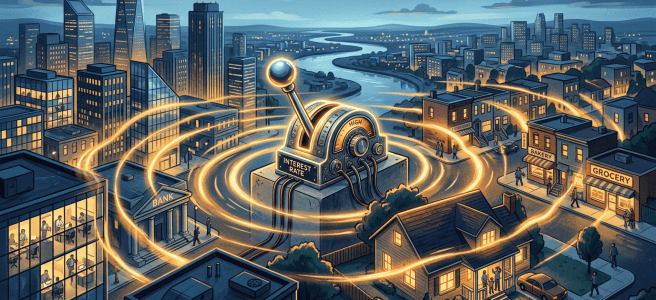
I used to picture the Federal Reserve reaching for one enormous lever marked INTEREST RATES. Pull it, and every mortgage, credit card, and savings account in the country obediently shifts at once. It is a satisfying image. It is also a little too tidy for real life.
Today’s Prompt Bank question asks for a plain-language walkthrough of what actually happens when the Fed raises rates. The first useful correction: the Federal Open Market Committee (FOMC) sets a target range for the federal funds rate—the rate banks pay to borrow reserves overnight. The Fed then uses its policy tools to guide short-term market rates toward that range. It does not simply announce one price for every loan in America. The St. Louis Fed explains this distinction and the way the target travels through financial markets.
Why make borrowing costlier? Congress gave the Fed two broad goals: maximum employment and stable prices. When inflation is too high or the economy is running hot, raising the target range tightens monetary policy. That tends to lift other rates and tighten financial conditions, which can make households and businesses pause before borrowing, spending, or investing. The Fed’s own overview describes this chain from its policy stance to decisions made by people and companies.
Think of a family deciding whether to replace an aging car, or a small business weighing a new piece of equipment. If financing costs rise, the monthly payment may look less friendly. Some purchases get postponed. Some projects wait. Across millions of decisions, demand can cool. With less pressure on demand, inflation may ease over time. “May” is doing honest work in that sentence; monetary policy is influence, not remote control.
And the effects are not identical for everyone. A change in the Fed’s target can influence borrowing costs and broader financial conditions, but it does not instantly rewrite every contract or dictate every bank’s price. Some rates move quickly; others are shaped by longer-term expectations and market conditions. A borrower with a variable-rate product may experience a different path from someone with a fixed payment. The Fed notes that links from policy to employment and inflation are neither direct nor immediate, and many other forces matter too.
That lag is important. If a rate increase is a nudge, the economy is not a shopping cart that turns the instant you push the handle. Households and businesses adjust gradually. Price pressures, hiring, and investment respond on their own timelines. The Fed is trying to steer toward stable prices while also supporting a strong labor market—not win a dramatic one-day contest against the grocery bill.
So, what happened? The FOMC raised the target range for a key overnight rate. What did it mean? It tried to influence the cost and availability of credit, and therefore the spending decisions that shape demand, inflation, jobs, and growth. What should we carry forward? When the next rate headline flashes across the screen, look past the lever metaphor. Ask what the policy is trying to change, who may feel it first, and what evidence will tell us whether the nudge is working.

