Take On Me and the Courage to Leave the Panel

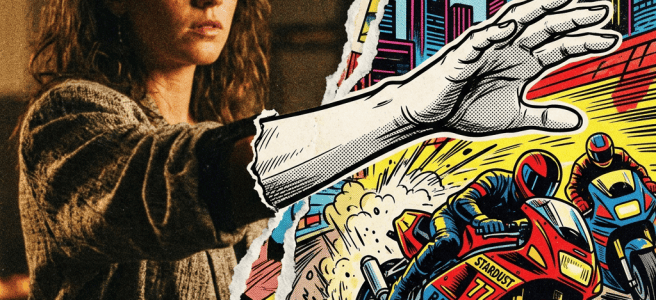
Woman beside comic motorcycle race labeled STARDUST RACING 77

There is a moment in a-ha’s “Take On Me” when the girl looks up from her coffee and realizes the comic-book hero is looking back. It is a wonderfully 1985 idea: romance as a portal, pencil lines as a doorway, and a chorus that sounds like somebody asking for one brave chance.

Then the video does something more interesting. It refuses to let the two worlds stay separate.

If you have somehow missed it, the video moves between live action and a black-and-white comic drawn in loose pencil. The technique is rotoscoping: filming movement, then drawing over the frames. The BBC’s account of the video’s making says animator Michael Patterson spent 16 weeks sketching roughly 3,000 drawings. That is not a weekend project. That is a small mountain of patient marks.

The official credits at Patterson and Reckinger’s site name Michael Patterson and Candace Reckinger as the animation directors. Their work gives the video its strange double vision: the comic feels more alive than the café, while the café feels safer than the comic. One world is exciting but dangerous. The other is ordinary but solid.

That tension is the whole song’s emotional engine. “Take On Me” is not just asking, “Do you like me?” It is asking, “Will you come with me, even though the place I’m inviting you into is unfinished?” The comic hero is literally sketched in. He has no polished edges. He is a possibility with a motorcycle.

And then comes the escape. The girl returns to the ordinary world, but the ordinary world has been altered. The strange thing has followed her home. Or perhaps she has learned to see the room differently. That is what longing often does. It does not simply make us dissatisfied with the present. It gives the present a second outline.

My favorite part is that the video does not treat reinvention as a clean makeover. There is no triumphant “new you” montage with suspiciously good lighting. The transition is messy. It involves fear, a torn page, and a person who has to decide whether the familiar world is still enough.

The song’s public life followed a similar path. Official Charts records a 19-week UK chart run, while the video became a defining example of how an ambitious visual could change a pop song’s reach. The band did not merely release a track; they built a doorway around it.

So what happened? A Norwegian band made a pop song and paired it with an unusually labor-intensive animated film. What did it mean? Millions of listeners were invited to believe that longing could be both frightening and creative. What can we carry forward? Maybe this: reinvention rarely begins with a finished plan. It begins with a line, then another, then the willingness to step through the panel before you know how the story ends.

What is one unfinished possibility you keep treating as if it needs to be polished before you can enter it?
Ukiyo-e and the Courage to Notice What Won’t Stay

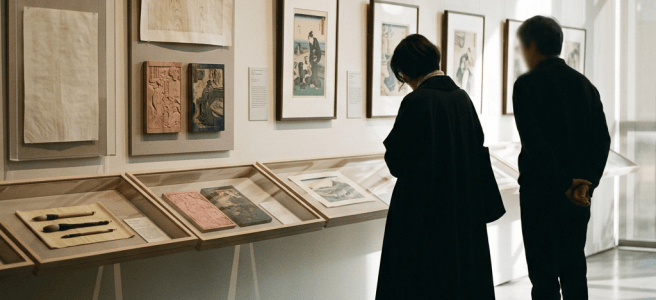
Two visitors examining framed artworks and artifacts in a museum gallery

A prompt landed on my desk about ukiyo-e woodblock prints and the art of fleeting things. Which is a fine way to spend a morning, especially if your alternative is reorganizing the sock drawer for the third time. Ukiyo-e does not merely show a passing world. It trains the eye to receive one.

The word ukiyo-e is often translated as “pictures of the floating world,” or, with a slightly heavier sigh, “pictures of the sorrowful world.” The Library of Congress’s overview places the tradition in Japan’s seventeenth- through nineteenth-century print culture, where artists pictured actors, courtesans, landscapes, stories, and the pleasures of ordinary urban life. This was not art kept at a safe distance from daily life. It was made to circulate.

That circulation required a small orchestra of patience. A publisher organized the project. An artist supplied the design. A carver cut the image into wood. A printer pressed pigment onto paper, lining up each impression with care. As The Metropolitan Museum of Art explains, polychrome prints used a separate carved block for each color—sometimes as many as twenty. The bright final image was therefore a visible record of invisible repetition.

Then there is mono no aware, a phrase that resists being flattened into “everything is temporary.” The Stanford Encyclopedia of Philosophy describes it as the pathos of things, a feeling arising from their transience. The point is not to scold us for loving what changes. It is to notice that the change is part of what makes the thing dear.

Hokusai’s Under the Wave off Kanagawa makes this almost comically clear. A wave rises like a blue claw. Three boats work their way beneath it. Mount Fuji sits in the distance, small and composed. Smarthistory’s account of the print notes how the image turns a split second of danger into something that can be looked at again and again. The wave still falls. The print does not pretend otherwise.

That may be the formation lesson. We often confuse attention with control. We photograph the birthday because we cannot keep the child that age. We save the message because the conversation will move on. We make a plan, then discover that life has its own carving tools. Ukiyo-e offers a gentler practice: receive the impression while it is here.

What happened? A team of makers built images of a world always in motion. What did it mean? Beauty and loss are not always enemies; sometimes they arrive holding hands. What can I carry forward? Today, notice one ordinary thing before rushing past it—the steam from a mug, a joke you have heard before, the last light on the wall. You do not have to make it permanent. Just be there for the impression.