The Song That Asked a Generation Not to Disappear

Empty school hallway with colorful lockers and large sunset-lit windows

I used to think “Don’t You (Forget About Me)” was just the song that played while Judd Nelson raised his fist. A very 1985 sentence. Probably the sort of sentence that should come with a denim jacket.

But listen again. The song is doing something more interesting than decorating the final shot of The Breakfast Club. It is asking a group of people who have been reduced to labels to remember one another as whole human beings.

The song was written for the movie by producer Keith Forsey and guitarist Steve Schiff. Simple Minds initially declined to record it because the band wanted to make its own material. Then Forsey came to meet them, and the story took a turn familiar to anyone who has ever been persuaded by a conversation over a drink: the Scots went to the pub with him, liked him, and reconsidered. The Guardian’s account of how the song was made captures that lovely bit of creative resistance giving way to human connection.

The result became Simple Minds’ biggest North American hit, reaching No. 1 in the United States and Canada. In Britain, it reached No. 7, according to Official Charts. Numbers are useful here, not because a chart position tells us whether a song is good, but because it shows how widely this particular plea traveled.

And the plea matters because the film understood something about formation. The five students in detention are introduced as types: the brain, the athlete, the basket case, the princess, and the criminal. Then the locked room gets uncomfortable. They confess things. They listen badly, then better. The categories do not vanish, exactly. They become too small.

That is why the Library of Congress added The Breakfast Club to the National Film Registry in 2016, naming it among films of cultural, historic, or aesthetic importance. The announcement called it a seminal coming-of-age drama. “Seminal” can sound like a museum label, but the point is simple: a movie about teenagers in a Saturday detention room kept giving later generations a vocabulary for feeling mis-seen.

Formation often begins when someone refuses the label that has been handed to him. Not with a grand reinvention. With the smaller courage of saying, “That is part of me, but it is not all of me.”

What happened? A film song became an anthem. What did it mean? A generation heard its private ache turned into a public chorus. What can I carry forward? When I am tempted to summarize someone quickly — difficult, lazy, successful, dramatic — I can leave room for the locked-room conversation I have not heard yet.

And maybe, before the day ends, I can ask one person a better question than “How’s it going?” Maybe: “What part of you have I forgotten to notice?”
The Tender Little Heart Inside a One-Hit Wonder

Microphone on a studio stage surrounded by vinyl records and instruments

I have a theory about 1980s one-hit wonders: they are where the decade’s hairspray occasionally lost an argument with the human heart.

You know the songs. The synth starts. The drum machine puts on its shoulder pads. Somebody in the room says, “Oh, I remember this,” and suddenly we are all back in a car we no longer own, wearing a jacket we should not have bought.

The joke is that these songs were disposable. One big single, then the cultural trapdoor. But listen again and a surprising amount of sincerity is still down there, humming beneath the gated reverb.

Take Nena’s “99 Luftballons.” It arrived as bright, bouncy new wave, the sort of tune that could make geopolitical dread sound almost danceable. Yet Deutsche Welle’s history of the song explains the grim little engine underneath: balloons appear on radar as possible enemy objects, both sides assume the worst, and fear escalates toward nuclear war. The song reached No. 2 on the U.S. Billboard chart. That is an astonishing amount of public attention for a warning about how quickly panic can dress itself up as patriotism.

Or “The Safety Dance,” which I once assumed was about safe sex, because the 1980s gave us many mysteries and very few instruction manuals. Ivan Doroschuk told Time Out that the song came from being kicked out of clubs for pogoing. The message was simpler and sweeter: you can dance if you want to. You do not have to borrow the crowd’s rhythm to prove you belong.

Then there is ’Til Tuesday’s “Voices Carry,” a song that could have been reduced to a stylish new-wave chorus and an excellent haircut. Instead, it carried a painful story. Stereogum’s interview with Aimee Mann describes it as a harrowing account of a woman trapped in an abusive relationship. The song was a top-10 hit, but its real staying power comes from the way the polished surface lets a frightened voice remain audible.

Maybe that is the unexpected sincerity. These songs were not always “deep” in the way a professor with elbow patches means deep. They were simply specific. A balloon. A bouncer. A person being told to hush. Small details, carrying larger fears and hopes.

That is how formation often works, too. Not through a grand speech, but through repeated little signals: the song we keep playing, the boundary we finally name, the joke that stops being funny because we have started hearing the hurt inside it. Culture forms us by giving feelings a shape we can recognize.

What happened? A glossy decade made room for strange, earnest songs. What did it mean? Sincerity can hide inside bright packaging without becoming less sincere. What can I carry forward? Before dismissing the old song, the old story, or the old version of myself as cheesy, listen one more time. There may be a small human voice in there, still asking to be heard.

When MTV Taught a Generation to See

Retro collage of vinyl records, cassette tapes, radio dials, and dancing silhouettes

At 12:01 a.m. on August 1, 1981, a new cable channel introduced itself with a sentence that sounded half like a concert emcee and half like a dare: “Ladies and gentlemen, rock and roll.” Then came the Buggles’ “Video Killed the Radio Star.” Britannica records the moment as MTV’s debut, and the first music video ever broadcast on the channel.

The opening sequence had an almost comic amount of ambition: space imagery, a moon, an MTV flag. The little network wanted to make music feel like an event. It did not yet have the reach to match the drama. The initial broadcast was available only to a small number of cable households in New Jersey, and distribution was hard to come by. NPR’s account of the first 100 videos notes that plenty of music-industry people expected the idea to fail.

That is part of the charm of the first year. MTV was not yet a monument. It was a strange little experiment that asked a strange little question: what if a song did not merely sound like something, but looked like something?

Radio had already taught us to carry music around in our heads. MTV added faces, clothes, rooms, gestures, choreography, and story. The five original video jockeys—Martha Quinn, Nina Blackwood, Alan Hunter, J.J. Jackson, and Mark Goodman—did not just introduce songs. They helped make the channel feel like a place you could visit. The screen became a kind of hallway where music, fashion, and personality kept bumping into one another.

The effect was bigger than a new way to promote records. A Newcastle University history of MTV describes how heavy rotation made visual image central to mainstream pop. A hit single now arrived with a look: the lighting, the jacket, the dance, the fantasy of the artist’s life. A song could become a short film, a commercial, and a little piece of mythology at the same time.

That formed people. Not in the grand, sermon-on-the-mount sense. More like a daily drip. We learned what confidence looked like before we had language for it. We learned that reinvention might involve a haircut, a hallway, a leather jacket, or simply the nerve to appear on camera as someone new. Some of us also learned to confuse a polished image with a whole person. Formation is rarely pure; it is usually a bundle of gifts and distortions.

And MTV’s early visual imagination had real blind spots. The Smithsonian’s history notes that the channel’s rock-oriented programming featured very few Black artists in its early years, a limitation challenged publicly by David Bowie and others. A truthful nostalgia keeps the wonder and the omission in the same frame.

So, what happened? A tiny cable experiment made sight part of the song. What did it mean? For a generation, music became a visual language for identity, aspiration, and belonging. What can we carry forward? Notice what is teaching you to see—and remember that every image, however thrilling, is still only one angle on a human life.

Take On Me and the Courage to Leave the Panel

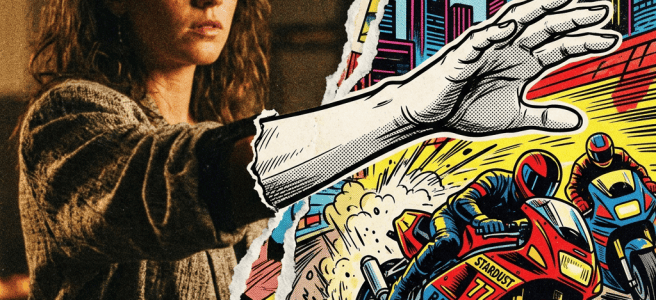
Woman beside comic motorcycle race labeled STARDUST RACING 77

There is a moment in a-ha’s “Take On Me” when the girl looks up from her coffee and realizes the comic-book hero is looking back. It is a wonderfully 1985 idea: romance as a portal, pencil lines as a doorway, and a chorus that sounds like somebody asking for one brave chance.

Then the video does something more interesting. It refuses to let the two worlds stay separate.

If you have somehow missed it, the video moves between live action and a black-and-white comic drawn in loose pencil. The technique is rotoscoping: filming movement, then drawing over the frames. The BBC’s account of the video’s making says animator Michael Patterson spent 16 weeks sketching roughly 3,000 drawings. That is not a weekend project. That is a small mountain of patient marks.

The official credits at Patterson and Reckinger’s site name Michael Patterson and Candace Reckinger as the animation directors. Their work gives the video its strange double vision: the comic feels more alive than the café, while the café feels safer than the comic. One world is exciting but dangerous. The other is ordinary but solid.

That tension is the whole song’s emotional engine. “Take On Me” is not just asking, “Do you like me?” It is asking, “Will you come with me, even though the place I’m inviting you into is unfinished?” The comic hero is literally sketched in. He has no polished edges. He is a possibility with a motorcycle.

And then comes the escape. The girl returns to the ordinary world, but the ordinary world has been altered. The strange thing has followed her home. Or perhaps she has learned to see the room differently. That is what longing often does. It does not simply make us dissatisfied with the present. It gives the present a second outline.

My favorite part is that the video does not treat reinvention as a clean makeover. There is no triumphant “new you” montage with suspiciously good lighting. The transition is messy. It involves fear, a torn page, and a person who has to decide whether the familiar world is still enough.

The song’s public life followed a similar path. Official Charts records a 19-week UK chart run, while the video became a defining example of how an ambitious visual could change a pop song’s reach. The band did not merely release a track; they built a doorway around it.

So what happened? A Norwegian band made a pop song and paired it with an unusually labor-intensive animated film. What did it mean? Millions of listeners were invited to believe that longing could be both frightening and creative. What can we carry forward? Maybe this: reinvention rarely begins with a finished plan. It begins with a line, then another, then the willingness to step through the panel before you know how the story ends.

What is one unfinished possibility you keep treating as if it needs to be polished before you can enter it?