What Dad Jokes Know About Market Timing

Abstract financial chart with rising candlesticks and glowing orbital lines

I have a theory about dad jokes: they are less about being funny than about arriving at exactly the wrong—therefore right—moment.

My children can see one coming from three rooms away. I set up the question. I pause. I deliver the pun. They groan with the weary dignity of people who have been asked to inspect one more “dad joke” portfolio. And yet, if I tell it too early, it dies. Too late, and the room has moved on. The joke needs a little runway.

That is timing. Not stopwatch timing. Relational timing.

A joke works by asking the listener to build one interpretation, then nudging them into another. A 2023 study in Frontiers in Psychology describes this as a kind of incongruity-resolution process: the punchline changes the frame, and the mind has to catch up. The laugh is often the sound of that catch-up.

There is something humbling here for a man who once thought a well-timed joke meant simply waiting three seconds before the punchline. The real question is not, “Have I found the perfect delay?” It is, “Is this person ready for this turn?”

Markets ask a similar question, only with more zeros and fewer forgiving teenagers.

Every investor wants to buy before the good news and sell before the bad news. That is the financial version of landing the punchline before anyone has heard the setup. Sometimes it works. More often, the moment you think you have mastered the rhythm, the market changes the joke.

Vanguard notes that the best and worst market days tend to cluster closely together, which means an investor who steps out to avoid the bad days may also miss the rebound. In one Vanguard illustration, a $100,000 investment in a balanced 60/40 portfolio grew to $865,000 over roughly 28 years if it stayed invested; missing the 25 best days reduced ending wealth by about $520,000. The example assumes no fees, taxes, or additional cash flows, and it is not a promise about the future. It is a picture of how quickly “I’ll get back in later” can become a very expensive pause. Read the details in Vanguard’s analysis.

This does not mean every joke deserves a laugh, or every portfolio deserves blind loyalty. A dad joke can be kind, or it can be a hostage situation. A portfolio still needs a plan, diversification, and the occasional honest review. Vanguard’s separate market-timing guidance makes the narrower point: nobody reliably knows in advance which days will be the best or worst.

My fatherly lesson is therefore modest. Keep the setup. Know your audience. Leave room for the turn. In comedy, patience gives the other person a chance to arrive at the joke. In investing, patience gives your plan a chance to survive your mood.

What happened? A pun created a tiny surprise. What did it mean? Timing is less about control than attention. What can I carry forward? Before I reach for the perfect moment, I can ask whether a faithful, ordinary rhythm might be wiser.

And if that sounds like a joke, please wait three seconds before groaning.
The Song in the Prompt: What Suno Can Make—and What a Human Still Has to Mean

Editorial featured image for an article about Suno AI music generation and human creativity. Split composition: on the left, abstract code, algorithms, glowing waveform data, and digital audio controls; on the right, handwritten lyrics, a vintage microphone, and a human performer’s emotional creative presence. The two halves blend through colorful musical waveforms. Sophisticated, thought-provoking, album-cover-inspired, cinematic lighting, no readable text, landscape orientation.

I made a song with Suno the other day. “Made” may be doing a little heavy lifting there. I typed a mood, a subject, and a few musical breadcrumbs; the machine handed me a finished track before I had time to locate my reading glasses.

That is Suno’s genuine trick. Its own how-to guide says a user can describe a genre, mood, instrumentation, tempo, or lyrics, and the system will generate a song with structure, instruments, and vocals. It returns two versions. You pick one, revise, extend, and try again. For the first ten minutes, it feels like having a very fast studio band that never asks whether you have paid the deposit.

And yet, “fast” is not the same as “deep.” Suno is excellent at turning a direction into an object. It can give you atmosphere, polish, and a surprisingly convincing chorus. It can help a stuck songwriter get unstuck. It can also produce the musical equivalent of a handsome hotel lobby: pleasant, competent, and hard to remember once you leave.

The human songwriter is doing something stranger. She is not merely arranging sounds. She is deciding which embarrassment to keep. Which line is too true. Which silence belongs before the chorus because that is where the father stopped calling, or the marriage ended, or the kid finally came home. A songwriter brings consequences to the room. The song is shaped not only by taste, but by a life that has had to live with its choices.

There is some evidence for this distinction, with an important asterisk. A 2026 MIT Media Lab report on a controlled study of 152 participants compared SunoAI tracks with music by human composers in calming and energizing settings. Human-composed music elicited the target emotions more effectively, even when listeners said they preferred the AI music. That is not a verdict on every song, or every listener. It is a useful reminder that liking a sound and being moved by it are not always the same thing.

There is another wrinkle. The U.S. Copyright Office’s January 2025 report says human authorship is required for copyright protection. Under current generally available technology, a prompt alone usually does not give a user enough control over the expressive elements to make that user the author of the output. Human-written lyrics, creative arrangement, and substantial edits can matter. Typing “make it sadder” 117 times is not, by itself, a songwriting apprenticeship.

So what happened? A machine made a very usable musical sketch. What did it mean? The sketch was not the same thing as a song with a history. What can we carry forward? Use the tool for speed, surprise, and play. Then bring the part no model can supply on command: attention to a particular life.

And before you release anything, check the rules. Suno’s rights-and-ownership guidance says free-plan songs are for personal, non-commercial use, while songs made while subscribed to Pro or Premier receive commercial-use rights; those rights are not automatically retroactive. The machine may be quick. The fine print, like a good bridge, deserves another listen.

The Dad Joke Lab: Why Puns Make the Brain Do a Little Rebuild

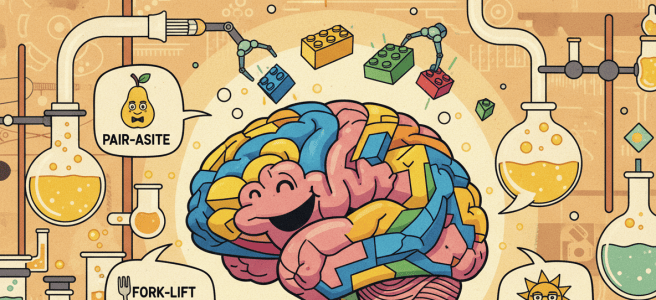
A clever, colorful editorial illustration for a blog post titled “The Dad Joke Lab: Why Puns Make the Brain Do a Little Rebuild.” Show a playful laboratory scene where a smiling brain rebuilds itself with tiny LEGO-like parts, speech bubbles containing harmless visual wordplay, and a warm humorous science-magazine aesthetic. No readable text, no logos, landscape composition suitable as a WordPress featured image.

I have a theory about dad jokes: they are not failed attempts at comedy. They are tiny household experiments in how meaning gets made.

Take the classic: “I’m reading a book about anti-gravity. It’s impossible to put down.” You can feel the eye-roll arriving before the laugh. The joke begins in one frame—gravity, perhaps, a book that is compelling—and then the last phrase quietly swaps the frame. “Put down” means stop reading. It also means set something on a surface. The pun makes your mind hold both meanings, then asks one to step forward wearing a fake mustache.

That little stumble is the engine. Researchers often describe humor comprehension as a two-part dance: first, the brain detects an incongruity; then it resolves the mismatch by finding a workable interpretation. A 2017 fMRI study in Frontiers in Psychology describes the punch line as a re-comprehension of the setup, a small reinterpretation that can feel like an insight. In its sample of 24 participants, 75 percent reported experiencing insight when they understood the jokes. That is a modest study, not a decree from Mount Neuroscience, but it gives the dad joke a respectable job description.

Puns turn the volume up on this process because language is slippery by design. One sound can point to two words. One phrase can carry two routes. The brain has to keep the first route available long enough to notice that the punch line has opened a side door.

A study of 27 native Mandarin speakers, using jokes built around ambiguity, inference, and exaggeration, found that different joke mechanisms recruited partly different patterns of brain activity. The ambiguity jokes required readers to return to the language of the setup and construct another interpretation. That is exactly what a pun asks us to do, except usually with less fMRI equipment and more groaning at the dinner table. The study is here.

Another fMRI study, this one with 17 participants viewing visual puns and other cartoons, separated detecting an incongruity from resolving it. The researchers linked resolution to a left-sided network that included the temporo-parietal junction, inferior frontal gyrus, and ventromedial prefrontal cortex. Translation into uncle-language: the laugh is not only in spotting that something is off. It is in finding the bridge back to sense. Read the PubMed summary.

This may be why a good pun feels briefly satisfying even when it is objectively terrible. The joke gives the mind a small problem, then lets it solve the problem without consequences. No quarterly earnings call. No family group-chat misunderstanding. Just “sole” becoming “soul,” and everyone gets to cross the little bridge together.

What happened? A sentence changed shape. What did it mean? Understanding often requires holding two possibilities before choosing the one that fits. What can we carry forward? Perhaps a little patience with confusion—our own and somebody else’s. Sometimes the mind is not lost. It is looking for the second meaning.

And if that sounds too serious, I have another one: I told my family I was going to write about puns. They said, “That’s a play on words.” I said, “Exactly.”

Untitled

Retelling the stories that bring people together.

Do you think that makes sense?  It tells us of your intentions.  Is it necessary that we weep?  No sir, I meant to include joy, relief, pain, grief, the pulling emotions of what reminds us as the planetside wanderers that we’re not alone.  In all the stories we like to tell and retell, the greatest character we enjoy telling of is ourselves.  So in your searches for intelligent lifeforms, don’t forget yourselves sapient ones; knowing and in the learning of ourselves the in ourselves we find our ails.  Loneliness it is.

We have one another, you know.

Tsk.  In the world we declare that we are connected, but I say jaded and discontent intentionentally… divided.  I say rage for that night under stars and works of fire.  Rage for the heart that struggles to bring things together.  In parts, we are nothing.  Apart meant for only tenants in little cages that captures our souls, entangled.