Ukiyo-e and the Courage to Notice What Won’t Stay

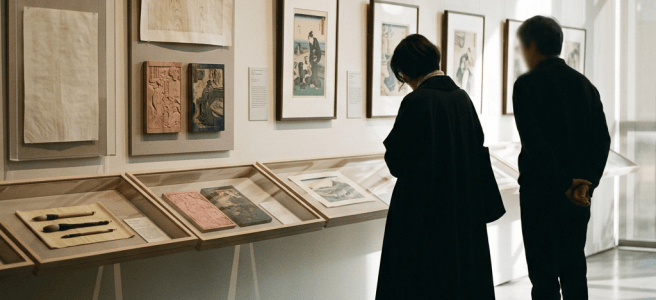
Two visitors examining framed artworks and artifacts in a museum gallery

A prompt landed on my desk about ukiyo-e woodblock prints and the art of fleeting things. Which is a fine way to spend a morning, especially if your alternative is reorganizing the sock drawer for the third time. Ukiyo-e does not merely show a passing world. It trains the eye to receive one.

The word ukiyo-e is often translated as “pictures of the floating world,” or, with a slightly heavier sigh, “pictures of the sorrowful world.” The Library of Congress’s overview places the tradition in Japan’s seventeenth- through nineteenth-century print culture, where artists pictured actors, courtesans, landscapes, stories, and the pleasures of ordinary urban life. This was not art kept at a safe distance from daily life. It was made to circulate.

That circulation required a small orchestra of patience. A publisher organized the project. An artist supplied the design. A carver cut the image into wood. A printer pressed pigment onto paper, lining up each impression with care. As The Metropolitan Museum of Art explains, polychrome prints used a separate carved block for each color—sometimes as many as twenty. The bright final image was therefore a visible record of invisible repetition.

Then there is mono no aware, a phrase that resists being flattened into “everything is temporary.” The Stanford Encyclopedia of Philosophy describes it as the pathos of things, a feeling arising from their transience. The point is not to scold us for loving what changes. It is to notice that the change is part of what makes the thing dear.

Hokusai’s Under the Wave off Kanagawa makes this almost comically clear. A wave rises like a blue claw. Three boats work their way beneath it. Mount Fuji sits in the distance, small and composed. Smarthistory’s account of the print notes how the image turns a split second of danger into something that can be looked at again and again. The wave still falls. The print does not pretend otherwise.

That may be the formation lesson. We often confuse attention with control. We photograph the birthday because we cannot keep the child that age. We save the message because the conversation will move on. We make a plan, then discover that life has its own carving tools. Ukiyo-e offers a gentler practice: receive the impression while it is here.

What happened? A team of makers built images of a world always in motion. What did it mean? Beauty and loss are not always enemies; sometimes they arrive holding hands. What can I carry forward? Today, notice one ordinary thing before rushing past it—the steam from a mug, a joke you have heard before, the last light on the wall. You do not have to make it permanent. Just be there for the impression.

The Shinkansen’s Formation Lesson: Punctuality Is Built, Not Born

Bullet train crossing rural rice fields with Mount Fuji in background

I have a confession: I am the sort of person who considers a train arriving “only” four minutes late a minor weather event. Somewhere between the platform and the coffee machine, I have already rewritten the morning.

Then there is the Shinkansen.

The Tokaido Shinkansen opened on October 1, 1964, linking Tokyo and Osaka just before the Tokyo Olympics. It cut the trip from six and a half hours to four; after a sensible bedding-in period, the 1965 timetable brought it down to three hours and ten minutes, according to the Japan Railway & Transport Review. A national project arrived not merely fast, but with a new relationship to time.

Today, JR Central reports an average delay of 1.6 minutes per train on the Tokaido line in fiscal year 2023, including delays caused by natural disasters. That is not a claim that Japan has defeated weather, earthquakes, or the occasional disgruntled pigeon. It is a reminder that reliability is measured across the real world, not a laboratory. The figure comes from JR Central’s own Shinkansen overview.

But punctuality is not a national personality trait that descends from the clouds and taps everyone on the shoulder. It is formed.

Dedicated tracks keep the trains away from many outside disturbances. Control systems, maintenance crews, detailed timetables, and operations-room staff all do their quiet work before a passenger ever hears the familiar chime. One account of the system describes drivers who can reach a destination within five seconds of schedule and stop within a centimeter of the prescribed position—precision made possible by an entire supporting organization, not heroic willpower alone. Read the wider story in Japan Policy Forum’s account of the high-speed rail network.

Even passengers were part of the formation. In 1925, Japan National Railways posted rules explaining that people getting off should go first, followed by those boarding. Shorter station stops meant more capacity without immediately buying more trains. In other words, the system taught people how to make the system work. Manners became infrastructure.

That line stays with me. We often imagine character as something stored inside us, like a coin in a pocket. The Shinkansen suggests another picture: character is also the arrangement of the track, the timetable, the checklist, the well-rehearsed response when something goes wrong. We become dependable partly by practicing, and partly by building surroundings that make the dependable choice easier.

So, a small evening examen. What happened? A train became a symbol of national modernity, then a daily exercise in coordination. What did it mean? Quiet excellence is rarely quiet because nothing is happening; it is quiet because thousands of small acts are happening on purpose. What can I carry forward? Perhaps one timetable for tomorrow, one five-minute reset, one place where I stop relying on last-minute inspiration.

Not every life needs to run on bullet-train precision. Mine certainly does not. But maybe the next faithful step is less about becoming a more disciplined person and more about laying a little better track.

What a Japanese Konbini Teaches About Quiet Excellence

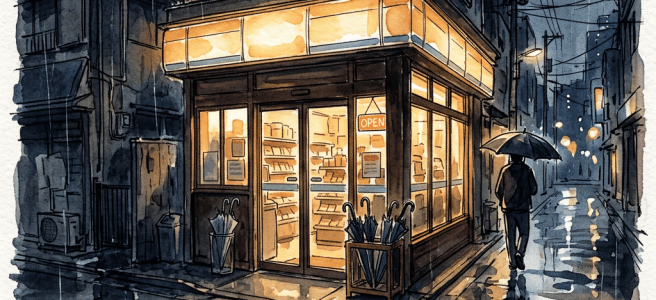
Illuminated corner shop with an OPEN sign on a rainy city street

I have a weakness for Japanese convenience stores. Give me ten minutes in a konbini and I will emerge with an onigiri, a coffee, and the vague conviction that I have briefly become a more organized person.

The joke works because the store feels so un-dramatic. No grand entrance. No luxury branding. Just bright shelves, a polite greeting, and the quiet sense that somebody has thought through the next five minutes of your life.

“Konbini” is short for convenience store, but that English phrase undersells the institution. A scholarly essay on Japanese food culture describes the konbini as one of contemporary Japan’s “peculiar institutions,” alongside the vending machine, and places it inside a larger story about modernity, speed, and convenience. The point is not that every Japanese shop is perfect. It is that these stores have become woven into ordinary life. The essay is worth reading for both the convenience and its discontents.

The scale is substantial. Japan’s Ministry of Economy, Trade and Industry reported convenience-store sales of ¥12.8887 trillion in 2024, counting goods and services together. The METI review is a useful reminder that “convenience” is not merely a feeling; it is a serious retail system. The Japan Franchise Association also publishes monthly and annual data on store sales and store numbers, which you can see in its statistical archive.

And then there are the small acts of infrastructure. At Seven-Eleven, the multifunction copy machine can print photos, send faxes, order tickets, and—in some municipalities—produce official documents such as residence certificates and tax statements, including on weekends and holidays. The company’s service guide reads less like an advertisement than a list of ways a neighborhood store quietly absorbs friction.

That, to me, is the formation story. Excellence here is not a heroic burst. It is a chain of modest decisions: the right item in the right place, a delivery arriving on time, a package accepted without fuss, a counter kept clean. One recent account of the Japanese model highlights the combination of franchise organization, data and technology, and a reconstructed distribution system. The system is designed, not accidental.

There is a temptation to turn this into a postcard about Japanese perfection. Let’s resist that. Systems have costs. Convenience can mean long hours, demanding work, packaging, and pressure that customers do not see. Respect begins by noticing the people and resources underneath the smooth surface.

Still, the konbini offers a lovely question for the rest of us: where could a little less drama and a little more preparation make someone else’s day easier? In a household, that might be a basket by the door for keys. In a budget, an automatic transfer before the month gets noisy. In faith, five quiet minutes before the day starts making demands.

What happened? A corner shop became part grocery, part post office, part civic counter, part dependable neighbor. What did it mean? Small repeated acts can become a form of care. What can we carry forward? Pick one useful thing, make it easier to repeat, and let the excellence stay quiet.

Ikigai, Translated Honestly: It Is Not Your Perfect Job

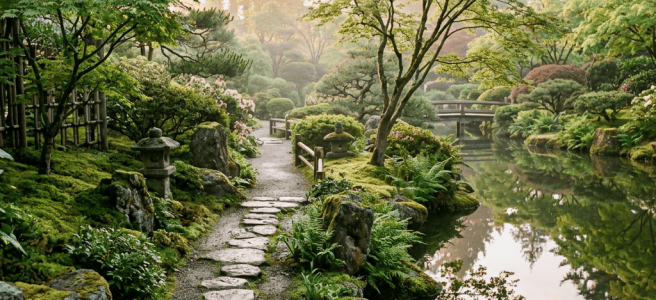
Moss-covered stepping-stone path beside a pond in a Japanese garden

I first met ikigai on a corporate wellness poster. Four circles leaned into one another: what you love, what you are good at, what the world needs, and what you can be paid for. In the middle sat a small, confident promise. Find this intersection and your life will click. Even the diagram looked well-rested.

The trouble is that this is not quite what ikigai means in Japanese. The word is often translated as “a reason for being,” but that translation can sound grander and more career-shaped than the thing itself. The Government of Japan describes it as something that brings value and joy to life. It can be a person—your child, a friend—or an activity, such as work or a hobby. It is less a job title than a felt sense that living is worthwhile.

That wider meaning matters. A word like “purpose” can make us imagine a mission statement, complete with a logo. Ikigai may be much more ordinary: tending a garden, making lunch for people you love, showing up for a club, learning a craft badly for three years before getting slightly less bad. The point is not that these activities are secretly monetizable. The point is that they can make a life feel inhabited.

The academic picture is appropriately humbling. A University of Pennsylvania review of psychological research notes that scholars still lack one consistent definition. Its useful threads are personally valued experiences, authentic relationships, and a sense of direction. That sounds less like a personality quiz and more like a life slowly teaching us what gives it weight.

Which brings us back to the famous four-circle graphic. It is a handy worksheet for thinking about work. It is not an ancient Japanese map. Marc Winn’s own account says that in 2014 he joined the word ikigai to Andrés Zuzunaga’s existing purpose diagram. That is a perfectly legitimate creative mash-up. It just should not be presented as a literal translation of a Japanese tradition. A foreign word can add mystery to a framework; it cannot make the framework native.

There is real reason to take the concept seriously, without turning it into a productivity hack. In a large Japanese cohort study of 73,272 adults, researchers found that people who reported having ikigai had lower all-cause mortality during follow-up. The authors described an association with longevity, not proof that a cheerful hobby causes a longer life. The PubMed record is a useful antidote to both cynicism and hype.

So, what happened? A modest Japanese word traveled into the English-speaking self-help world, picked up a four-circle diagram, and became a career brand. What did it mean? The word itself remained more spacious than the brand: value and joy can arrive through people, practices, and small loyalties, not only through a vocation. What can we carry forward? Instead of asking, “What is my one perfect purpose?” try asking, “What made life feel quietly worth living this week?” Then notice the answer before turning it into a business plan.

Kintsugi and the Next Careful Repair

Kintsugi-repaired ceramic mug beside broken pottery pieces on wooden table

I broke a favorite mug last month. Not dramatically—no cinematic slow motion, just an elbow, a tile floor, and the small domestic silence that follows. I swept up the pieces and wondered whether the mug had become trash or a project.

Kintsugi, the Japanese craft of repairing broken ceramics with lacquer and powdered metal, offers a third category: not new, not ruined. Re-made. Japan’s National Crafts Museum describes it as a technique for repairing cracks and chips with lacquer and gold powder, rooted in preserving objects and passing them down. That is a sturdier idea than “everything happens for a reason.” Sometimes things simply break.

The technical detail matters. Traditional repairs use urushi, a tree-based lacquer that acts as an adhesive; the gold is not the glue, but the visible finish. The Smithsonian’s Folklife program notes that a traditional project can take up to three months, and that wet urushi can irritate skin even though it is harmless once dry. In other words, the pretty line on the finished bowl is the last chapter of a long, careful process. Gold gets the photograph. Patience does the work.

That is where the metaphor becomes useful—and where I want to handle it gently. A scholarly study of kintsugi warns us not to reduce the practice to the slogan that damage automatically makes an object more beautiful. The break still names a catastrophe. The repair names an amelioration. Both remain visible. Kintsugi is not pretending the crack was secretly good news.

This has obvious applications to money. A failed business, a layoff, a foolish purchase, or a season of debt can leave a seam in the household story. We do not need to gild the mistake or turn it into a personality. We can name what happened, repair what is repairable, and let the new habits show where the work was done: a smaller fixed expense, an honest conversation, an emergency fund built one transfer at a time.

It also has a spiritual edge, though not a shortcut. The repaired bowl is not valuable because it suffered. It is valuable because someone stayed with it. Someone cleaned the edges, fitted the pieces, waited for the lacquer to cure, and refused the easy conclusion that broken means finished. That feels close to the quiet work of formation: not self-invention, but faithful return.

So, what happened? A vessel broke. What did it mean? The break became part of its history, but not the whole of it. What can we carry forward? This week, choose one damaged place—financial, relational, or inward—and ask a less heroic question: what is the next careful repair?

The Meiji Restoration: How a Nation Was Formed Under Pressure

Steam locomotive passing traditional Japanese buildings in a mountain town

I used to think national character was something a country simply possessed, like a flag or a favorite snack. History is less tidy. Sometimes a nation is formed in public, under pressure, while everyone is arguing about what must be saved and what must change.

Japan’s Meiji Restoration is one of the clearest examples. In 1853, Commodore Matthew Perry arrived in Edo Bay with American warships. The Tokugawa shogunate, which had governed Japan for more than 250 years, was forced to open the country and sign unequal treaties. The shock was not only military. It was psychological: an old political order suddenly looked unable to protect the country’s independence. Encyclopaedia Britannica’s account describes the resulting pressure from foreign powers, famine, peasant unrest, and samurai debt.

What followed was not a neat handoff. On January 3, 1868, reform-minded samurai and court allies seized control in Kyoto and announced the restoration of imperial rule. The Boshin War continued into 1869. As historian Chushichi Tsuzuki notes in Oxford Academic, calling the whole process a “restoration” can hide the fact that a small group of leaders was building a new state while speaking in the language of old authority.

That tension makes the story useful for thinking about formation. The new government did not merely ask, “What do we believe?” It asked, “What practices will make those beliefs durable?” Domains were replaced by prefectures. A national army and conscription followed. Schools, railways, telegraphs, tax systems, and new industries tied distant places to a central government. Within five years, the reformers had dismantled much of the Tokugawa structure and begun assembling the machinery of a modern nation. The Ohio State University’s Origins essay calls this the “spirit of 1868”: the event mattered, but the habits and institutions that followed mattered more.

Then there was the Charter Oath. Its five articles called for public discussion, cooperation across classes, freedom to pursue one’s calling, a break with harmful customs, and the search for knowledge throughout the world. Britannica’s translation of the oath sounds surprisingly fresh: learn widely, consult others, and do not confuse inherited practice with permanent wisdom.

But formation is never the same as perfection. The modernization story also carried coercion, exclusion, industrial disease, and the colonization of Ainu lands. The reforms created new possibilities while imposing new burdens. A country can become more capable without becoming uniformly just. That is not a footnote; it is part of the history.

So, what happened? Japan faced external danger and internal strain, then rebuilt its political and social machinery at remarkable speed. What did it mean? National identity is not only inherited; it is practiced through institutions, education, infrastructure, and the stories leaders tell about change. What can we carry forward? Under pressure, we may need to learn quickly without pretending every “new” thing is good—or every old thing is disposable.

Perhaps the small examen is this: when life asks us to change, which parts of our formation are sturdy enough to keep, and which parts have simply been waiting for a crisis to be questioned?

The Warrior Way of a Boring Budget

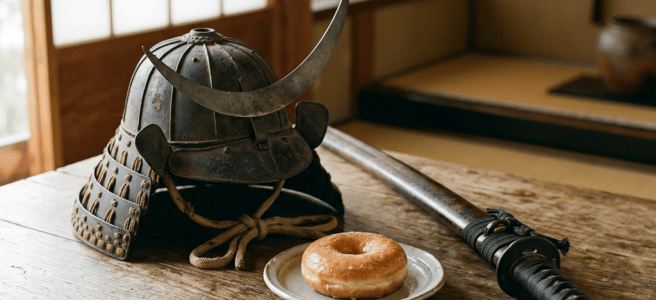
Samurai helmet, sword, and glazed doughnut on a wooden table

I once saw a coffee mug that said, “Train like a samurai.” It was beside a plate of office doughnuts. I admired the ambition and ate the doughnut.

Still, the question is useful: what would a warrior ethic have to do with a household budget?

First, a small historical brake pedal. Bushido is often presented as one timeless Japanese code. It was not quite that tidy. A University of British Columbia study notes that premodern warriors did not share one universally accepted ethic; ideas and loyalties shifted by era and region. Even the word bushido appears late and changed meaning over time. Britannica’s overview likewise traces a changing tradition, shaped by Buddhist and Confucian thought and later repurposed for modern national instruction.

So this is not an attempt to turn your 401(k) into a miniature castle keep. It is a modest borrowing: a few virtues, translated carefully into ordinary money decisions.

1. Frugality is freedom, not a costume.

Frugal living was among the qualities associated with Bushido in later summaries. In personal finance, that does not mean performing poverty or refusing every pleasant thing. It means making enough room between income and spending that a surprise bill does not become a personal crisis. A budget is less a punishment than a little patch of open ground.

2. Discipline beats mood.

The samurai image is all dramatic resolve: rain, sword, excellent posture. Most financial progress is less cinematic. It is an automatic transfer on payday, repeated while you are tired, distracted, or mildly annoyed. Investor.gov recommends automatic deposits to an emergency fund and regular investing over time, even suggesting a fixed affordable amount or a portion such as 5% or 10% of income. The virtue here is not intensity. It is returning to the practice.

3. Courage includes refusing the exciting mistake.

Courage in investing is not clicking “buy” on the loudest story in the room. Sometimes it is declining a hot tip, paying down expensive debt, or keeping emergency savings somewhere boring and accessible. The brave choice may look, from the outside, like nothing happened. That is often the point.

4. Loyalty needs a better object.

Historical Bushido could place supreme loyalty in a lord or state. We should not import that hierarchy into family finances. But we can ask what our money serves: a child’s stability, a spouse’s breathing room, a future self who may be sick or between jobs. A savings plan is a small declaration of allegiance to people and purposes beyond today’s impulse.

What happened? A varied warrior tradition was later gathered into a powerful story about character. What did it mean? Discipline is not a personality trait reserved for heroes; it is a structure that helps ordinary people keep promises. What can we carry forward? Choose one quiet practice: an automatic transfer, a weekly spending check, or a 24-hour pause before a major purchase.

No sword required. The doughnut remains optional.

The Tea Ceremony’s Quiet Lesson: Attention Is a Way of Life

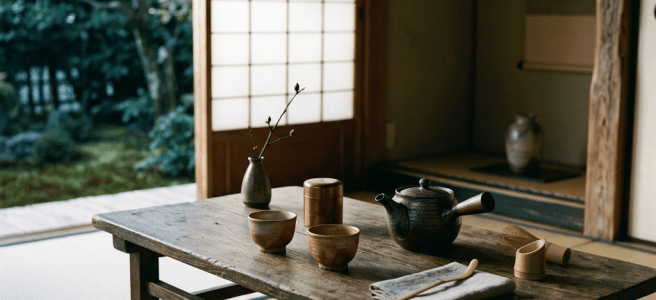
Tea table with teapot, cups, whisk, and vase beside a Japanese garden

I have a bad habit of drinking tea while doing three other things. I answer a message, glance at the news, and then wonder why the cup went cold. This is not a failure of tea. The tea has been giving me a perfectly clear assignment. I just keep submitting the wrong homework.

Chanoyu—often translated as “hot water for tea”—is a Japanese practice that turns an ordinary act into a carefully held encounter. The Metropolitan Museum of Art describes a small tea room where host, guests, utensils, garden, and season meet. The room is intimate. The movements are choreographed. The gathering is never quite repeated.

That last part matters. The Asian Art Museum’s teaching guide explains the phrase ichi-go ichi-e—“one time, one meeting”—as an awareness that each gathering is once in a lifetime. Not because the world is dramatic every minute, but because this minute is not coming back. The tea bowl in your hands is not a prop. It is the thing happening now.

The practice is not casual about attention. Before the tea arrives, the guest notices the scroll, the flowers, the kettle, the brazier. The host purifies the utensils and prepares the bowl in front of everyone. Guests watch with all five senses. Even the beautiful front of the bowl is turned away before drinking, then returned to face the host. Courtesy is taught through the hands before it is explained by the mouth.

Sen no Rikyu’s famous seven rules are wonderfully plain: make a satisfying bowl of tea; heat the water well; offer warmth in winter and coolness in summer; arrange flowers as they grow in the field; prepare ahead; be ready for rain; and show utmost consideration to your guests. The MIT Japanese Tea Ceremony page preserves the list. It sounds less like mysticism than good hosting. Which may be why it is so difficult. Most of us can manage one thoughtful gesture. The formation comes from making thoughtfulness the shape of the room.

The four principles often associated with the Way of Tea—wa (harmony), kei (respect), sei (purity), and jaku (tranquility)—are not four inspirational posters. They are a sequence. Attend to the setting and the other person. Clear what distracts. Then, sometimes, calm arrives. As the Association for Asian Studies notes, the methodical ritual cultivates respect, connection, and being “present in the present.”

What happened? Someone made tea with enough care for a simple cup to become an encounter. What did it mean? Attention is not merely a personality trait; it is a practice, reinforced by rooms, rituals, and repeated gestures. What can I carry forward? Perhaps one cup today with the phone in another room. No grand transformation. Just hot water, a little patience, and the courtesy of actually arriving.