Before Self-Help, There Was Apprenticeship

Two woodworkers assembling a wooden frame at a workshop bench

I have bought enough self-help books to build a small, slightly judgmental bookshelf. Most promise a better life through a plan: wake earlier, track the habit, optimize the morning. Useful, sometimes. But before we learned to call everything a system, people learned by standing near someone who already knew how to do the thing.

That older pattern was apprenticeship. Not a weekend course. Not a motivational quote over a photo of a mountain. You watched, copied, failed, received correction, and tried again. The point was not merely to collect information. It was to become the sort of person who could notice what mattered and respond well.

In early modern Europe, apprenticeship was probably the largest organized form of learning available to ordinary people, and artisans commonly began that way, according to historian Patrick Wallis in Science in Context. The arrangement was imperfect. Masters did not always teach systematically. Apprentices had to find other workshops, books, and teachers. Still, the workshop gave learning a place, a rhythm, and a human face.

The same logic lives in music. A young player does not become a musician by downloading every scale chart. She listens to a teacher phrase a line, tries it, hears where it goes flat, and discovers that “almost right” is a useful address. Modern learning researchers call this cognitive apprenticeship: authentic work beside someone more experienced, with scaffolding, reflection, and even productive failure. In plain English, you get better by doing the real thing with company.

Faith has an apprenticeship shape, too. In the Gospel accounts, Jesus does not simply hand the disciples a syllabus and wish them luck. He says, “Come, follow me.” They watch him pray, teach, welcome, confront, rest, and serve. Then they are sent to practice. One theological account describes those three years of following, watching, and hearing as a kind of theological apprenticeship, aimed at preparing the disciples to continue the work. The pattern is wonderfully concrete: learn a way of life by living near it.

The American story kept this practical tradition in view. The U.S. Department of Labor’s history points to George Washington, Benjamin Franklin, and Paul Revere as early apprentices who later became nationally known. The detail is almost funny: before the résumé, before the personal brand, there was a master, a bench, and a beginner doing the unglamorous work.

What happened? People were formed in proximity to a craft, a community, or a teacher. What did it mean? Skill was never only a private possession; it carried a responsibility to pass something on. What might we carry forward? Choose one practice you respect and find a living example: a musician, craftsperson, elder, or faithful friend. Watch closely. Try the work. Let correction be a gift instead of a verdict. A life may still need goals, but it probably needs a few good teachers more.


Discipline Is a Practice; Self-Punishment Is a Trap

Stacked stones on a moss-covered rock beside a forest stream

I have occasionally confused discipline with being mean to myself. The evidence was compelling: a stern inner monologue, a new rule written in permanent ink, and the temporary satisfaction of feeling like a tiny prison warden. Very productive. Very exhausting.

But discipline and self-punishment are not twins. They are more like cousins who show up to the same family reunion wearing identical sweaters.

Discipline asks, “What helps me practice the good?”

Discipline is a structure that serves a value. I go for the walk because I want to be present for my family. I set a bedtime because tomorrow’s version of me deserves a functioning brain. I put money aside because generosity and stability both need somewhere to stand. The practice may be boring. That is not a bug. Boring is often where character gets its work clothes.

Self-punishment asks a different question: “How can I make failure hurt enough to prove I am serious?” It turns a missed workout, a sharp word, or a wasted hour into a courtroom. The verdict is not merely “I did something unhelpful.” It becomes “I am the kind of person who cannot be trusted.” That is a heavy sentence to carry into the next attempt.

The distinction matters because motivation has different flavors. In their overview of Self-Determination Theory, psychologists Richard Ryan and Edward Deci distinguish motivation supported by autonomy, competence, and relatedness from motivation driven by pressure and control. A rule we freely connect to a meaningful value can become a home. A rule enforced only by fear becomes a landlord who never fixes anything.

This is where self-compassion enters—not as a scented candle for people who have given up, but as a way of staying honest without becoming cruel. The American Psychological Association’s review of self-compassion research notes that it can be learned and is associated with well-being, relationships, physical health, and learning. In other words, treating yourself like a fellow human being is not the same as handing yourself a trophy for showing up late.

Self-compassion still tells the truth. I missed the deadline. I was impatient with my child. I spent money I meant to save. Then it adds the sentence punishment leaves out: I can repair this and practice differently next time.

A small examen for the next stumble

What happened? Name the event without adding a biography. “I skipped the plan” is usually more useful than “I never follow through.”

What did it mean? Maybe the goal was too vague. Maybe the day was overloaded. Maybe you were avoiding discomfort. Curiosity gives you information; shame mostly gives you volume.

What can I carry forward? Keep the standard, change the next step. Make the walk shorter. Move the savings transfer to payday. Apologize before composing the director’s cut of your defense.

Research on self-compassion describes it as a healthier way to relate to oneself, one that can support initiative rather than excuse passivity. That sounds like the formation I want: not a softer life, necessarily, but a sturdier way to return to it.

What happened? I failed at a practice. What did it mean? I am still being formed. What will I carry forward? Discipline can hold the line without picking up a stick.

What Raising Kids Taught Me About Compounding

Adult and child watching ripples spread across a sunset pond

I used to think patience was a personality trait. Some people had it. Some people, like me, had a charming little emergency supply that ran out around 4:17 p.m.

Then I had children, and discovered that patience is less like a virtue you own and more like a muscle you use while someone asks the same question for the ninth time. It grows in small, mostly unphotogenic repetitions.

The money analogy is useful—but incomplete

We usually meet “compounding” in a finance conversation. Investor.gov defines compound interest as earning interest on interest. Its simple example begins with $100 at 5 percent: $105 after year one, $110.25 after year two, and more than $162 after ten years, even without another deposit. Time gives small gains a chance to earn their own gains.

Children do something similar to a parent’s character. One bedtime story does not make a reader. One calm explanation does not make a patient dad. But the repeated act leaves a little residue. The next explanation may come a half-second sooner. The apology may arrive before the lecture. Not dramatic growth. Just a slightly different default.

Small exchanges become the environment

This is not just a nice metaphor. The Harvard Center on the Developing Child describes “serve and return”—the back-and-forth between a child and a caring adult—as important for brain architecture and early language and social skills. A child points at a truck. You look. You name it. The child looks back. Tiny exchange, repeated across ordinary days. The Harvard Center explains why these responsive interactions matter.

And routines matter, too. A review of five decades of research in the American Psychological Association’s Journal of Family Psychology found that family routines and rituals were associated with parenting competence, child adjustment, and marital satisfaction, while also noting limits in the underlying studies. That word—associated—is doing honest work. A routine is not a magic spell. It is a repeated place where people can meet one another.

What I am trying to carry forward

What happened? I kept waiting for patience to arrive as a finished product. What did it mean? I was overlooking the deposits: the snack shared, the shoe found, the question answered without turning it into a courtroom drama.

What can I carry forward? Choose one small practice and make it boringly repeatable. Read ten minutes. Put the phone away during one conversation. Pause before answering the familiar question. In money, time lets returns build on returns. In a family, attention lets trust build on trust.

None of this makes the 4:17 p.m. hour disappear. Sorry. But it can make the next response a little more generous—and that, too, is a kind of compounding.

Formation Happens in Seasons, Not Sprints

Colorful abstract artwork featuring overlapping patterned circles and botanical motifs

I have a bad habit of treating my life like a software launch. Pick a goal, announce the goal, buy the notebook, and expect a new personality by Thursday. The notebook is usually beautiful. The personality remains in beta.

That is why the Christian liturgical year keeps catching my attention. It does not ask us to become a finished person in one heroic burst. It gives us a rhythm. The United States Conference of Catholic Bishops describes a cycle of seasons and saints that returns again and again: Advent, Christmas, Lent, the Triduum, Easter, and Ordinary Time. The point is not merely to remember dates. The cycle is meant to draw people into the mystery of Christ and into lives shaped by it.

Formation is repetition with meaning

Modern life loves the sprint. Thirty days to a new body. Ninety days to a new business. One inspirational podcast to a new soul. Some of these promises are useful. Most are wearing very fast shoes.

A season works differently. It gives a theme enough time to sink below the level of a slogan. Advent, for example, is not simply a countdown to Christmas. The USCCB presents it as a four-week season of preparation for both Christ’s birth and his promised return, a time of alertness, hope, and a heart made quieter. You do not “win” Advent. You practice receiving it.

Historically, this rhythm grew rather than dropped from the sky fully assembled. Britannica traces Sunday worship to the apostolic age and describes how other observances and seasons developed over centuries. That matters. It means formation can be organic. A community repeats what helps it remember, then refines the repetition until the calendar becomes a kind of shared memory.

The long middle counts

We tend to notice beginnings and endings. New Year’s Day. Graduation. Retirement. Before-and-after photos. But the long stretch called Ordinary Time makes a quieter claim: ordinary days are not empty space between meaningful events. They are where a life is practiced. Scripture is heard. Patience is attempted. We fail, apologize, and try again without a dramatic soundtrack.

This is good news for anyone whose progress feels unimpressive. A season gives you permission to return. You can begin Lent tired. You can enter Easter still carrying questions. You can come back to prayer after missing a week without issuing a press release about your spiritual collapse.

What happened, what it meant, what to carry forward

What happened? I kept trying to force change through intensity. What did it mean? I had confused urgency with faithfulness. What can I carry forward? Choose one season-shaped practice for the next few weeks: a Sunday review, a short daily prayer, a weekly act of generosity, or simply five minutes of silence before the phone gets a vote.

Do not demand a new self by Thursday. Return to the practice next week. Then the week after that. A life is not formed in a sprint. It is formed by what we keep coming back to.

The Holy Habit of Not Checking the Market

Glowing gold and silver coins floating among concentric metallic rings

I have a small ritual that makes me feel like a very serious investor: I open the app, look at the chart, nod as if I understand the chart, and then close the app before doing anything foolish. This is not a strategy. It is theater with Wi-Fi.

The prompt on my desk asks what Ignatian discernment can teach a dollar-cost-averaging investor. Quite a lot, as it turns out. Both practices begin with the same unfashionable move: slow down long enough to notice what is moving you.

Dollar-cost averaging, or DCA, means investing equal portions at regular intervals, regardless of what the market is doing. FINRA’s example is straightforward: instead of putting $10,000 to work all at once, an investor might invest $1,000 a month for 10 months. The schedule does not predict the market. It simply refuses to let every headline rewrite the plan.

Ignatian discernment is not just making a pros-and-cons list with a candle nearby. The Jesuit tradition describes it as prayerful attention to the interior movements of the heart, along with freedom from attachments that keep us from seeing clearly. The Jesuits’ overview puts the point plainly: things are means to loving and serving, not ends to cling to. That is a useful sentence to carry into a brokerage account.

Because money is never only money. A falling balance can feel like danger. A rising balance can feel like vindication. The temptation is to confuse those feelings with wisdom. Discernment asks a quieter question: Where is this movement coming from, and where is it leading me? Is my urge to sell part of a considered plan, or is it just anxiety wearing a necktie?

DCA can create a little space between the feeling and the action. The next contribution arrives on Tuesday because Tuesday was the day we chose—not because a pundit sounded confident on Monday. That repetition can form patience. It can also expose our attachments. If I cannot tolerate a predetermined schedule for even three months, perhaps the issue is not the calendar. Perhaps I am asking the market to give me emotional certainty, which is a famously expensive financial adviser.

Now for the honest footnote. DCA is not a magic wand, and it is not automatically superior to investing a lump sum. Because some money stays in cash while the schedule unfolds, spreading purchases out can mean lower returns when markets rise. FINRA names that tradeoff, and an academic analysis finds that DCA can lower risk while generally performing worse than lump-sum investing—though it may suit some investors depending on their risk aversion. That is a tradeoff, not a verdict.

So the Ignatian lesson is not “always dollar-cost average.” It is “become free enough to choose honestly.” Name the goal. Gather the facts. Notice the fear, the greed, the need to be right. Ask whether the plan fits your time horizon, cash needs, and ability to stay with it. Then make the decision without demanding that it feel thrilling.

At the end of the month, try a tiny financial examen: What happened? When did I feel pulled to act? What did it mean? Maybe the plan needs changing. Maybe the plan was fine and my nervous system needed a walk. What will I carry forward? One written rule, one date to review it, and a little less worship of the blinking line on the screen.

The market will keep moving. Formation is learning how not to move with every movement.

The Quiet Practice of Becoming

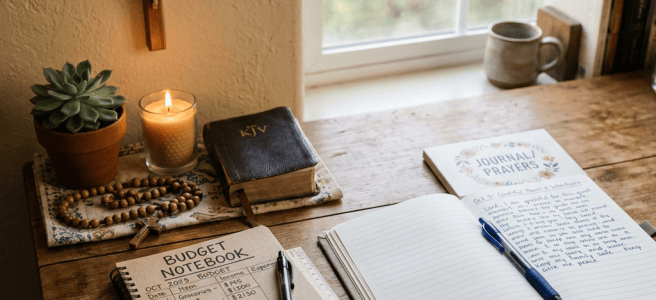
Desk with Bible, prayer journal, budget notebook, rosary, candle, and plant

I have a confession: I like the idea of a new habit much more than I like the middle of one. The beginning has fresh notebooks and heroic promises. The middle has Tuesday, a tired brain, and an instrument that sounds like it is filing a formal complaint.

But most of a life is built in that middle. Not by one grand decision, but by the small thing we return to when nobody is applauding. Prayer. A budget. Scales on a piano. These can look unrelated from the outside. Inside, they are all practices of attention.

Prayer, at its most ordinary, is not a performance review for God. It is a way of coming back. The same chair. The same few quiet minutes. The same honest question: What was moving in me today? Repetition does not make the moment empty. It gives the heart a familiar doorway.

A budget works in a surprisingly similar way. The Consumer Financial Protection Bureau recommends starting with a complete picture of income, spending, and bill timing, then making a working plan and adjusting it as life changes. That is less like building a cage and more like turning on the kitchen light. We are not trying to become perfectly predictable people. We are trying to see clearly enough to choose.

The same humility helps with an instrument. Practice is not merely “putting in the hours.” A meta-analysis of research on musical achievement found a meaningful relationship between task-relevant practice and musical performance, while also reminding us that practice is structured, goal-directed work—not magical time served. Ten distracted minutes and ten attentive minutes may share a clock, but they do not share a result. The metronome is a stern little uncle.

This is where long-term formation differs from self-punishment. Self-punishment asks, “How can I make myself pay for failing?” Discipline asks, “What small structure would help me return?” One tightens the knot. The other leaves a path back home.

And please, let us retire the fantasy that a habit becomes permanent after 21 days. In a real-world study summarized by University College London, automaticity took an average of 66 days—and the range varied widely from person to person. Missing one day did not erase the process. The lesson is not to worship a streak. It is to keep practicing the return.

What happened? We repeated small acts until they became easier to recognize and re-enter. What did it mean? Our routines were quietly teaching us what deserves attention. What can we carry forward? Pick one practice, make it modest, attach it to a real part of the day, and review it without drama.

Tonight, perhaps, pray for five minutes. Look at the last week of spending without flinching. Play one scale slowly. Becoming is rarely loud. Most days, it sounds like showing up again.

Character Is Built in the Boring Reps

Glowing outline of a walking person over a mountainous valley at night

I used to think character showed up in the dramatic moments. The honest answer in the meeting. The brave decision. The cinematic pause before doing the right thing. Then I became a parent and discovered that most character is formed while somebody is asking for a snack.

The prompt on my desk says 10,000 small repeated choices. That number is not a scientific speed limit. It is a useful nudge: formation is usually less like a lightning strike and more like a path across a lawn. You walk it again and again, often without noticing that the grass is changing.

Habit researchers describe something similar. In a real-world study, people practiced a chosen eating, drinking, or activity behavior each day in a consistent context. Automaticity grew gradually, but at very different speeds: the time to reach a person’s plateau ranged from 18 to 254 days. Missing one opportunity did not ruin the process. Repetition mattered, but perfection was not the price of admission. The study is a helpful antidote to the internet’s favorite habit myth—that everyone needs exactly 66 days, or some other magic number.

That distinction matters for character. A child who puts one book back on the shelf is not becoming a librarian overnight. A spouse who pauses before answering is not suddenly a saint. But each small act is practicing a response. The cue arrives, and a slightly better path becomes easier to find.

There is some evidence that the practice itself can strengthen self-regulation. In one study, college students spent two weeks practicing a small exercise such as monitoring posture, regulating mood, or recording what they ate. Compared with a control group, the exercise groups improved on a later measure of self-regulatory capacity. The result was modest, not magical. Still, it suggests that discipline is not only a personality trait we either inherited or missed in the family raffle.

More recent work helps explain why repetition works: practice can strengthen the link between a recurring cue and a response. Researchers found that greater task practice was associated with stronger cue-response associations, which in turn supported performance. The brain learns the route we keep taking.

So what might this look like at home? Pick one tiny response and give it a familiar doorway. After dinner, ask one good question before reaching for the phone. When a mistake is named, say, “Thank you for telling me,” before explaining. On Sunday night, write down one thing you received and one thing you repaired. The point is not to turn the household into a monastery with better snacks. It is to make the next faithful move visible.

At the end of the day, an examen can be wonderfully ordinary: What happened? Where did I repeat an old groove? Where did grace—or simple patience—open a new one? What did it mean? That the small choices were not small to the people living inside them. What can I carry forward? One repeatable act, attached to a real moment, with room to miss once and begin again.

Ten thousand is a lot of choices. Fortunately, we only have to make the next one.